
Long-leaved bark beetle
Polygraphus longifolia
Description
How to identify
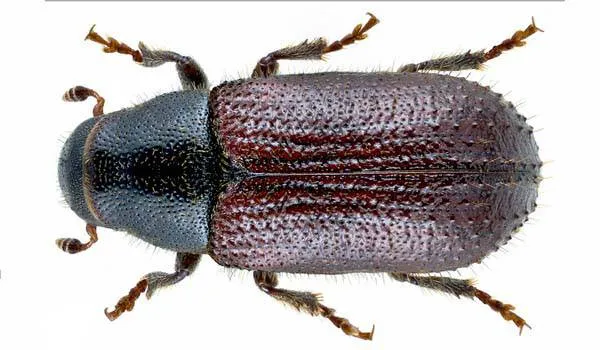
The long-leaved bark beetle (lat. Polygraphus longifolia) belongs to the order Coleoptera, family Curculionidae, and subfamily Scolytinae. This is a small beetle, typically measuring between 2 and 3 millimeters in length.
The insect’s body has a cylindrical shape and is colored in dark brown or almost black tones. A distinctive feature of the species is the structure of the pronotum and elytra, which are covered with fine scales and hairs.
The larvae of this pest are legless, white or yellowish, with a distinct dark head. They have a curved body shape, which is typical for many bark beetle larvae developing beneath the bark of coniferous trees.
Systematically, this species is closely related to other representatives of the Polygraphus genus. An important diagnostic feature for specialists is the pattern of the maternal and larval galleries left by the beetles in the bast and on the surface of the sapwood.
Adult individuals have developed wings, which allow them to actively fly over significant distances in search of suitable feeding substrates in weakened forest stands.
What it damages
The primary targets for the long-leaved bark beetle are coniferous tree species. Pines are primarily at risk, as reflected in the species name, although it may also attack other conifers in mixed forests.
The pest prefers weakened, dying, or recently fallen trees; however, when population numbers are high, it can shift to healthy trees, causing them to gradually wither and die.
The damage caused by this insect involves the disruption of normal nutrient transport within the trunk. By feeding on the bast layer, the beetles and their larvae interrupt the transport of nutrients from the crown to the roots.
In addition to direct tissue damage, these bark beetles act as vectors for various fungal infections, including blue stain fungi, which further weaken the tree and accelerate its death.
Mass reproduction of this pest can lead to significant timber losses in forest areas, requiring constant monitoring and prompt actions to contain outbreaks.
When it appears
The life cycle of the bark beetle is closely linked to the ambient temperature. The flight of overwintered beetles typically begins in the spring, when the average daily air temperature reaches optimal levels.
During the flight period, the insects actively search for host trees. After mating, females bore entry holes into the bark and construct maternal galleries where they lay eggs, starting the development of a new generation.
Summer is the period of most intensive larval development. Depending on the climatic conditions of a specific region, one to two generations of this pest can develop per year.
Pupation of the larvae occurs in late summer or early autumn. Young beetles, after emerging from the pupae, undergo a period of supplementary feeding before preparing for overwintering.
The insects overwinter primarily in the adult stage within the bark at the base of trunks or in the forest litter, which allows them to successfully survive harsh winter conditions.
Signs of infestation
The first visual sign of the pest's presence is the appearance of boring dust—fine bark shavings that accumulate at the base of the tree or in bark cracks near the beetle entry points.
Upon inspecting the trunk, one can find entry holes that look like small punctures. If a small patch of bark is removed, a branched network of tunnels characteristic of this species will be revealed.
In the early stages of infestation, external signs may be subtle, but over time the needles begin to turn yellow and eventually drop off, signaling critical damage to the tree's vascular system.
Discoloration of the bark and the appearance of resin flow (if the tree is attempting to defend itself) are also reliable indicators that the tree has been attacked by bark beetles.
For accurate diagnosis in forest stands, the use of pheromone traps is recommended, which helps not only to confirm the presence of the pest but also to estimate its population density.
Control measures
The primary control method is the sanitary felling of infested trees. Removing "occupied" individuals before the new generation of beetles emerges allows for a drastic reduction in the population density within an outbreak area.
Forest pathology monitoring plays a crucial role. Regular surveys allow for the timely detection of breeding sites and the implementation of preventive measures to clean up forest debris.
Chemical control methods, including spraying trunks with contact insecticides, are primarily used in protective forests or park zones where the preservation of every individual tree is important.
Biological measures include encouraging natural enemies of bark beetles, such as insectivorous birds, and entomophages (parasitic Hymenoptera), which limit population numbers under natural conditions.
Compliance with forestry regulations is mandatory: avoiding the abandonment of logging residues and unremoved timber in forest stands, as these serve as excellent incubators for pest development.
Taxonomy
- Latin name
- Polygraphus longifolia
- Order
- Coleoptera (beetles)
- Family
- Curculionidae
- EPPO code
- POLGLO
Discussion
No discussions yet — be the first.