
Bark beetle
Polygraphus
Description
How to identify
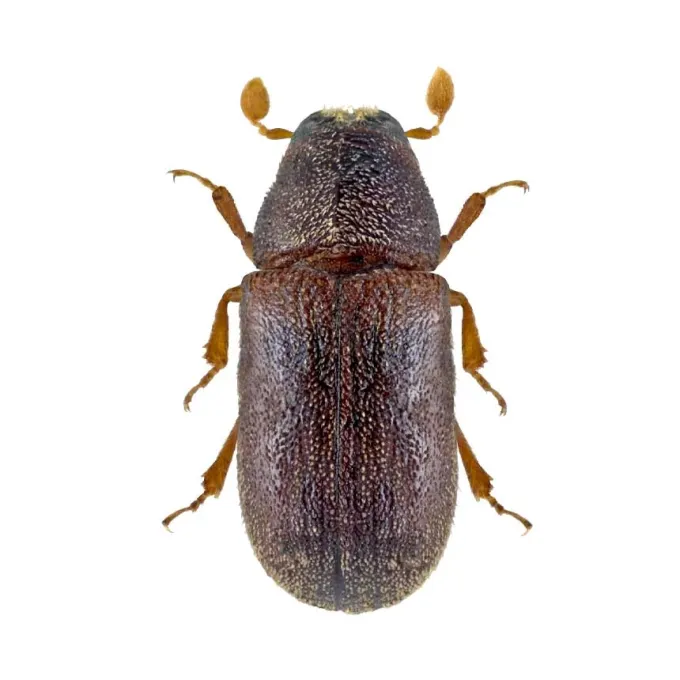
The genus Polygraphus belongs to the family Curculionidae and the subfamily Scolytinae. These are small beetles, typically measuring between 2 to 3 mm in length.
Their bodies are covered with dense, fine hairs, giving them a distinct matte appearance. Unlike many other bark beetles, they lack a declivity (a flattened "slope") on their elytra.
The larvae are legless, white-colored with a yellowish head, and exhibit a curved posture, which is typical for bark-boring insects within this genus.
They typically inhabit the phloem layer of the host tree, where they construct complex systems of galleries beneath the bark.
Taxonomically, the genus includes several important species known for their role as secondary pests that can become primary threats in stressed forests.
What it damages
The primary hosts of Polygraphus species include various coniferous trees, most notably spruce (Picea), as well as pine, fir, and occasionally larch.
The beetle primarily targets trees that are physiologically stressed due to drought, root diseases, or physical damage caused by windstorms.
When environmental conditions favor the beetle, populations can erupt, leading to attacks on healthy trees, which often results in widespread forest mortality.
The feeding activity of larvae and adults disrupts the tree's nutrient transport, which inevitably leads to the decline and eventual death of the host.
Economic damage is significant, as timber quality degrades rapidly and large-scale salvage logging operations become necessary to prevent further spread.
When it appears
Adult flight usually commences in the spring when temperatures consistently reach above 15–18 degrees Celsius, often aligning with early seasonal phenology.
Females bore through the bark to construct maternal galleries, where they lay eggs along the sides in small niches carved into the inner bark.
The life cycle duration is highly dependent on ambient temperature and can range from several weeks to several months in cooler climates.
In many regions, the beetle can complete multiple generations per year, which significantly increases its potential for population growth during the summer.
Overwintering typically occurs as larvae or adults beneath the bark of the host tree or within the forest duff at the base of the tree.
Signs of infestation
The most visible sign of infestation is the presence of tiny entry holes in the bark, often accompanied by resin flow or "pitch tubes."
Bore dust, which resembles fine wood sawdust, is frequently found gathered in bark crevices or at the base of the trunk near the entry points.
Removing a small section of the outer bark reveals the distinctive, radial gallery patterns created by the beetles during their feeding and reproductive phases.
The foliage of affected trees begins to fade, shifting from green to pale yellow and eventually turning a reddish-brown color as the tree dies.
Increased woodpecker activity on the tree trunks is often a secondary indicator that the tree is heavily infested with beetle larvae.
Control measures
Forest hygiene is the cornerstone of management; this involves the prompt removal and processing of infested or windthrown timber before adults emerge.
Pheromone traps are widely used for monitoring population levels and for mass-trapping strategies to reduce the number of breeding adults in the area.
Maintaining high forest stand vigor through proper silvicultural practices helps prevent the conditions that typically trigger a beetle outbreak.
Biological control methods focus on protecting natural enemies, including predatory flies and parasitic wasps that target the beetle larvae.
In cases of extreme infestation, trunk injections or insecticidal sprays may be considered, provided they comply with local environmental regulations.
Taxonomy
- Latin name
- Polygraphus
- Order
- Coleoptera (beetles)
- Family
- Curculionidae
- EPPO code
- POLGSP
Discussion
No discussions yet — be the first.