
Polydrusus tibialis
Polydrusus tibialis
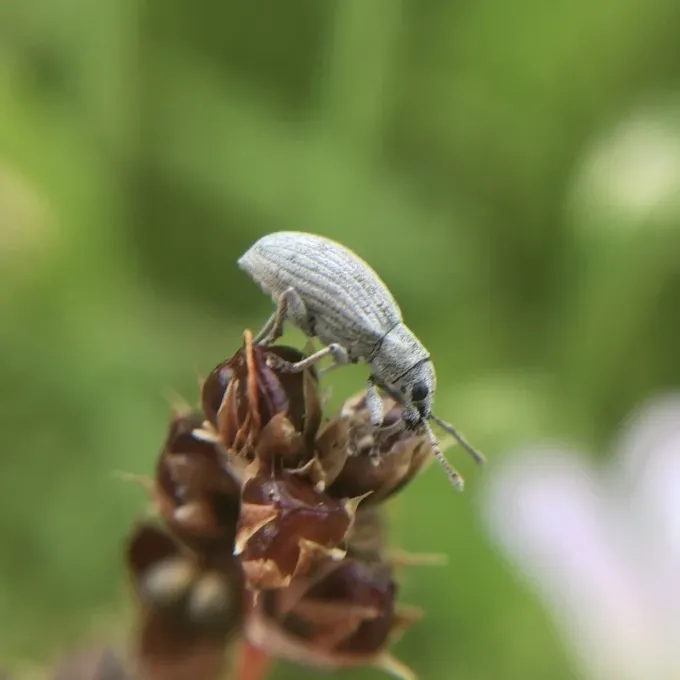
Description
How to identify
Polydrusus tibialis is a species of broad-nosed weevil belonging to the Curculionidae family. Adults typically measure 6–8 mm in length and feature a body covered with fine scales, often displaying a metallic sheen.
The defining characteristic of this species is the shape of its anterior tibiae, which are slightly curved, providing the basis for its taxonomic identification.
The eyes are slightly convex, and the snout is relatively short and broad, which is typical for members of the Polydrusus genus, often found in deciduous forests and orchards.
Larvae are soil-dwelling, legless, white grubs with a curved body and a distinct brown head capsule, adapted for feeding on roots beneath the soil surface.
Like many other weevils, adults exhibit a thanatosis behavior—the act of feigning death and dropping from host plants to the ground when disturbed.
What it damages
Both adult beetles and larvae cause damage, although they impact different parts of the plant. Adults primarily target the canopy, feeding on leaves and developing buds.
Common hosts include fruit trees such as apples, pears, and various stone fruits. In nurseries, adults can significantly damage young foliage, leading to reduced growth potential.
The larvae live in the soil and feed on the root systems of various plants. This feeding activity disrupts the plant's ability to uptake water and nutrients effectively.
Heavy infestation can lead to leaf loss, reduced photosynthetic capacity, and stunted development of young trees or nursery stock.
Root damage caused by larvae can make the trees more susceptible to environmental stressors and soil-borne diseases, causing long-term health issues for the plants.
When it appears
Adult activity typically begins in late spring, usually around May, as temperatures rise and host plants initiate new vegetative growth.
The mating and oviposition periods occur throughout late spring and early summer, which coincides with the period of peak leaf development on most fruit trees.
Larval development takes place throughout the summer and autumn months within the soil, where they actively consume root tissues before entering dormancy.
Overwintering occurs in the soil, where the larvae seek refuge from freezing temperatures at a depth appropriate to the soil type and local climate.
The life cycle concludes with pupation in the soil during early spring, followed by the emergence of new adult beetles to repeat the cycle.
Signs of infestation
The most recognizable sign of adult infestation is the characteristic irregular scalloping of leaf margins, often leaving a jagged edge on the foliage.
A simple monitoring technique involves shaking branches over a light-colored cloth or tray, which usually reveals the presence of beetles hiding in the canopy.
If trees show unexplained stunted growth or premature yellowing without clear signs of foliar pathogens, larval damage to the root system should be investigated.
Mass accumulation of beetles on foliage during early morning hours indicates a high population density that may require immediate control actions.
In nurseries, the presence of these beetles on young grafts is a major red flag, as they can quickly destroy delicate new growth before the tree is established.
Control measures
Mechanical cultivation of the soil around the base of the trees during the pupal stage can significantly disrupt the life cycle and reduce the next generation.
Systemic insecticides are effective when applied during the peak emergence of adults to prevent them from feeding on and damaging the foliage.
Biological control options, such as the application of entomopathogenic nematodes to the soil, can target larvae and offer a more sustainable management approach.
Sticky bands applied to the tree trunks can act as a barrier to prevent the beetles from climbing into the upper canopy of young fruit trees.
- Maintaining clean orchard floors by removing weed hosts.
- Encouraging natural predators such as ground beetles and birds.
- Regular scouting and monitoring using light traps or shaking sheets.
Taxonomy
- Latin name
- Polydrusus tibialis
- Order
- Coleoptera (beetles)
- Family
- Curculionidae
- EPPO code
- POLOTI
Discussion
No discussions yet — be the first.