
Green leaf weevil
Polydrusus tereticollis
Description
How to identify
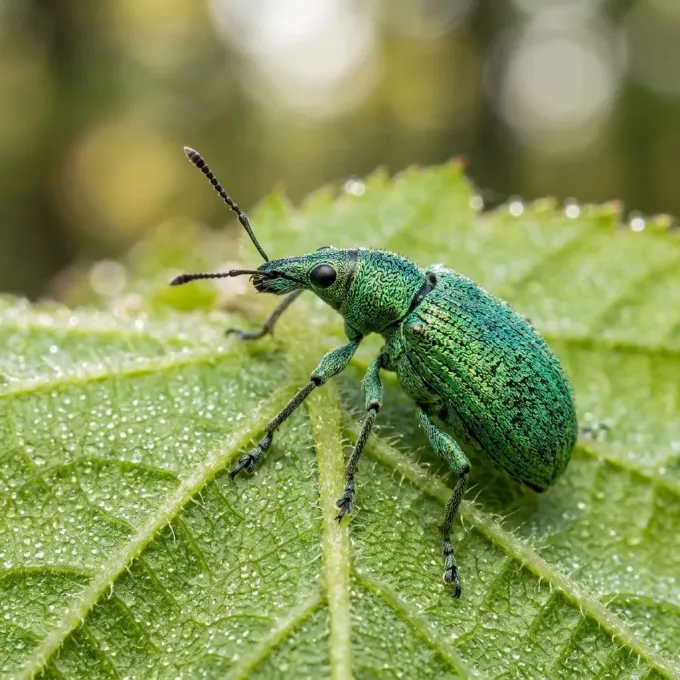
The green leaf weevil (Polydrusus tereticollis) is a beetle belonging to the Curculionidae family. Adult specimens are 6–8 mm long with an elongated body, typically covered in metallic green or golden scales that may wear off as the beetle ages.
A distinctive feature of this genus is its short, broad snout (rostrum). The antennae are elbowed and attached near the tip of the rostrum, ending in a prominent club, which helps distinguish it from other similar weevil species found in gardens.
The larvae are white to creamy, legless, and C-shaped with a distinct brown head capsule. They spend their entire life cycle underground, feeding on the roots of plants, which makes them difficult to monitor without digging into the soil.
These insects are widely distributed across the forest and forest-steppe zones of Eurasia. Adults are primarily active during the day and are strong fliers, though they often drop from foliage to the ground when threatened, staying motionless to avoid detection.
The life cycle involves complete metamorphosis. The development is closely tied to the host plant's root health during the larval stage and the availability of fresh foliage for adult feeding during the spring and summer months.
What it damages
Adult weevils are polyphagous, meaning they feed on a wide variety of woody and shrub species. They are particularly troublesome in orchards, causing damage to apple, pear, plum, and cherry trees, as well as various ornamental plants.
Larvae living in the soil feed on the roots of young trees and seedlings. This root damage inhibits nutrient uptake, stunts growth, and can result in the decline or even death of young plants if the infestation density is high.
Nurseries are at the highest risk for infestation. Damage to both the root system (by larvae) and the leaves (by adults) can render young stock commercially unviable within a single growing season.
Mass infestations often occur during the bud-break stage. Adults chew the edges of leaves, which, under high populations, can lead to significant defoliation and skeletonization of the foliage.
The economic impact is a result of the combined pressure on subterranean and aerial plant parts, which weakens the host and leaves it susceptible to secondary infections by fungi and bacteria through feeding wounds.
When it appears
The adult activity period typically spans from late spring through mid-summer, with peaks in May and June when the majority of adults emerge from the soil to feed on newly developed foliage.
Females lay eggs in the soil or on the underside of leaves. After hatching, the larvae move into the soil profile to feed on small roots and organic matter, continuing their development throughout the summer and autumn months.
The life cycle of the green leaf weevil can take one or two years to complete, depending on regional climatic conditions and soil temperatures. Larvae overwinter in the soil to protect themselves from harsh winter temperatures.
Pupation takes place in the soil during the spring. Once the ground warms up, adults emerge, begin feeding on foliage, and start the reproductive cycle again.
Soil moisture levels are critical for larval survival. Drought conditions can significantly reduce population density, whereas a wet spring often promotes successful emergence and higher adult population levels.
Signs of infestation
The most recognizable sign of adult infestation is the characteristic scalloped leaf edges. These semi-circular or irregular notches are a classic symptom of weevil feeding on tree foliage.
During the day, adults can often be found on the underside of leaves or resting on branches. Shaking the canopy will cause many individuals to drop to the ground, allowing for quick inspection of the pest population.
Root damage caused by larvae is more subtle and manifests as general plant decline. Symptoms include premature yellowing of leaves, reduced shoot growth, and an overall lack of vigor that cannot be attributed to other diseases.
In nursery settings, heavily infested seedlings may become loose in the soil due to extensive root system destruction, making them easy to pull out of the ground.
A high concentration of weevils on the canopy during the early growing season is a clear indicator of a potential outbreak, requiring immediate preventative or remedial measures.
Control measures
The most effective management strategy involves cultural practices such as regular cultivation and tilling of the soil around the base of trees, which physically disrupts the larval and pupal stages in the soil.
- Installing sticky bands on tree trunks to prevent adult weevils from climbing into the canopy.
- Using light traps at night to monitor and capture active adult beetles.
- Applying contact or systemic insecticides during the peak feeding period when the economic threshold is reached.
- Weed management to eliminate alternative host plants that support larval development in the orchard.
- Encouraging natural predators, such as birds and beneficial insects, to help keep weevil populations in check.
Chemical control is most effective during the initial leaf-growth stage, when adults are actively feeding and are most exposed to the applied treatments.
Taxonomy
- Latin name
- Polydrusus tereticollis
- Order
- Coleoptera (beetles)
- Family
- Curculionidae
- EPPO code
- POLOTE
Discussion
No discussions yet — be the first.