
Green silken weevil
Polydrusus sericeus
Description
How to identify
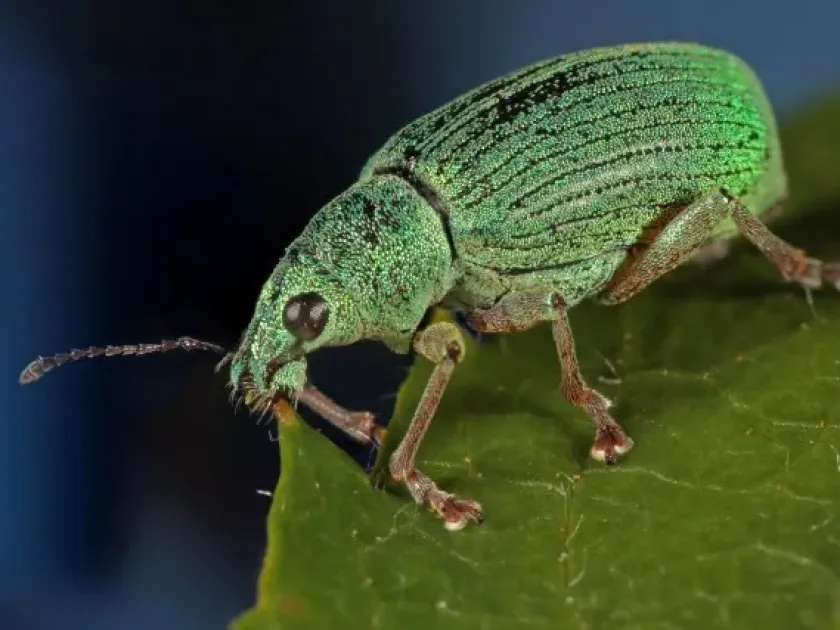
The green silken weevil (Polydrusus sericeus) is a member of the Curculionidae family, easily recognized by its striking metallic appearance.
The adult beetle typically measures between 6 and 9 mm in length, with an oval-shaped body densely covered in brilliant green or golden scales.
These scales provide the insect with a characteristic silken, metallic sheen that allows it to blend in with fresh foliage during the spring season.
The rostrum (snout) is short and robust, which is a key morphological feature distinguishing this species from fruit-boring weevils.
The larvae are typically legless, white grubs with a curved body and a dark head capsule, adapted for a subterranean life cycle near the roots of host plants.
What it damages
This species is a generalist pest that attacks a wide variety of deciduous trees and shrubs, showing a clear preference for fruit-bearing species.
Common hosts include fruit trees like apple, pear, cherry, and plum, as well as forest trees such as hazel, birch, linden, and willow.
Adult weevils cause significant damage by feeding on developing buds and young, tender leaves during the early spring vegetative growth phase.
While the aesthetic damage to foliage is most visible, extensive feeding can weaken young saplings and stunt the growth of newly planted orchard trees.
The larvae feed on the fine root systems of both woody and herbaceous plants in the soil, potentially impacting the plant's nutrient uptake capabilities.
When it appears
Adult weevils emerge from the soil in early spring as temperatures rise, perfectly timing their arrival with the flushing of leaves on host plants.
The peak activity period for adult beetles occurs throughout May and June, which is the critical window for mating and feeding on the canopy.
The life cycle is univoltine, meaning there is one generation per year, with the larval stage spending the remainder of the summer and autumn in the soil.
Pupation takes place within a small earthen cell in the soil during early spring, followed by the emergence of the new generation of adults.
By mid-summer, the adult population significantly declines as the life cycle progresses to the next developmental stages within the soil environment.
Signs of infestation
The most distinctive symptom of an infestation is the presence of irregular, ragged notches along the leaf margins, often referred to as "edge-feeding."
In cases of severe infestation, the buds may appear chewed or fail to open properly, which can severely compromise the potential yield of fruit trees.
During the day, the beetles often remain motionless or drop to the ground when disturbed, making them difficult to spot without careful inspection.
If you observe thinning foliage or leaf loss on young trees in late spring, it is a clear indicator that a weevil population is likely present.
Early season leaf damage is usually the first warning sign, necessitating immediate action before the beetle population spreads further across the orchard.
Control measures
Mechanical control using sticky bands on tree trunks can effectively trap the beetles as they attempt to climb from the ground to the foliage.
Early morning manual removal, such as shaking the beetles onto a catch sheet or tarp, is a simple and effective strategy for home orchards.
Insecticide treatments should be timed carefully to coincide with the period of adult feeding before the trees reach the fruit-setting stage.
Soil cultivation around the base of the trees during the autumn or early spring can disrupt the larvae and pupae in the soil, reducing future generations.
Maintaining a weed-free zone around the tree base helps reduce the alternative food sources for larvae and limits the overall success of the pest population.
Taxonomy
- Latin name
- Polydrusus sericeus
- Order
- Coleoptera (beetles)
- Family
- Curculionidae
- EPPO code
- POLOSE
Discussion
No discussions yet — be the first.