
Green leaf weevil
Polydrusus pterygomalis
Description
How to identify
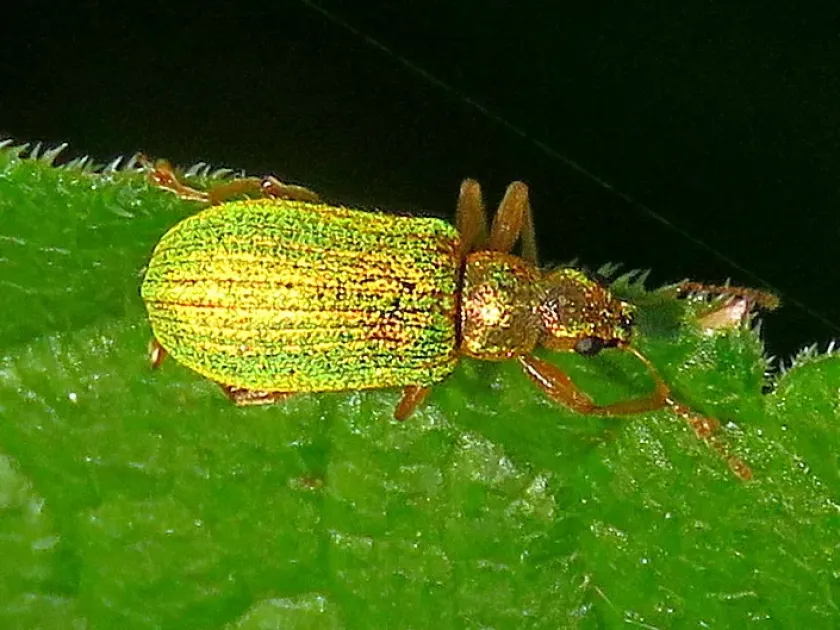
The green leaf weevil (Polydrusus pterygomalis) is a small beetle measuring approximately 5–7 mm in length. Its body is covered with metallic green or golden scales, providing excellent camouflage against the foliage of host trees.
The species is characterized by a short, broad rostrum and distinct elbowed antennae. The legs are generally lighter in color compared to the dorsal side, which helps in identifying this specific member of the Curculionidae family.
The larvae are typically legless, white, with a yellowish-brown head and a curved body. They are soil-dwellers, which makes them difficult to observe during their early developmental stages.
Adult beetles are most active during sunny, warm weather. When threatened, they exhibit a defensive behavior known as thanatosis (playing dead), dropping from leaves to the ground, where they are nearly impossible to spot against the soil.
Overwintering occurs primarily in the larval stage deep within the soil profile. Pupation takes place in the spring, leading to the emergence of the adult generation that coincides with the budding phase of host plants.
What it damages
This weevil is a polyphagous insect that shows a preference for members of the Rosaceae family. Key host plants include apple, pear, cherry, plum, and hazel trees, making it a significant nuisance in commercial orchards.
Adult beetles feed primarily on foliage. They consume the edges of the leaf blades, often leaving behind only the veins. Severe infestations can result in total defoliation, which severely stresses the tree and reduces its photosynthetic capacity.
In addition to leaves, the beetles damage emerging buds and young fruitlets. This feeding behavior can lead to significant yield losses, especially in young orchards where the loss of early-season growth affects the tree's architecture and vigor.
The larvae feed on the roots of young trees and seedlings. This underground activity can weaken the tree's root system, making it more susceptible to drought, nutritional deficiencies, and secondary pathogens.
Cumulative damage from both adult feeding on leaves and larval feeding on roots can lead to stunted growth, reduced fruit quality, and, in severe cases, the decline of the affected tree.
When it appears
Adult emergence typically begins in early spring, correlated with the phenological stage of bud break. The peak activity period for feeding and mating is usually during May and June.
Females lay eggs in crevices of the bark or on leaves. These eggs are protected by hardening secretions, which serve as a barrier against predators and adverse environmental conditions.
Upon hatching, larvae burrow into the soil. They spend the summer and autumn months feeding on the fine roots of host trees, growing progressively until they reach a size sufficient to endure the winter months.
The life cycle is generally univoltine, meaning one generation per year. However, temperature fluctuations can influence the duration of each stage, leading to variations in the timing of pest appearance between different climatic zones.
Monitoring the soil temperature and the bud development stage is critical for predicting the arrival of the beetles and implementing timely control measures before significant damage occurs.
Signs of infestation
The most recognizable sign of infestation is the notched or scalloped appearance of leaf edges. This "hand-cut" leaf damage is a hallmark of many weevil species, including the green leaf weevil.
Visual inspection in the early morning can reveal adults on the undersides of leaves. The use of a beating tray—shaking branches over a white cloth—is an efficient method for estimating the population density.
Stunted growth or chlorotic foliage in young trees, in the absence of obvious aerial pests, often suggests that the root system is being compromised by larval feeding activity.
- Small dark fecal spots left on the leaf surface by feeding adults.
- Distorted or necrotic buds that fail to develop into healthy flowers or shoots.
- Increased bird activity in the orchard, as many bird species prey on these beetles.
In nurseries, the presence of the beetle can lead to unsightly damage that affects the marketability of young saplings, requiring close attention to early detection.
Control measures
Cultural control, such as soil cultivation in the root zone (tilling), is effective in disrupting the life cycle of larvae and pupae. This practice exposes them to environmental stressors and natural predators.
Manual control via shaking trees early in the morning is a viable option for small-scale gardens. Collecting and destroying the beetles during this period of low activity significantly reduces the population.
Chemical control should be limited to situations where economic thresholds are exceeded. If necessary, systemic or contact insecticides are applied during the pre-flowering stage to prevent damage to buds and young leaves.
Biological control involves supporting the population of natural enemies, such as carabid beetles, spiders, and insectivorous birds, which play a crucial role in regulating the weevil population naturally.
Integrated Pest Management (IPM) strategies, including monitoring and combining cultural and biological measures, are recommended to minimize chemical reliance and promote long-term orchard health.
Taxonomy
- Latin name
- Polydrusus pterygomalis
- Order
- Coleoptera (beetles)
- Family
- Curculionidae
- EPPO code
- POLOPT
Discussion
No discussions yet — be the first.