
Polydrusus pilosus
Polydrusus pilosus
Description
How to identify
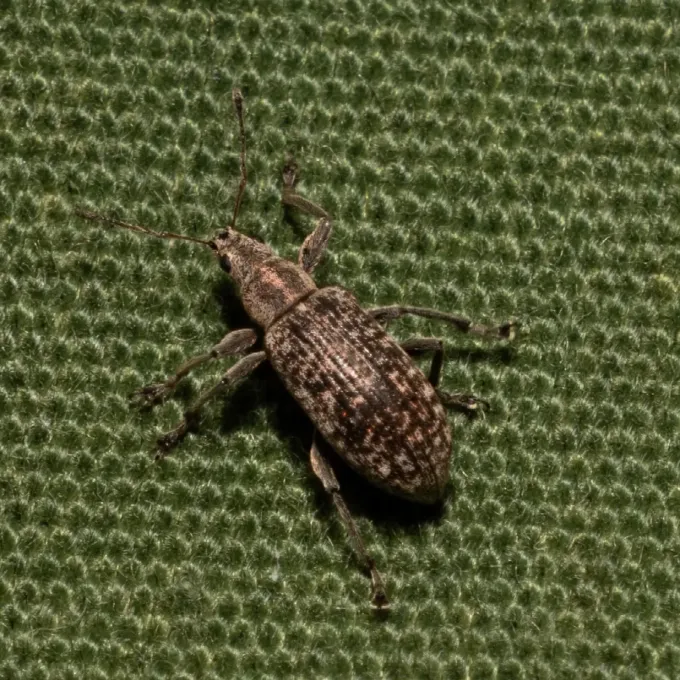
The Polydrusus pilosus beetle belongs to the family Curculionidae, order Coleoptera. It is a small weevil with a body covered in dense hairs, giving it a matte appearance.
The insect's coloration varies from yellowish-brown to dark brown, often displaying a subtle metallic sheen beneath the layer of scales and setae.
Adult beetles reach a length of 5–7 millimeters. They feature a short, broad rostrum, which is characteristic of the broad-nosed weevil subfamily to which they belong.
The larvae are legless, C-shaped grubs, typically white or yellowish in color with a distinctly darkened head capsule.
The lifecycle is closely linked to woody vegetation, where the insect completes its development from egg to adult.
What it damages
This pest primarily affects fruit trees and deciduous forest species. In orchards, it causes significant damage to apple, pear, plum, cherry trees, as well as hazel and oak.
Adult beetles feed on buds and young leaves by nibbling the edges, which, during outbreaks, can lead to severe defoliation of the trees.
The larvae develop in the soil, feeding on the fine roots of woody plants, which negatively impacts the growth rate and overall vitality of young saplings.
The pest poses the greatest threat to nurseries and young orchards, where bud and root damage can stunt development for several consecutive seasons.
Mass emergence of adults often coincides with the bud-break period, making young plantings highly vulnerable to intense feeding pressure.
When it appears
Adults emerge from hibernation early in the spring, as soon as average daily temperatures become stable and consistently positive.
The feeding period for adults spans spring and early summer, coinciding with the active leaf formation and shoot growth of host plants.
Females typically lay eggs on leaves or directly into the soil, depending on environmental conditions and population preferences.
Larval development in the soil is a lengthy process, often extending throughout the entire growing season before pupation occurs.
The insects generally overwinter in the larval stage within the soil profile, though adults may occasionally remain in leaf litter to emerge the following season.
Signs of infestation
The primary sign of infestation is the characteristic scalloped edge damage on leaves, similar to the work of other broad-nosed weevils.
Spring inspection of buds may reveal hollowed-out areas, leading to delayed development or failure of fruit buds to bloom properly.
When high populations are present, shaking branches over a white sheet will cause the beetles to drop; they often feign death when disturbed.
A generally stunted appearance of young trees without visible foliar disease may indicate root system damage caused by larvae in the soil.
The presence of beetles on foliage during daylight hours confirms active adult feeding, as they are most visible on sunny days.
Control measures
The main control method involves insecticide spraying during the emergence phase and the beginning of adult feeding to reduce populations before oviposition occurs.
In nurseries and young orchards, regular soil cultivation in the tree rows or around the base can disrupt the larval development stage.
Effective agrotechnical practices, such as maintaining optimal moisture levels and balanced fertilization, increase tree tolerance to pest damage.
- Application of biological preparations based on entomopathogenic fungi.
- Mechanical collection of beetles from young trees during early morning hours.
- Weed control around plantings to limit alternative food sources.
The use of pheromone traps for population monitoring allows for timely decision-making regarding the necessity of chemical intervention.
Taxonomy
- Latin name
- Polydrusus pilosus
- Order
- Coleoptera (beetles)
- Family
- Curculionidae
- EPPO code
- POLOPI
Discussion
No discussions yet — be the first.