
Soft leaf weevil
Polydrusus mollis
Description
How to identify
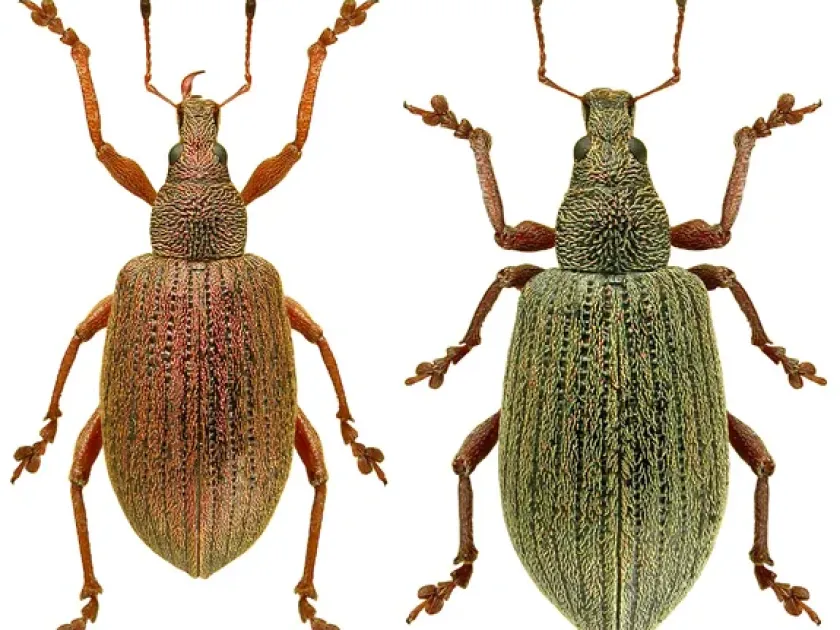
The soft leaf weevil (Polydrusus mollis) is a small beetle belonging to the Curculionidae family, order Coleoptera. These insects typically measure between 5 to 7 mm in length and are covered with fine scales that give them a characteristic greenish-golden or greyish appearance.
The head features a short, broad snout, which is a key diagnostic feature distinguishing it from other weevil species. Their antennae are elbowed and clubbed, attached to the front of the snout, serving as a reliable identification marker for agronomists.
Equipped with well-developed legs, these beetles are capable of moving actively across branches and leaves. When disturbed, the weevil typically pulls its legs against its body, making it blend perfectly with the plant tissue, effectively camouflaging itself against predators.
The larvae are typically white, legless, and have a brown head. They live underground, completing their development within the soil profile, where they feed on the roots of host plants, making them difficult to detect without careful excavation.
The life cycle involves complete metamorphosis. Environmental factors, particularly soil temperature and humidity, play a critical role in the timing of their emergence and the progression of the larval stages.
What it damages
This pest is a polyphage, impacting a diverse range of plant species. It is frequently observed causing significant damage in fruit orchards, affecting crops like apples, pears, cherries, and plums, as well as various deciduous forest trees like birch and oak.
Adult beetles feed primarily on leaves, consuming the edges and creating characteristic scalloped or notched patterns. During peak infestations, they can skeletonize the leaf blade, leaving only the veins, which drastically impairs the plant's photosynthetic capacity.
The larvae residing in the soil feed on the roots of young seedlings and herbaceous plants. This underground activity is often overlooked but can lead to severe stunting, nutrient deficiency, and reduced vigor in young trees.
The damage is most severe in nurseries and young plantations. While established, healthy trees are generally resilient to moderate feeding, severe defoliation can weaken their overall immune system, increasing susceptibility to fungal diseases and drought stress.
Ongoing feeding activities reduce the vitality of the plant, potentially leading to lower fruit yields in mature orchards and decreased winter hardiness in young transplants.
When it appears
Adult weevils typically emerge in the spring, synchronized with the onset of leaf budding and active plant growth. This period is crucial for orchard monitoring as the timing directly correlates with the availability of new, tender foliage.
The peak activity period usually occurs in May and June. During these months, the beetles are most visible, as they engage in feeding and mating, which represent the primary windows for effective intervention.
After the feeding season, adults lay eggs in the soil or in bark crevices. Larvae subsequently migrate into the soil profile to continue their development throughout the summer and autumn months.
Overwintering usually occurs in the larval stage deep within the soil or as dormant adults in leaf litter. As the ground warms in the following spring, the insects become active again, renewing the cycle.
Unusually warm springs can trigger earlier emergence, which requires farmers to adjust their monitoring schedules and pest control strategies accordingly to avoid early damage to budding plants.
Signs of infestation
The primary symptom of infestation is the presence of irregular, notched edges on leaves. This "snipped-edge" pattern is a clear indication that leaf weevils are active in the canopy.
Morning observations are most effective; the beetles are often found resting on leaves and will drop to the ground when touched. This "death-feigning" behavior is a common defensive reaction that makes them harder to find later in the day.
If significant dieback occurs in young shoots or if plants show premature yellowing, one should investigate the root zone for larval presence. Checking the soil around affected plants often reveals the white, C-shaped larvae.
Monitoring using white sheets placed beneath branches while shaking them can help estimate the population density. This is a standard procedure for determining if the infestation has reached a threshold that warrants treatment.
Early identification through periodic inspection of the leaf margins prevents the pest from completing its life cycle uninterrupted, reducing the long-term impact on orchard productivity.
Control measures
Cultural practices are foundational to management. Autumn cultivation or digging of the soil around the base of trees disrupts the overwintering larvae, exposing them to environmental stresses and natural predators like birds.
Chemical control involves the application of appropriate insecticides during the period when adult weevils are feeding on the canopy. It is essential to select products that are effective yet safe for beneficial organisms.
To avoid resistance, rotate the chemical classes used for treatments. It is recommended to perform sprayings during cooler times of the day, such as early morning or late evening, to maximize coverage.
Biological controls include supporting populations of insectivorous birds and utilizing beneficial nematodes or entomopathogenic fungi like Beauveria bassiana in the soil to target larvae.
- Monitor regularly with sticky traps or pheromone lures to detect early arrivals.
- Clear weeds from the base of trees to minimize alternative food sources for larvae.
- Use physical barriers or banding on trunks to catch migrating adults.
- Ensure proper hydration and nutrition for trees to help them recover from defoliation.
Taxonomy
- Latin name
- Polydrusus mollis
- Order
- Coleoptera (beetles)
- Family
- Curculionidae
- EPPO code
- POLOMO
Discussion
No discussions yet — be the first.