
Polydrusus marginatus
Polydrusus marginatus
Description
How to identify
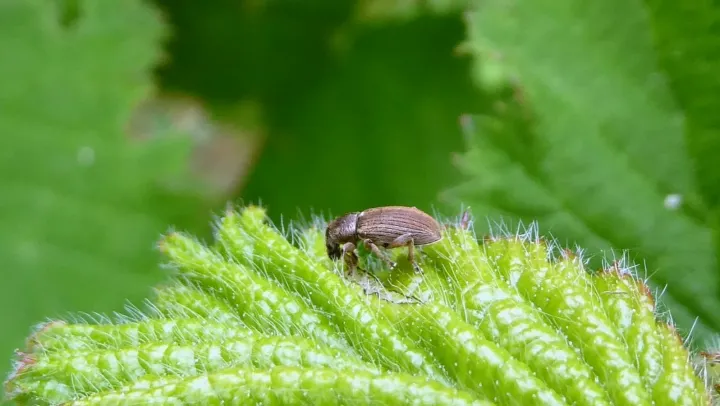
Polydrusus marginatus is a species of broad-nosed weevil belonging to the Curculionidae family. Adult beetles typically measure 6–8 mm in length and are covered in shimmering scales, giving them a distinct metallic green or golden-red appearance.
The defining feature of this species is a light-colored margin running along the sides of the elytra, which serves as a key identification mark. The snout (rostrum) is short and broad, distinguishing it from other weevils with elongated snouts.
The larvae are subterranean, white, C-shaped, and legless, with a brown head capsule. They spend their entire development period within the soil, feeding on roots and staying hidden from predators and gardeners.
The life cycle involves egg, larval, pupal, and adult stages. Depending on regional climate and soil conditions, the development from egg to adult may take one or two years, with larvae being the stage most commonly found overwintering in the soil.
Adult beetles emerge in spring, seeking host plants for feeding and mating. Their metallic coloration provides excellent camouflage against green foliage, making them difficult to spot during daylight hours.
What it damages
Polydrusus marginatus is a polyphagous pest that affects a variety of deciduous trees and shrubs. Fruit trees like apple, pear, cherry, and plum are frequent targets, as are small fruit bushes like currants and raspberries.
Adult beetles consume the leaves, starting from the edges and creating characteristic scalloped or irregular notches. Severe infestations can result in skeletonized leaves, significantly reducing the tree's photosynthetic capability.
The larvae cause damage to the root system by feeding on fine feeder roots and stripping the bark from larger roots. This can lead to stunted growth, reduced nutrient uptake, and a weakened state that invites secondary fungal infections.
Young plants in nursery settings are particularly vulnerable to larval feeding, which can cause significant growth delays or even the death of the sapling. The root damage is often overlooked until the tree starts showing signs of systemic stress.
The overall impact on the orchard depends on the population density. High numbers of beetles during the budding phase can ruin the season's new growth, directly impacting fruit set and orchard productivity.
When it appears
Adult emergence typically begins in mid-spring (April or May), coinciding with the leaf flush. This is the period when beetles are most active and visible on the canopy of host plants.
Peak populations are usually observed in late May and June, which is the primary window for mating and oviposition. During this time, females deposit eggs into the soil near the host plants.
As summer progresses, adult numbers decline, and the focus of the life cycle shifts to the underground larval stage. Larvae develop throughout the summer and autumn, often remaining active until soil temperatures drop.
In colder regions, the larval stage may enter a state of dormancy during winter, resuming development when temperatures rise in the following spring.
The emergence of a new adult generation usually happens in late summer or autumn, though in many populations, this process is synchronized with the spring phenology of the host trees.
Signs of infestation
The most prominent sign of an infestation is the irregular "notching" along the edges of the leaves. Unlike the smooth cuts made by some insects, these are jagged and concentrated along the leaf margins.
Gardeners can detect the presence of adults by gently shaking tree branches over a white sheet or tray, especially during the cool early morning hours when the beetles are less active and prone to "playing dead."
Unexplained decline in plant vigor, leaf yellowing (chlorosis), or a lack of new shoot growth can be indicative of severe root damage caused by larvae, especially if the tree is otherwise well-watered.
- Irregular notched edges on leaves.
- Presence of metallic beetles on branches during morning inspections.
- Reduced leaf area due to heavy feeding.
- Stunted plant growth and lack of vigor.
- Sudden decline in nursery seedling health.
Control measures
Effective management begins with mechanical practices. Tilling or hoeing the soil under the canopy during the late summer can disrupt the pupation process and expose larvae to predators and desiccation.
Chemical control using approved insecticides should be timed to match the peak adult activity in the spring. Applications are most effective when targeted at the foliage to prevent the beetles from feeding and laying eggs.
Biological control involves maintaining a healthy ecosystem that supports natural predators of beetles, such as ground beetles and certain bird species that forage in the orchard.
In nursery environments, ensuring that soil is free from larvae before planting and maintaining a consistent irrigation schedule helps the plants tolerate minor root damage.
Regular monitoring of the canopy and soil health is essential to catch infestations early, before the larval population causes irreversible damage to the root system of mature trees.
Taxonomy
- Latin name
- Polydrusus marginatus
- Order
- Coleoptera (beetles)
- Family
- Curculionidae
- EPPO code
- POLOMA
Discussion
No discussions yet — be the first.