
Leaf weevil
Polydrusus impressifrons
Description
How to identify
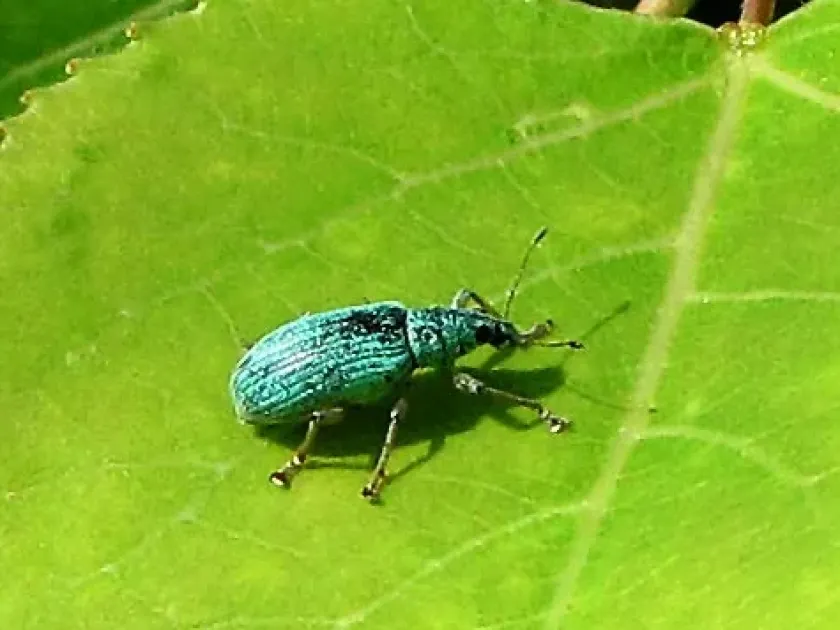
The leaf weevil Polydrusus impressifrons is a small beetle, typically ranging from 4 to 6 millimeters in length. Its body has a distinctive elongated shape covered in tiny, iridescent scales that give it a metallic green, gold, or bronze appearance.
Taxonomically, it belongs to the order Coleoptera and the family Curculionidae. The head features a short, broad snout, which is a hallmark of the weevil family and helps in the rapid visual identification of this specific species in the field.
The larvae of this beetle are legless, white, and have a brown head capsule. They live exclusively in the soil, which makes them quite elusive during the early stages of an infestation when conducting standard surface inspections.
Adult beetles possess a unique survival mechanism; when threatened, they drop from the foliage to the ground and remain still, mimicking dead insects. This defensive behavior helps them evade predators like birds and spiders.
To accurately identify the species, one should examine the surface of the elytra, which feature regular rows of punctures. The metallic coloration combined with the specific snout structure clearly differentiates this species from other common garden weevils.
What it damages
This pest is highly polyphagous, meaning it feeds on a wide variety of host plants. It is commonly found on deciduous trees such as birch, aspen, and alder, as well as many fruit-bearing species including apple, pear, and cherry trees.
In nursery settings and young orchards, leaf weevils can cause significant harm by feeding on young leaves and developing buds. This activity reduces the photosynthetic capacity of the plant and stunts overall growth during the critical early season.
While the adults damage the canopy, the larvae residing in the soil feed on the root systems of various woody and herbaceous plants. This underground feeding can weaken the plant, making it more susceptible to environmental stress and secondary pathogens.
In cases of heavy infestation, the cumulative damage from both adults and larvae can be severe. This often results in weakened trees, reduced fruit production, and, in severe cases, the mortality of young saplings that cannot withstand root damage.
Economic damage is largely measured by the loss of plant vigor and growth in commercial forestry and fruit production. Managing these populations is essential to maintain the health and productivity of young woody plantations.
When it appears
Adult beetles emerge in early spring, coinciding with bud burst and the onset of the growing season. This is the period of intense feeding as they prepare for mating and subsequent egg-laying activities.
The peak activity and flight period for this species typically occur during May and June. During these months, the beetles are most visible on the leaves of host trees, actively grazing on the foliage.
Following mating, female beetles deposit their eggs in the soil near the host plants. The larvae hatch and begin their development in the soil, where they remain throughout the summer while feeding on plant roots.
Pupation usually takes place in the soil in late summer or early autumn. Many individuals overwinter in the larval stage, buried deep within the soil profile, which provides protection from winter temperatures.
Weather patterns significantly influence the development cycle. Warmer springs can accelerate the emergence of adults, while cold and wet conditions might delay the cycle and reduce the immediate impact of the pest on plant health.
Signs of infestation
The primary symptom of a leaf weevil infestation is the characteristic scalloped edge of the leaves. Adults feed by chewing the margins, resulting in semi-circular or irregular notches that are distinct from other insect feeding patterns.
In severe infestations, large portions of the leaf tissue may be consumed, leaving only the midribs intact. This sparse, damaged canopy is a clear indicator that the plant is under attack by these beetles.
Bud damage is another critical sign during the spring. Beetles can destroy terminal and lateral buds, preventing proper leaf and flower development and causing deformed growth or stunted development of the affected branches.
Larval presence in the soil is difficult to detect without careful excavation. However, sudden wilting or yellowing of foliage in the absence of obvious aerial pests often warrants an inspection of the root zone for larval activity.
Direct sightings of the beetles on the undersides of leaves or by shaking branches over a collection sheet are the most reliable methods of confirmation. Observing these signs early allows for more effective intervention before the population booms.
Control measures
Managing the leaf weevil involves an integrated pest management (IPM) approach that combines mechanical, chemical, and cultural practices to minimize damage to host plants.
Mechanical control is effective in small gardens: gently shaking the branches over a drop cloth in the early morning helps collect and remove the beetles while they are less active and prone to falling.
Chemical control can be utilized when populations exceed the economic threshold. Applying contact insecticides during the early spring before the bloom period helps protect the trees while minimizing harm to pollinating insects.
Cultural methods include regular cultivation and tilling of the soil around the base of trees. This disturbs the larval habitat and exposes the larvae and pupae to desiccation and natural predators, reducing the next generation's population.
Biological control involves encouraging the presence of natural enemies such as insectivorous birds, ground beetles, and parasitic wasps. A balanced garden ecosystem often maintains weevil populations at a level that does not threaten plant health.
Taxonomy
- Latin name
- Polydrusus impressifrons
- Order
- Coleoptera (beetles)
- Family
- Curculionidae
- EPPO code
- POLOIM
Discussion
No discussions yet — be the first.