
Green leaf weevil
Polydrusus chrysomela
Description
How to identify
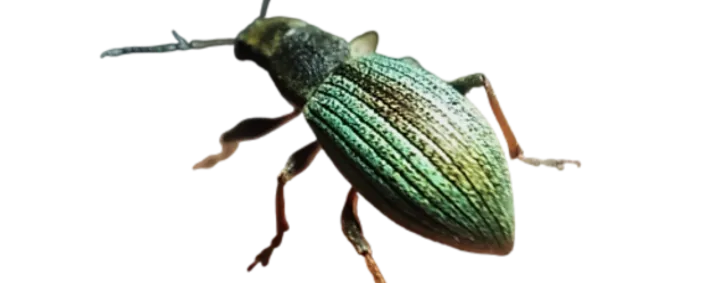
The green leaf weevil (Polydrusus chrysomela) is a member of the Curculionidae family. These insects are well-known for their stunning, metallic green or golden-green coloration, which is caused by tiny scales covering their bodies.
Adult beetles are typically 5–7 mm long. They possess a characteristic snout that is shorter and less distinct than in many other weevil species, giving them a more streamlined appearance.
The larvae are soil-dwelling insects with a typical C-shaped, legless body. They are creamy-white with a brown head capsule and are perfectly adapted to living underground in the plant's root zone.
Adults are strong fliers, which allows them to migrate between host plants throughout the spring and summer months, making them highly mobile pests in orchards and forests.
These beetles are diurnal, being most active during the day, especially when temperatures are warm, as they seek out fresh plant material to feed upon.
What it damages
This species primarily attacks a variety of broad-leaved trees and shrubs, including fruit trees like apples, pears, and cherries, as well as forest trees like oaks, beeches, and alders.
Adults feed on the leaves, creating jagged, irregular notches along the leaf margins. In cases of high infestation, they can strip leaves almost completely, leaving only the midribs intact.
They also pose a threat to developing buds in early spring, which can stunt tree growth and lead to significant reductions in potential fruit yield for the current season.
The larvae feed on the roots of host plants. While the damage is often hidden, it causes the plant to lose vigor, reduces water and nutrient uptake, and makes the plant more susceptible to other stressors.
In nursery settings, larval feeding on roots can be devastating, causing poor growth in young trees and occasionally leading to the death of vulnerable saplings.
When it appears
The life cycle of Polydrusus chrysomela is typically univoltine, meaning one generation per year, with the insects overwintering as larvae in the soil.
Pupation occurs in the soil during early spring. As the ground warms up, adult beetles emerge and move toward the canopy to start their feeding cycle.
The peak period of adult activity is usually late spring to early summer (May and June), which is when feeding, mating, and egg-laying occur.
Females lay their eggs in the soil near the base of host plants or sometimes in crevices in the bark. Once the eggs hatch, the larvae move into the soil to feed on roots.
The larval stage lasts through the autumn, and they remain in the soil throughout the winter, completing their development once the next spring's temperatures arrive.
Signs of infestation
The most noticeable sign of infestation is the notched leaf edges caused by adult feeding. This damage is very characteristic and easy to spot when inspecting the foliage.
Adult beetles are often visible on the undersides of leaves or on branches. They exhibit a 'drop-off' behavior, where they fall to the ground when disturbed, pretending to be dead.
Poor tree growth, yellowing foliage, and a general lack of vigor in late spring may indicate that a significant population of larvae is damaging the root system below the soil.
Early-season inspection of buds and young shoots is critical, as damaged buds will fail to develop into healthy leaves or blossoms, signaling the presence of the pest.
A high density of shiny green beetles observed on fruit trees during the blooming period is a clear indicator that immediate control measures may be required.
Control measures
Cultural control, such as soil cultivation or tilling around the base of trees, helps disrupt the soil-dwelling larval stage by exposing them to predators and desiccation.
For chemical control, contact or systemic insecticides can be applied during the adult peak emergence period, ensuring full coverage of the tree foliage to manage the beetle population.
When applying insecticides, it is crucial to follow the label recommendations, particularly regarding pollinator safety, to avoid harming beneficial insects visiting the orchard.
Sticky bands applied to the trunk can help catch migrating adults, especially in smaller gardens or for young trees where chemical use should be minimized.
Encouraging natural predators, such as insectivorous birds and parasitic wasps, can help maintain the weevil population at manageable levels without the need for intensive chemical spraying.
Taxonomy
- Latin name
- Polydrusus chrysomela
- Order
- Coleoptera (beetles)
- Family
- Curculionidae
- EPPO code
- POLOCH
Discussion
No discussions yet — be the first.