
Green leaf weevil
Polydrusus
Description
How to identify
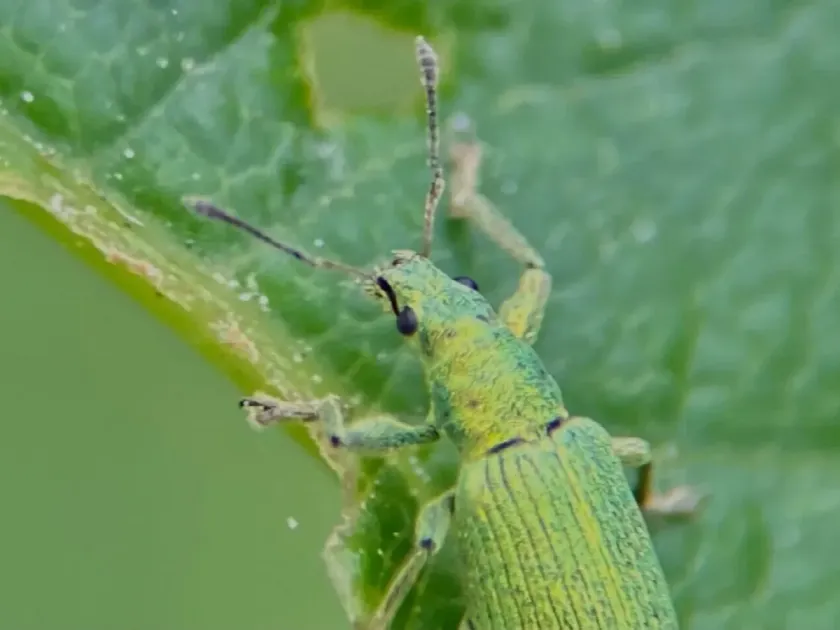
The green leaf weevil (Polydrusus) belongs to the order Coleoptera and the Curculionidae family. These are small beetles, typically measuring between 5 to 9 mm in length.
Their bodies are densely covered with scales that provide a characteristic metallic green, golden, or bluish-green sheen, making them appear quite striking on green foliage.
The snout (rostrum) of the Polydrusus species is noticeably short and broad, which serves as a key diagnostic feature distinguishing them from longer-snouted weevil species.
The larvae are white, legless, and curved, featuring a dark brown head capsule. They spend their entire developmental period residing in the soil.
The life cycle is complex, often spanning one to two years. They overwinter as either larvae in the soil or as adults in forest litter, depending on the specific climate.
What it damages
Green leaf weevils are generalist polyphages, attacking a wide range of fruit trees and shrubs. Primary hosts include apple, pear, cherry, and plum trees.
Beyond cultivated orchards, they frequently infest deciduous trees such as birch, alder, hazel, and oak, which act as secondary reservoirs for the population.
The adult beetles cause significant damage by feeding on young leaves. They consume the margins of the leaf blade, often leaving behind irregular, scalloped edges.
In cases of high infestation, entire leaves may be skeletonized, leaving only the midribs, which significantly reduces the tree's photosynthetic capacity.
Larval stages feeding on the fine root hairs of young plants can cause stunted growth, making them particularly dangerous in commercial nurseries.
When it appears
Adult weevils emerge from their overwintering sites in early spring, coinciding with the period of bud burst in fruit trees, which is their primary food source.
The peak activity for adult feeding, mating, and oviposition occurs from May through June, depending on local weather conditions.
Females lay eggs in small batches, typically tucking them into crevices of bark or inside rolled-up leaves to provide protection from predators.
Once hatched, the larvae drop into the soil. They migrate downwards to the root zone, where they feed and undergo several molting stages over the following months.
Pupation takes place in the soil during the spring, completing the cycle as the next generation of adults emerges to repeat the process.
Signs of infestation
The most obvious visual sign is the presence of scalloped or irregular bite marks along the edges of new foliage, often accompanied by the presence of small green beetles.
These beetles exhibit a behavioral trait known as thanatosis, where they drop to the ground and play dead when the branch is disturbed or shaken.
Rolled-up or webbed leaves are common signs that the female has laid eggs within the leaf tissue, which then serve as a protected nursery for the hatching larvae.
In nurseries, premature yellowing, wilting, or a lack of vigorous new growth during the spring can indicate severe root damage caused by larvae underground.
Observing the trees during the cooler morning hours often reveals the beetles resting on the underside of the leaves, where they are less active.
Control measures
Cultivation of the soil beneath tree canopies (tilling) is a highly effective control measure that disrupts the soil-dwelling larval and pupal stages.
For small-scale orchards, manual shaking of branches onto a cloth sheet early in the morning is a simple, non-chemical way to reduce the adult population.
- Application of contact insecticides during the bud burst stage if population thresholds are exceeded.
- Use of sticky bands on tree trunks to prevent non-flying weevils from reaching the canopy.
- Preservation of natural predator populations, such as ground beetles and insectivorous birds.
Maintaining a clean orchard floor by controlling weeds removes alternative food sources and nesting habitats, effectively limiting the weevil's success.
The use of biological control agents, such as entomopathogenic fungi or nematodes, can be highly effective in managing soil-dwelling larvae without chemical residue.
Taxonomy
- Latin name
- Polydrusus
- Order
- Coleoptera (beetles)
- Family
- Curculionidae
- EPPO code
- POLOSP
Discussion
No discussions yet — be the first.