
Creeping bryozoan
Plumatella repens
Description
How to identify
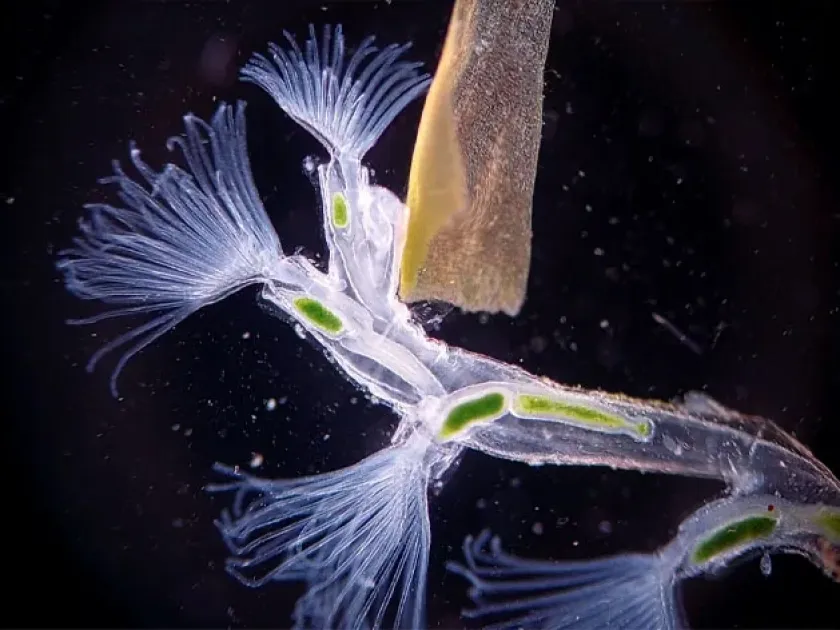
Plumatella repens, known as the creeping bryozoan, is a colonial aquatic organism belonging to the class Phylactolaemata. It forms branching, creeping colonies that attach firmly to various submerged substrates.
The colony consists of individual zooids living within translucent, chitinous tubes. These tubes are often brown or yellowish and can form dense, tree-like structures covering surfaces.
As filter feeders, they extend a lophophore—a ring of ciliated tentacles—to trap plankton and organic particles from the water column. They are highly adaptable to various environmental conditions.
The species reproduces sexually and asexually, notably through statoblasts. These are resistant, dormant stages capable of surviving harsh conditions, including desiccation and freezing, for long periods.
They are frequently spread by water currents, waterfowl, or the movement of contaminated equipment between different water bodies, making them a persistent issue in agricultural hydrology.
What it damages
The primary agricultural impact of Plumatella repens is the mechanical clogging of hydro-technical equipment. Colonies colonize the internal surfaces of pipelines, drastically reducing flow capacity.
In drip irrigation systems, these colonies obstruct nozzles and emitters, leading to uneven water distribution and potential water stress for crops. This requires frequent maintenance and system shutdowns.
The decomposition of large, dying bryozoan colonies within irrigation reservoirs can significantly degrade water quality, releasing organic waste that may harm sensitive plant species.
Equipment such as water intakes, valves, and mechanical filters often require intensive cleaning due to the persistent adhesion of bryozoan mats to metal, plastic, and concrete components.
These pests increase operational costs by necessitating frequent technical interventions and the use of chemical cleaning agents, which adds to the overall burden of water management in agriculture.
Signs of infestation
A sudden decrease in water flow or pressure within irrigation lines, despite functional pumps, is a primary indicator of internal colony growth or clogging by debris.
Visual inspection of intake screens or clear sections of piping often reveals brownish, slimy, or branched clusters attached to the surface, which is a hallmark of bryozoan infestation.
The presence of foul, decaying odors in the irrigation water, particularly during warmer months, often signals that parts of the bryozoan colonies are dying inside the plumbing network.
Observation of small, disc-shaped, brown statoblasts in filtration units provides a clear indication that a population is actively reproducing and likely present throughout the water source.
Frequent clogging of spray nozzles with a gelatinous or gritty substance is a common field sign that requires immediate investigation of the irrigation mainlines.
Control measures
Mechanical cleaning through high-pressure flushing is effective for removing young, less calcified colonies before they harden and become difficult to dislodge from pipe walls.
The installation of fine-mesh filtration at the water source is essential to prevent the intake of statoblasts and larvae, effectively isolating the irrigation network from colonization.
Chemical control involving the use of mild biocides or disinfectants can suppress colony growth, but these must be selected carefully to ensure they do not harm the agricultural crops being irrigated.
Periodically draining and drying irrigation reservoirs helps to significantly reduce bryozoan populations. While statoblasts are resilient, prolonged desiccation is detrimental to the survival of active colonies.
Limiting light penetration in water storage tanks can help, as reducing the growth of microscopic algae—a primary food source for bryozoans—naturally limits the potential for colony expansion.
Taxonomy
- Latin name
- Plumatella repens
- Family
- Plumatellidae
- EPPO code
- PLUMRE
Discussion
No discussions yet — be the first.