
Pleroneura
Pleroneura
Description
How to identify
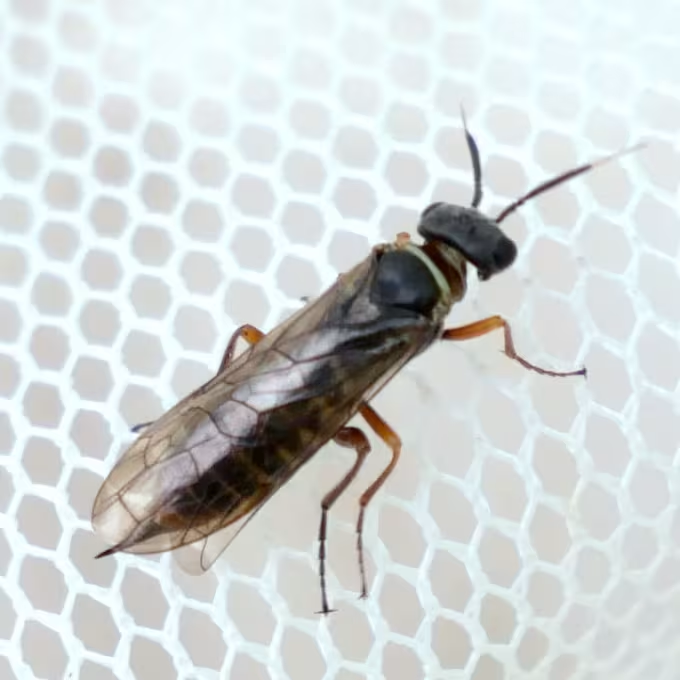
Pleroneura is a genus of insects belonging to the family Xyelidae, which are among the most primitive members of the order Hymenoptera (sawflies).
These small insects, known colloquially as conifer shoot sawflies, are often overlooked due to their inconspicuous appearance during the adult stage.
The larvae are the destructive stage, typically living inside the shoots of coniferous trees, which provides them with a sheltered environment.
The taxonomic classification identifies them as ancient Hymenoptera, and their morphology is adapted to specifically target the terminal buds of their host trees.
Correct identification often requires expert analysis of adult specimens or the study of specific damage patterns on the coniferous host.
What it damages
Pleroneura species primarily infest coniferous trees, with Abies (fir) being the most common host, though spruce can also be affected in some regions.
The larvae bore into the current year's shoots, which disrupts the vascular system and prevents the shoot from maturing correctly.
This damage is particularly problematic in tree nurseries, as it causes the terminal leader to die, leading to stunted or deformed tree growth.
In addition to physical deformation, infested trees may experience reduced vigor, making them more susceptible to subsequent attacks by secondary pests.
Persistent infestations in forest stands can significantly reduce the annual growth increment and timber quality of young conifers.
When it appears
The emergence of adults is highly synchronized with the phenology of the host plant, occurring in early spring when buds begin to swell.
Egg-laying happens shortly after emergence, placing the eggs into the succulent tissues of young, developing buds.
The larval stage is short-lived, taking place entirely during the spring growth flush of the host tree.
By early summer, mature larvae drop to the soil, where they form pupae and remain in a state of diapause throughout the year.
The diapause phase is a critical survival strategy, allowing the insect to wait until the next spring to emerge and restart the cycle.
Signs of infestation
Signs of infestation become obvious in late spring as the damaged terminal shoots wilt, droop, and begin to turn brown.
The needles on the affected shoot fade and eventually drop prematurely, contrasting sharply with the healthy needles on lower branches.
A closer inspection reveals the entry point of the larva and the hollowed-out interior of the shoot filled with frass.
In many cases, the terminal shoot exhibits a characteristic kink or bend at the point where the larval tunneling has occurred.
- Wilting and browning of terminal shoots
- Premature shedding of needles on the leader
- Hollowed-out shoots containing frass
- Deformed or stunted terminal growth
- Presence of larvae within buds during spring
Control measures
Management of Pleroneura relies on systemic insecticides applied before or during the bud-burst stage to eliminate the adults before they lay eggs.
Sanitation is a vital cultural control method; infested shoots should be pruned and destroyed immediately to reduce the population for the following year.
In nursery settings, regular monitoring of adult activity using traps can help determine the exact timing for chemical intervention.
Promoting overall tree health through proper fertilization and watering can improve the trees' resilience against minor infestations.
Long-term forest management strategies focus on maintaining diverse stands that are less attractive to specialized sawfly pests.
Taxonomy
- Latin name
- Pleroneura
- Order
- Hymenoptera
- Family
- Xyelidae
- EPPO code
- PLERSP
Discussion
No discussions yet — be the first.