
Oak pinhole borer
Platypus cylindrus
Description
How to identify
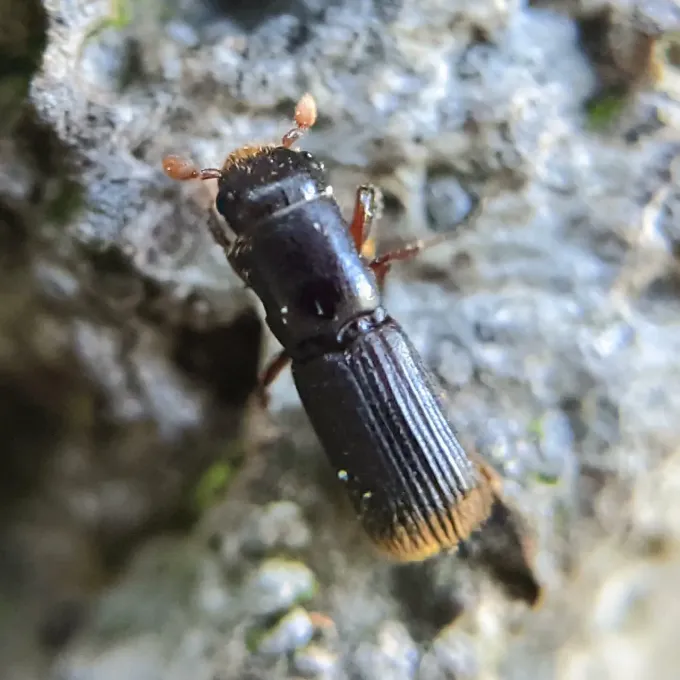
The oak pinhole borer (Platypus cylindrus) is a species of ambrosia beetle belonging to the Curculionidae family. Adult beetles are characterized by their narrow, cylindrical body shape, usually reaching lengths of 5 to 6.5 mm.
Larvae are white, legless, and have a curved body shape with a robust head capsule. They live within the maternal galleries constructed by the adults, where they feed primarily on symbiotic fungi.
A key biological feature is the presence of mycangia, special organs in the adult female that transport fungal spores. These fungi are cultivated inside the wood to provide essential nutrition for the offspring.
Adult beetles exhibit sexual dimorphism, particularly in the structure of the abdominal segments, which is useful for species identification in professional entomology.
Because they are deep wood-borers, these beetles are rarely seen on the surface of the bark, making their early detection difficult for non-specialists in the forestry sector.
What it damages
This pest mainly attacks deciduous trees, with a strong preference for oak, beech, hornbeam, and chestnut. It primarily infests stressed, moribund, or freshly felled trees.
The beetle drills deep, radial tunnels into the heartwood of the tree, which can significantly damage the timber quality. These tunnels are often stained black due to the growth of cultivated fungi.
Infested timber loses its structural integrity and aesthetic value, making it unsuitable for high-quality furniture making or decorative wood applications.
Widespread infestations in logging yards can cause substantial economic losses, as infected wood is often downgraded or rejected by timber merchants.
Although they often target already compromised trees, large populations can attack healthy trees during drought conditions, leading to rapid decline and mortality.
When it appears
The flight period of adult beetles typically begins in spring, from April to May, depending on regional weather patterns and temperature accumulation.
During the summer months, the beetles focus on tunnel construction and egg-laying. The development from egg to adult occurs entirely within the host wood.
As autumn approaches, new adults mature within the galleries. The species usually has one generation per year, but favorable climate conditions can lead to overlapping cycles.
Overwintering occurs in the adult stage, with the beetles remaining inside the gallery system of the host tree, protected from extreme temperatures.
The activity of the beetles is highly sensitive to humidity levels, with warm and damp weather being the most conducive to colonization and successful fungal growth.
Signs of infestation
The most reliable sign of an infestation is the presence of fine, light-colored boring dust (frass) visible on the bark surface or around the base of the tree.
Entry holes are circular, roughly 2 mm in diameter, and often appear in clusters or patterns. They penetrate deep into the sapwood and heartwood of the host.
Trees suffering from a heavy attack may show signs of wilting, thinning foliage, or branch dieback due to the destruction of the water-conducting tissues.
In some cases, sapwood bleeding can be observed around the entry points as the tree attempts to defend itself against the boring activity of the beetles.
If the bark is removed, the extensive and complex network of blackened tunnels confirms the presence of the infestation and the degree of timber degradation.
Control measures
Sanitation felling is the most effective management strategy, involving the prompt removal and processing of infested trees to stop the beetle's life cycle.
Rapid transport of felled timber away from forest sites is crucial. If immediate transport is impossible, de-barking logs can significantly reduce the success of colonization.
Pheromone traps are used in forestry management to monitor population density and identify the start of the flight period for targeted preventive actions.
Proper forest hygiene, including the removal of logging residues and small-diameter timber, minimizes the potential breeding sites for the beetle.
In high-value timber storage areas, professional insecticide treatments may be applied to logs if recommended by local forestry regulations and safety standards.
Taxonomy
- Latin name
- Platypus cylindrus
- Order
- Coleoptera (beetles)
- Family
- Curculionidae
- EPPO code
- PLTPCS
Discussion
No discussions yet — be the first.