
Platypus apicalis
Platypus apicalis
Description
How to identify
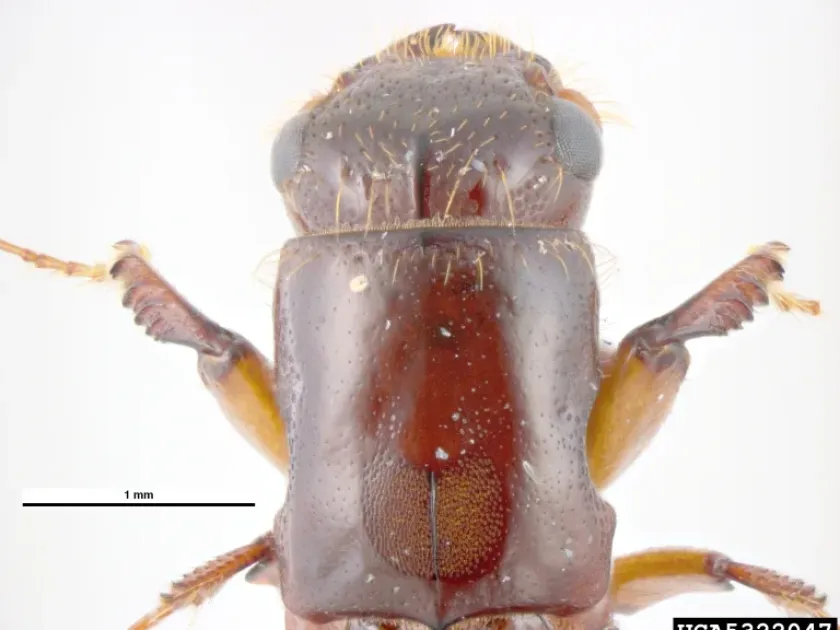
Platypus apicalis belongs to the Curculionidae family, Scolytinae subfamily, and the Platypodini tribe. Adult beetles are small, characterized by an elongated, cylindrical body perfectly adapted for navigating narrow tunnels within the wood.
The coloration of the beetle typically ranges from dark brown to almost black. Sexual dimorphism is evident in the structure of the posterior end of the elytra, which, in males, possesses specific projections or teeth used during tunnel construction.
Larvae of this pest are legless, white or cream-colored, and possess a well-developed head capsule. They live a hidden life, spending their entire development inside the tree tissues, where they feed primarily on the mycelium of symbiotic fungi introduced by the parents.
This species is highly specialized. Unlike many bark beetles, they do not feed directly on wood but rather "farm" specific microflora, which serves as their main nutrient source within the gallery system.
Systematically, this species is a typical representative of the ambrosia beetle group, which penetrates deep into the tree trunk, making them some of the most dangerous technical pests of timber within their distribution range.
What it damages
Primary targets include various species of deciduous and coniferous trees. The pest prefers stressed, freshly cut, or fallen trees, but during high population density, it can also attack seemingly healthy plants.
The main danger lies in the deep drilling of tunnels into the sapwood and heartwood. This disrupts the tree’s vascular system, leading to rapid wilting of affected specimens or a significant decrease in the quality of industrial timber.
The damage is purely technical: numerous entry holes and branched internal galleries render the wood unsuitable for high-grade lumber production, causing significant economic devaluation.
In addition to mechanical destruction, the pest introduces spores of ambrosia fungi into the tree. These pathogens cause wood staining (bluing or darkening), which is a critical defect for the woodworking industry.
In forest plantations, mass outbreaks of this species trigger the death of large forest stands, especially during periods of drought or following damage caused by forest fires, windthrow, and other adverse environmental factors.
When it appears
The active flight of beetles and the process of colonizing new trees occur during the spring-summer period, when stable temperatures favor the egg-laying process.
Several generations can develop within a single season, depending on the region's climatic conditions. A warm autumn may extend the pest's activity period until the first heavy frosts.
Hibernation usually occurs at the adult stage, either within the maternal galleries or in the forest litter, allowing the species to survive unfavorable conditions and resume reproduction quickly with the first signs of warmth.
Population dynamics are heavily dependent on the availability of host material: large accumulations of logging debris in the forest act as a catalyst for mass outbreaks of this pest.
Monitoring the pest’s phenology is vital for planning sanitary logging, as removing infested trees before the emergence of the next generation significantly reduces population pressure on the stand.
Signs of infestation
The first and most noticeable sign of infestation is the appearance of "boring dust"—fine wood powder ejected by the beetles through entry holes during tunnel excavation.
Entry holes appear as perfectly circular perforations with a diameter of about 1–2 millimeters. Unlike some other bark beetles, there is usually no resin accumulation around the holes if the tree is under severe stress.
The internal wood becomes covered with specific dark stains, which are the result of fungal growth that accompanies the larvae’s life activity.
A decline in the tree's vigor manifests as yellowing of leaves or needles, as well as premature canopy thinning, indicating a disruption of nutrient transport due to the pest's activity.
Removing the bark from infested areas reveals clear, deep gallery labyrinths directed into the trunk, distinguishing this species from surface-level cambium and phloem pests.
Control measures
The primary control measure is timely forest sanitation. It is essential to promptly remove and dispose of newly infested trees, logging debris, and fallen logs that serve as breeding grounds.
An important silvicultural practice is creating conditions that enhance tree vitality. Proper care, timely irrigation, and fertilization prevent tree weakening, making them less attractive to colonization.
The use of pheromone traps allows for qualitative monitoring of population levels and captures beetles during mass flight periods, which helps in taking timely protection measures.
In the timber industry, effective methods for wood disinfestation include kiln drying or fumigation, which ensure the elimination of all insect life stages in harvested material.
Chemical insecticide treatments applied to the trunks of healthy trees may be used in exceptional cases, such as in parks or ornamental areas, where saving valuable specimens from pest attacks is a priority.
Taxonomy
- Latin name
- Platypus apicalis
- Order
- Coleoptera (beetles)
- Family
- Curculionidae
- EPPO code
- PLTPAP
Discussion
No discussions yet — be the first.