
Tufted apple bud moth
Platynota idaeusalis
Description
How to identify
The tufted apple bud moth (Platynota idaeusalis) is a moth species belonging to the family Tortricidae. It is a significant pest known for damaging various fruit crops across North America.
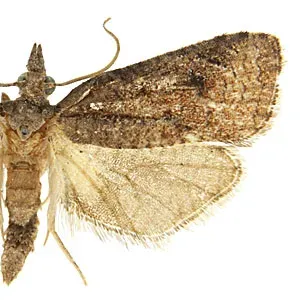
Adult moths have a wingspan of approximately 18 to 25 mm. Their forewings typically exhibit shades of reddish-brown or grayish-brown, often marked with darker transverse bands.
Larvae, or caterpillars, change in appearance as they develop, generally displaying a light green to olive-brown body with a dark brown or black head capsule and thoracic plate.
Eggs are laid in clusters on the upper surfaces of leaves. These clusters are covered with a protective, translucent substance, creating a scale-like appearance that camouflages them effectively.
Pupae are typically brownish and are found within protected sites, such as folded leaves or silken webs, which helps ensure their survival against predators and environmental stress.
What it damages
This species is highly polyphagous, capable of feeding on a wide range of woody plants. It is particularly noted for causing economic damage in commercial apple and stone fruit orchards.
Host crops include apples, pears, peaches, plums, and cherries. The pest also affects various berries, including blackberries, raspberries, and occasionally other small fruit plants.
In nurseries and young orchards, larvae feed on developing buds and foliage. This early-season feeding can stunt branch growth and significantly impact the overall vigor of young trees.
The most severe damage occurs when larvae feed on developing fruit. They tunnel into the fruit surface, creating irregular cavities that can lead to fruit drop and rot infections.
Economic losses arise not only from direct feeding damage but also from the increased susceptibility of damaged fruit to secondary fungal infections during storage and transport.
When it appears
The life cycle of the tufted apple bud moth generally consists of two generations per year. They overwinter as late-instar larvae within sheltered spots like bark crevices.
In early spring, larvae emerge to feed on opening buds and newly developing leaves, providing a critical window for control before the canopy fully develops.
The first flight of adults usually occurs in late spring or early summer. Following mating, females lay eggs, and the resulting larvae feed during the warmer months.
A second generation of larvae typically appears in late summer. This generation is often more damaging as it coincides with the maturation of fruit, leading to harvest-time injury.
As temperatures decrease in the fall, the late-stage larvae seek out protective hibernacula, completing their cycle and preparing for the winter dormancy period.
Signs of infestation
One of the earliest signs of an infestation is the presence of webbed or rolled leaves. Larvae draw leaves together with silk, creating small, protective nests where they feed.
Evidence of feeding includes holes in leaves and the presence of frass (larval excrement) within the webbed leaf clusters, which is often visible upon closer inspection.
Surface damage on fruits is a major indicator. Look for small, shallow, or deep cavities on the skin, often near the point where a leaf touches the fruit.
During the growing season, a damaged canopy may look patchy or stressed due to the destruction of terminal buds and leaves caused by the feeding caterpillars.
- Tightly webbed leaf clusters in the tree canopy.
- Damaged or hollowed-out spring buds.
- Superficial or deep grooves on maturing fruit skin.
- Silk webbing connecting leaves to the fruit surface.
Control measures
Effective management requires an Integrated Pest Management (IPM) approach, utilizing monitoring tools such as pheromone traps to time insecticide applications accurately.
Cultural control practices, such as pruning trees to open the canopy and removing infested fruit or debris, can significantly reduce overwintering sites for the larvae.
Chemical control is often necessary during peak emergence periods. It is vital to use selective insecticides that minimize impact on beneficial insects and natural predators.
Biological control methods, including the release of parasitic wasps (such as Trichogramma species), can help manage population levels in sustainable orchard systems.
Regular orchard scouting is essential. By identifying larval activity early, growers can intervene before the population reaches an economic threshold that threatens the harvest.
Taxonomy
- Latin name
- Platynota idaeusalis
- Order
- Lepidoptera (butterflies)
- Family
- Tortricidae
- EPPO code
- PLAAID
Discussion
No discussions yet — be the first.