
New Guinea flatworm
Platydemus manokwari
Description
How to identify
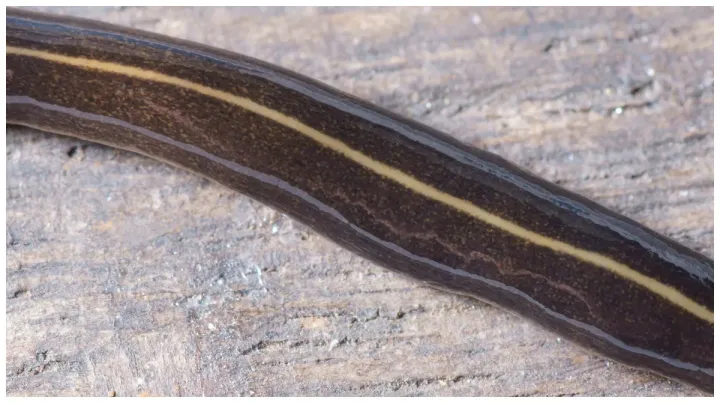
The New Guinea flatworm is a terrestrial predatory planarian, reaching lengths of 40–65 mm and widths of about 5 mm. Its body is flattened, elongated, and typically colored dark brown or olive-black, with a distinctive pale stripe running along the dorsal side.
Multiple small, sensitive eyes are located along the margins of the front of the body, allowing the flatworm to navigate its environment. A mouth is located on the ventral side of the body, which it uses to consume the soft tissues of its prey, primarily mollusks.
As a hermaphrodite, the species can easily establish new populations even from a single individual. It reproduces by laying eggs in small, protective cocoons, which are often attached to moist surfaces like soil, pots, or leaf litter.
The biology of this species is highly dependent on humidity. While it thrives in tropical and subtropical climates, in temperate regions, it is mainly restricted to greenhouses and indoor plant nurseries where a consistent, moist microclimate is maintained.
The spread of this species is primarily human-assisted, occurring through the movement of potted plants, soil, and agricultural material. Strict phytosanitary checks on imported nursery stock are crucial to preventing its introduction into new areas.
What it damages
The primary impact of the New Guinea flatworm is its predation on native terrestrial mollusks, including snails and slugs. This often leads to a significant decline or local extinction of snail populations, which are essential components of many natural ecosystems.
For agriculture and nurseries, this flatworm poses an indirect threat. By destroying mollusks that play a role in decomposition and soil nutrient cycling, the worm disrupts essential biological processes, potentially reducing soil health and quality.
While the flatworm does not feed on plants directly, the loss of soil-dwelling invertebrates creates an ecological imbalance. In greenhouses, this may lead to the degradation of ornamental plant quality due to altered soil biology and the absence of natural detritivores.
Recognized globally as one of the "100 worst invasive alien species," its presence threatens biodiversity in botanical gardens and nurseries, where rare plant species often host the very mollusks the flatworm consumes.
The worm's ability to outcompete local predators leads to its dominance in infested areas, making it extremely difficult to restore the original ecological balance once a population is well-established.
When it appears
The flatworm's activity is highly dependent on moisture levels. In outdoor settings, it is most active during rainy seasons or periods of high humidity, when the soil surface remains damp enough for the creature to move and hunt.
In greenhouses and indoor nurseries, the concept of a "season" is effectively eliminated. With consistent watering and controlled temperature, the flatworm can remain active and reproductive throughout the year, posing a year-round threat to cultivated crops.
These flatworms are nocturnal or crepuscular, avoiding direct sunlight and desiccation. During the day, they hide beneath stones, decaying vegetation, or deep within the soil profile, emerging at night to search for prey.
Reproduction can occur whenever environmental conditions, specifically high humidity, are met. The survival of their egg cocoons is heavily dependent on the moisture content of the substrate, making well-watered greenhouses ideal for population surges.
Mass migrations or dispersal events are often observed after heavy rainfall. During such times, the worms can move across significant distances, colonizing new parts of a garden or spreading through commercial plant facilities, necessitating careful monitoring.
Signs of infestation
The most prominent sign of infestation is a sudden and drastic reduction in snail and slug populations in an area where they were previously common. If you notice empty shells but no living snails, it is a strong indicator of flatworm presence.
Direct sightings of the worms under pots, damp debris, or garden tools during wet conditions confirm the infestation. They are often found clustered together, appearing as thin, dark streaks on moist soil or container walls.
The presence of egg cocoons is another key sign. These appear as small, oval capsules (about 3–4 mm) that may be reddish-brown or black, often hidden on the undersides of pots or buried in the top layer of substrate.
Ecological shifts, such as the disappearance of normal soil-dwelling fauna, can indicate that the flatworm has taken over a specific area. The soil may seem devoid of its usual biological activity, as the flatworm has consumed the local mollusk population.
Finding even a single specimen during a routine inspection should be treated as an emergency. All nearby plant material and substrate must be quarantined immediately to prevent further spread within the facility.
Control measures
There are currently no specific pesticides registered for the control of the New Guinea flatworm, making prevention and quarantine the most important lines of defense. Management relies heavily on physical removal and strict sanitation.
Manual collection is the most effective way to manage small infestations. Always wear gloves, as the worm produces a mucus that can cause skin irritation. Captured worms should be placed in boiling water or alcohol to ensure they are destroyed.
Managing moisture is critical. Avoid overwatering and keep greenhouse floors free of standing water and debris. A drier environment significantly hinders the movement and reproductive success of the flatworm.
If an infestation is discovered, all infested substrate should be replaced or heat-treated. Do not transport soil from a confirmed infested area to other parts of the garden or nursery, as this is the most common way the pest is spread.
- Maintain strict quarantine on all incoming plant shipments.
- Use flashlights for nocturnal monitoring in humid greenhouse areas.
- Install physical barriers to prevent the migration of worms between zones.
- Regularly clear debris, fallen leaves, and unnecessary clutter from floor areas.
- Educate nursery staff to identify the species and report sightings immediately.
Taxonomy
- Latin name
- Platydemus manokwari
- Family
- Rhynchodemidae
- EPPO code
- PTYDMA
Discussion
No discussions yet — be the first.