
Flatworm
Platydemus
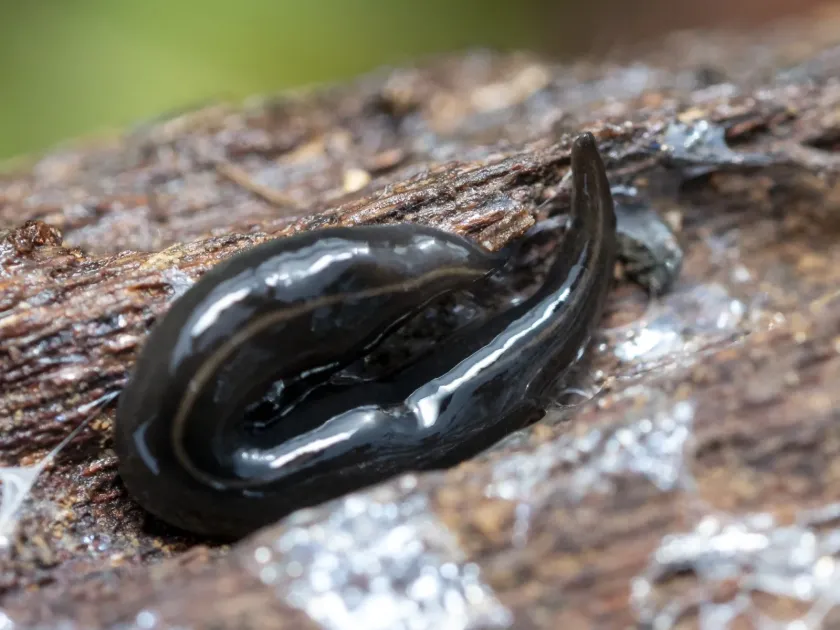
Description
How to identify
Platydemus manokwari, commonly known as the New Guinea flatworm, is a land-dwelling flatworm of the order Tricladida and the family Geoplanidae.
Adult individuals reach 40 to 65 mm in length and about 5 mm in width, featuring a flattened, ribbon-like body that is dark olive-brown or black in color.
The organism has a distinctive light-colored medial stripe along its ventral surface and a slightly pointed head with eyespots sensitive to light and movement.
As a hermaphrodite capable of both sexual reproduction and fragmentation, this species exhibits high reproductive potential and adaptability to various environments.
It moves across soil surfaces using muscular waves and leaves behind a thin layer of mucus, which acts as a sign of its presence in the garden or greenhouse.
What it damages
The primary impact of this flatworm is its role as an apex predator of soil invertebrates, specifically earthworms, which are essential for nutrient cycling and soil aeration.
By consuming local earthworm populations, the flatworm drastically alters the structure of the soil, leading to compaction and reduced water-holding capacity.
While it does not feed directly on plant tissues, its environmental impact causes a decline in overall soil fertility, thereby hindering the growth of various horticultural and ornamental crops.
In managed landscapes and nurseries, its presence can disrupt the balance of the ecosystem, necessitating higher input of fertilizers to mitigate the loss of natural processes.
Furthermore, the decline in earthworm populations increases the risk of pathogen outbreaks that would otherwise be suppressed by healthy, active soil fauna.
When it appears
Platydemus manokwari is highly dependent on environmental moisture; its activity is highest during periods of frequent rainfall and humid conditions.
The species thrives in warm, tropical, and subtropical climates, but can remain active throughout the year in greenhouses if moisture levels are consistently maintained.
During dry spells or cold weather, the worms seek refuge deep within soil cracks, under thick layers of organic debris, or beneath objects to avoid dehydration.
There is no specific developmental stage tied to plant growth cycles, meaning that the threat remains constant whenever soil moisture and temperature conditions are favorable.
Most sightings occur in the early morning or evening, as the flatworm is photophobic and prefers to avoid exposure to direct sunlight.
Signs of infestation
The most alarming sign of an infestation is a significant or total disappearance of native earthworm populations in a formerly healthy garden or potted plant collection.
Presence can be confirmed by observing shiny, mucous trails on the soil surface, greenhouse benches, or the sides of plant containers after dusk.
Individuals can often be found hiding in cool, dark, and damp locations, such as under potted plants, discarded wood, or piles of leaf mulch.
In areas with high densities of the worm, one may observe a decrease in the decomposition of organic matter on the soil surface, as earthworms are no longer present to break it down.
- Shimmering mucus trails left on moist surfaces at night.
- Absence of earthworm casts or activity in soil samples.
- Discovery of live, flattened worms under mulch or greenhouse pots.
Control measures
Currently, there are no effective chemical control measures specific to this flatworm; therefore, strict quarantine and sanitation are the most vital tools for management.
Preventing the international or inter-regional transport of soil, potted plants, and nursery stock is essential to stop the spread of this invasive species into new territories.
Manual collection and destruction of the worms is the most effective approach for greenhouse managers and hobbyists to control populations in confined areas.
Maintaining clean and tidy work areas, removing debris that serves as shelter, and ensuring proper drainage helps to discourage the establishment of the pest.
Integrated pest management strategies should focus on ecosystem preservation, monitoring for early detection, and avoiding the accidental introduction of soil infested with worms.
Taxonomy
- Latin name
- Platydemus
- Family
- Rhynchodemidae
- EPPO code
- PTYDSP
Discussion
No discussions yet — be the first.