
Small pine bark beetle
Pityophthorus rubidus
Description
How to identify
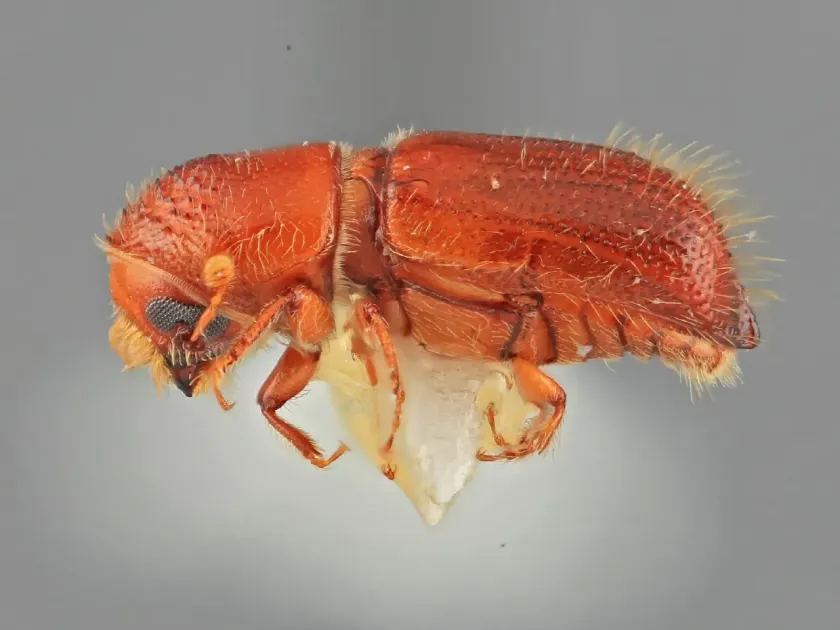
The small pine bark beetle (Pityophthorus rubidus) is a tiny coleopteran belonging to the Curculionidae family. Adult beetles measure approximately 1.5–2.0 millimeters in length.
These beetles possess a cylindrical body shape, typical of bark beetles, with a reddish-brown or dark brown color. Their head is usually tucked under the pronotum, making it less visible from above.
The species primarily inhabits the thin-barked branches and young shoots of various pine species. Their small size allows them to bore into delicate woody tissues where other larger beetles cannot.
Taxonomically, they are recognized as secondary pests, yet their impact can be significant in young pine plantations where the host trees are still developing their defenses.
Distinguishing Pityophthorus rubidus from other bark beetle species requires professional entomological examination of the gallery patterns under the bark.
What it damages
This pest mainly affects Scots pine and other related conifer species. It poses the greatest threat to young trees, saplings, and the terminal shoots of more mature pines.
Feeding larvae and adults disrupt the phloem and cambium layers, which effectively cuts off the tree's supply of nutrients and water from the roots to the crown.
In high populations, these beetles can kill young trees entirely. They create extensive networks of tunnels that structurally weaken the branches and stems of the host.
Secondary damage often occurs as the stressed trees become susceptible to fungal infections and colonization by other, more aggressive timber-boring insects.
Economic damage is most notable in commercial forestry and ornamental nurseries where the health of young planting stock is vital for future timber quality.
When it appears
The activity of the small pine bark beetle typically begins in early spring, as temperatures rise, allowing the overwintered adults to emerge and seek new host plants.
The main flight period usually occurs between April and June. During this time, beetles mate and start constructing galleries under the bark to deposit their eggs.
Development from egg to adult takes several weeks, during which the larvae feed greedily on the wood tissue. One or two generations may occur per season depending on climate.
As autumn approaches, the new generation of adults seeks suitable shelter for overwintering, often boring into the same branches or stems they utilized during the summer.
Extended drought periods or warm, mild winters can significantly influence the lifecycle, leading to accelerated development and higher survival rates for the population.
Signs of infestation
The first sign of an infestation is the appearance of fine wood dust, known as frass, appearing on the bark where the beetles have entered the tree.
Yellowing or browning of the needles on specific branches is a clear indicator of compromised health, often appearing shortly after the beetles have started their tunneling process.
- Entry holes on the surface of young pine bark.
- Sap bleeding or resin accumulation at the site of attack.
- Premature dropping of needles from infected limbs.
- Terminal leader dieback in younger pine trees.
- Presence of intricate gallery systems under the bark layer.
Monitoring these symptoms during the spring and early summer is essential for foresters and gardeners to implement control measures before the beetle population spreads.
Control measures
Sanitation is the most effective control method. Removing and burning or chipping infested branches and trees helps prevent the emergence of the next beetle generation.
Felling and debarking infested timber can expose the larvae to sunlight and predators, significantly increasing their mortality rates during the summer months.
Pheromone traps are used in professional forest management to monitor population levels and can sometimes be used to lure beetles away from healthy stands.
For ornamental trees, systemic or contact insecticides may be applied during the flight phase, though this is only practical on a small, high-value scale.
Encouraging natural predators such as woodpeckers and various parasitic wasps can help maintain the beetle population at levels that do not cause major economic losses.
Taxonomy
- Latin name
- Pityophthorus rubidus
- Order
- Coleoptera (beetles)
- Family
- Curculionidae
- EPPO code
- PITORU
Discussion
No discussions yet — be the first.