
Pine bark beetle
Pityophthorus pullus
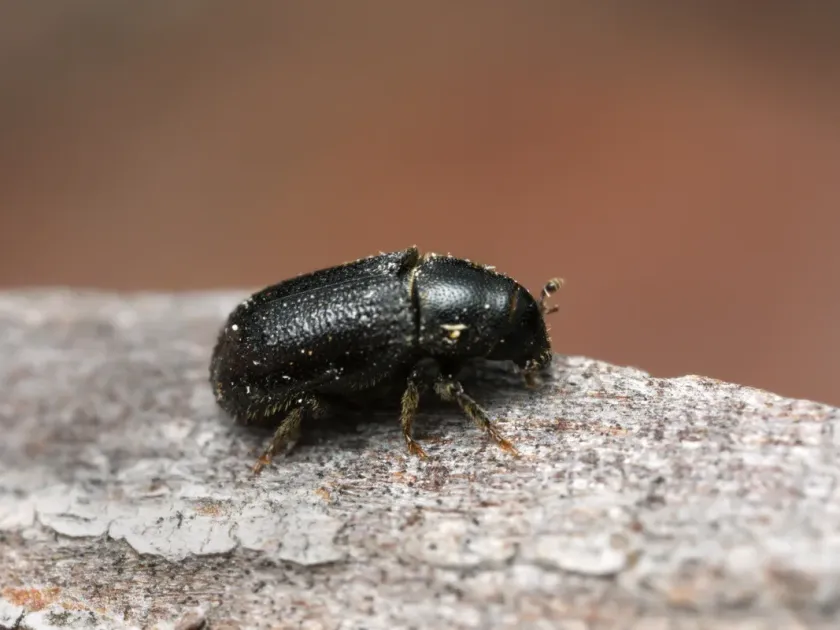
Description
How to identify
The pine bark beetle (Pityophthorus pullus) belongs to the order Coleoptera and the family Curculionidae (subfamily Scolytinae). These are small, cylinder-shaped beetles typically measuring between 1.5 and 2.0 mm in length.
The body color ranges from reddish-brown to almost black. Their physical structure is highly adapted for life under the bark, allowing them to navigate and excavate galleries within the phloem and cambium layers of host trees.
Larvae are legless, creamy-white in color with a distinct brown head capsule. They are curved in shape and remain hidden within the tree's bark throughout their development stage.
Adult beetles are equipped with wings, facilitating their dispersal across pine stands. Their small size makes them difficult to detect until an infestation is already well-established.
The entire life cycle of Pityophthorus pullus occurs under the bark, which provides protection from many environmental factors and natural predators.
What it damages
This species primarily targets the Scots pine (Pinus sylvestris). While they prefer weakened or stressed trees, dense populations can successfully colonize healthy individuals, causing rapid decline.
The beetles and their larvae damage the tree by constructing maternal and larval galleries that disrupt the vascular flow of nutrients. This leads to the eventual necrosis of the cambium layer.
Significant infestations cause needle discoloration, branch dieback, and, in severe cases, the death of the entire tree. This is particularly problematic in young forest stands and ornamental pine plantations.
The presence of these beetles often serves as a precursor to fungal infections. The galleries created by the insects allow pathogens to enter the wood, further compromising the tree's structure.
In economic terms, damage caused by the pine bark beetle leads to a reduction in timber quality and the loss of young forest growth, impacting both forestry production and aesthetic value.
When it appears
The adult beetle flight period typically begins in the spring when temperatures consistently reach favorable levels. This is the primary time for colonization and the start of a new life cycle.
Depending on the climatic zone and temperature conditions, the beetle can complete one or two generations per year. Warm, dry summers significantly accelerate the developmental cycle of the larvae.
Summer months are characterized by peak reproductive activity. Adults lay eggs in new host trees, and the subsequent larval development continues until the autumn transition.
As temperatures drop in autumn, beetles and larvae seek refuge. They often overwinter in the bark of host trees, creating specialized hibernation chambers to survive the cold season.
The synchronization of emergence with host tree susceptibility is critical for the beetle's survival, making early spring a high-risk period for forest health.
Signs of infestation
The most common indicator of an infestation is the presence of "frass" (fine boring dust) appearing on the surface of the bark or near the base of the trunk. This is ejected by the beetles during gallery construction.
Resin flow, or "pitch tubes," may be visible on the outer bark at entry points. While this indicates the tree is attempting to defend itself, it also confirms the presence of an active attack.
Crown symptoms are a late but obvious sign of infestation. Needles may turn yellow and begin to fall off, starting from the top of the tree and moving downwards as the vascular system fails.
When a piece of bark is removed from an infected tree, the maternal galleries are clearly visible. These patterns are specific to the species and indicate the intensity of the colonization.
- Presence of boring dust at the tree base.
- Pitch tubes on the trunk or branches.
- Discoloration and loss of needles in the crown.
- Small, circular entrance holes in the bark.
- Visible gallery patterns under the outer bark.
Control measures
Sanitary logging remains the most effective management strategy. Removing and destroying infested trees before the next generation of beetles emerges helps to break the life cycle.
Good silvicultural practices, such as the prompt removal of logging debris and fallen wood, are essential to minimize the breeding sites available to the population.
Pheromone traps are highly useful for monitoring population levels and determining the timing of beetle activity, which assists in planning targeted management actions.
In high-value ornamental areas or nurseries, systemic insecticides can be applied to trunks to provide a barrier against beetle attack during peak flight periods.
Promoting a healthy and diverse ecosystem encourages the presence of natural enemies, such as parasitic wasps and predatory beetles, which play a role in regulating bark beetle populations.
Taxonomy
- Latin name
- Pityophthorus pullus
- Order
- Coleoptera (beetles)
- Family
- Curculionidae
- EPPO code
- PITOPL
Discussion
No discussions yet — be the first.