
Pine bark beetle
Pityophthorus pubescens
Description
How to identify
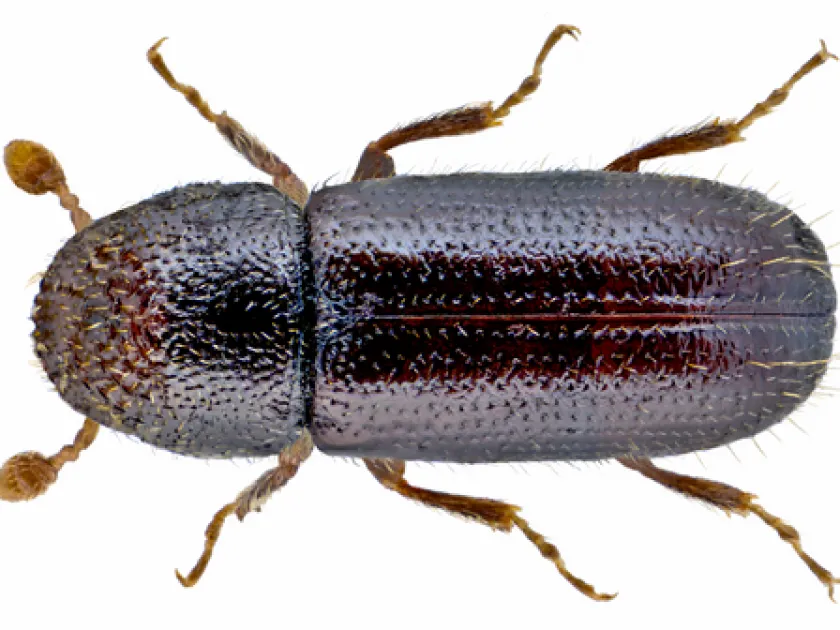
The pine bark beetle (Pityophthorus pubescens) belongs to the Curculionidae family and the Scolytinae subfamily. These are tiny beetles, usually measuring between 1.5 and 2.0 mm in length.
They possess an elongated, cylindrical body shape and exhibit a dark brown to black coloration. The body surface is covered in dense, fine hairs, which is the origin of the specific epithet pubescens.
A distinctive feature is the structure of the elytra, which feature characteristic depressions on the apex, common among many members of the genus Pityophthorus.
The larvae are legless, white in color, and possess a prominent brown head capsule. They lead a cryptic lifestyle, excavating tunnels within the bark and the subcortical layers of the tree.
Adults are capable of strong flight, allowing them to rapidly disperse throughout forest stands and nurseries in search of suitable host trees.
What it damages
The primary hosts for this pest are various pine species, including Scots pine. The beetle typically colonizes young trees or the thin branches of mature specimens.
While the beetle prefers weakened trees, high population densities may lead to attacks on healthy trees, eventually causing their decline and death.
Damage is caused by the construction of maternal galleries directly under the bark, which severely impairs the tree's nutrient and water transport systems.
Beyond mechanical damage, the beetles often act as vectors for fungal pathogens, which further stress the tree and accelerate the mortality process.
Widespread outbreaks of this species can lead to significant degradation of pine plantations, establishing foci for secondary infestations by other pests.
When it appears
Adult activity begins in the spring when average daily temperatures reach 15–18 degrees Celsius, typically between late April and May.
The breeding season is prolonged, and depending on regional climate conditions, the pest may produce one to two generations within a single growing season.
Adult flight is most intense during warm, sunny days when they actively seek out suitable bark patches on weakened host plants.
Insects overwinter primarily as adults, sheltering in the galleries they have created within the bark or in the forest litter at the base of the trees.
As autumn approaches, insect activity decreases, and they move to their overwintering sites to survive the harsh winter conditions.
Signs of infestation
The first visual sign of infestation is the presence of brown or reddish "boring dust" accumulating in bark crevices and at the base of the tree trunk.
Upon closer inspection of branches or stems, one can identify small entry holes made by the beetles, measuring approximately 1 millimeter in diameter.
Resin flow is frequently observed at infestation sites, serving as the tree's defensive response to internal tissue damage.
Gradual yellowing and subsequent wilting of individual branches or the tree top indicate significant disruption of the vascular system.
- presence of entry holes in the bark;
- accumulation of boring dust at the tree base;
- resin bleeds on the bark surface;
- premature needle discoloration;
- bark sloughing in areas with galleries.
Control measures
The most effective protection method is sanitation logging and the timely removal of infested trees to prevent the emergence of the next generation of pests.
Regular monitoring of forest stand health is essential, along with the prompt disposal of logging residues that could serve as breeding grounds.
In nurseries and ornamental landscapes, trunk spraying with contact insecticides is recommended during the onset of the peak flight period.
Preventative measures include maintaining high silvicultural standards to ensure optimal growth conditions and robust immunity for coniferous species.
The use of pheromone traps helps track population dynamics and determines the precise timing for necessary chemical control measures.
Taxonomy
- Latin name
- Pityophthorus pubescens
- Order
- Coleoptera (beetles)
- Family
- Curculionidae
- EPPO code
- PITOPB
Discussion
No discussions yet — be the first.