
Lichtenstein's bark beetle
Pityophthorus lichtensteini
Description
How to identify
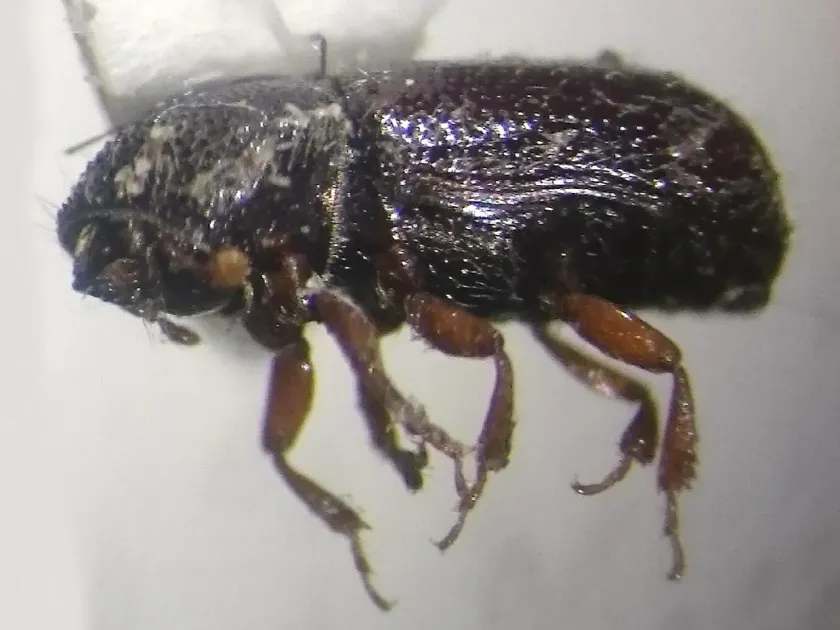
Lichtenstein's bark beetle (Pityophthorus lichtensteini) is a minute beetle species belonging to the family Curculionidae, subfamily Scolytinae. Adult beetles typically measure between 1.5 and 2.0 mm in length.
They possess a cylindrical body characterized by a dark brown coloration. A distinguishing feature of this species is the structure of the elytra, which exhibit longitudinal rows of fine punctures.
The pronotum of this beetle is slightly narrowed at the front and covered with small, scattered granules. These morphological characteristics are critical for identification under laboratory magnification.
As members of the Curculionidae family, they are highly specialized in colonizing woody plants. They predominantly target small-diameter branches and tops of conifers, which is a key diagnostic behavior.
Due to their very small size, these beetles are often overlooked by casual observers until the visible symptoms of tree decline become apparent in the surrounding forest canopy.
What it damages
This species primarily infests coniferous trees, with a strong preference for the Scots pine (Pinus sylvestris). They typically colonize weakened or stressed trees, although high populations can attack healthy trees.
The larvae and adults create complex systems of galleries beneath the bark. This mining activity disrupts the translocation of nutrients and water within the branches, eventually leading to dieback.
Beyond direct damage, the beetle serves as a vector for various blue-stain fungi. These fungal infections penetrate deep into the sapwood, significantly degrading the quality of the timber.
Heavy infestations result in widespread crown thinning and the death of individual branches. In nursery settings or young plantations, this can cause stunted growth or total mortality of the plants.
Forest stands that have experienced drought, storm damage, or soil compaction are at the highest risk, as these conditions favor the rapid buildup of beetle populations.
When it appears
The activity of Pityophthorus lichtensteini is highly dependent on ambient temperatures. Spring emergence typically begins when daily average temperatures exceed +15 degrees Celsius.
Depending on the climatic region, the beetle may produce one or two generations per year. The first generation usually emerges in late spring, while the second may appear by late summer.
The mating and colonization phase is concentrated between May and July. During this time, the beetles seek out suitable host material to establish their breeding galleries and lay eggs.
Larval development occurs rapidly, taking several weeks to complete. Once the pupal stage is finished, the new generation of adults bores out of the bark to find new host material or overwintering sites.
Overwintering takes place in the adult stage, usually within the bark crevices of host trees or in the protective leaf litter on the forest floor, awaiting the next spring season.
Signs of infestation
The most reliable sign of an infestation is the presence of minute entry holes on the bark, often resembling tiny pinpricks. These are created by the parent beetles as they initiate gallery construction.
Frass, or wood boring dust, is another critical indicator. This fine, powdery residue accumulates around the entry points and in bark fissures, signaling active tunneling beneath the surface.
Visual symptoms in the canopy include the premature yellowing and browning of needles on specific branches. Eventually, these branches die and become brittle, failing to support healthy growth.
Peeling away a section of the bark reveals the internal gallery system. The pattern typically shows a central nuptial chamber with several radial larval galleries extending outwards into the sapwood.
- Tiny pinprick-like entry holes on the bark.
- Accumulation of fine wood dust (frass) on the branches.
- Yellowing or fading needles on individual twigs.
- Resin droplets (pitch tubes) appearing on the surface of the bark.
Control measures
Sanitation cutting is the primary management strategy. Removing and properly disposing of infested branches or downed trees significantly reduces the available breeding habitat for the beetle.
Maintaining a clean forest environment by removing logging residues and debris is essential. These materials provide the ideal conditions for the beetle population to thrive and spread.
Monitoring programs utilizing pheromone-baited traps are highly effective for detecting early population increases. This allows forest managers to take preemptive action before an outbreak occurs.
In high-value areas, chemical treatments may be used, though they should be applied judiciously. It is vital to ensure that such measures do not harm non-target beneficial insect species.
Encouraging the presence of natural predators, such as woodpeckers and parasitic wasps, provides a sustainable biological control method that keeps beetle numbers within natural limits.
Taxonomy
- Latin name
- Pityophthorus lichtensteini
- Order
- Coleoptera (beetles)
- Family
- Curculionidae
- EPPO code
- PITOLI
Discussion
No discussions yet — be the first.