
Small spruce bark beetle
Pityophthorus deletus
Description
How to identify
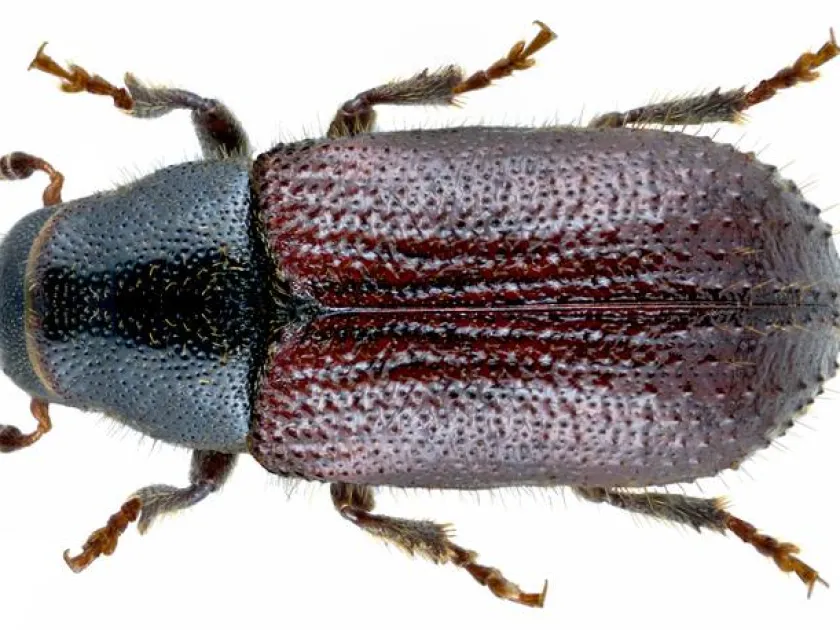
The small spruce bark beetle (Pityophthorus deletus) is a member of the Curculionidae family and the Scolytinae subfamily. It is an extremely small insect, with adults typically measuring between 1.5 and 2.0 mm in length.
The body of the beetle is cylindrical and dark brown, often exhibiting a slight metallic shine. The elytra have precise rows of punctures, which serve as a critical feature for identifying this specific species among other bark beetles.
The larvae are typically legless, white in color, and feature a distinct brown head. They live and feed exclusively within the bark layers of spruce trees, completing their life cycle in a hidden environment.
Pupation occurs in small chambers gnawed into the inner bark. The pupa is white, free-living, and stays protected under the bark until it emerges as an adult beetle.
Unlike larger bark beetle species that target thick-barked trunk sections, this species favors thin-barked areas, including tops, branches, and young spruce stems.
What it damages
The primary host for this beetle is the spruce tree (Picea). It predominantly attacks stressed, dying, or wind-fallen trees, although it can attack healthy trees during outbreaks.
The beetle larvae feed on the cambium and phloem layers, which are essential for nutrient and water transport. This activity disrupts the tree's vascular system, causing physiological decline.
Damage is often localized to the upper canopy and branches. As the vascular tissue is destroyed, the needles on the affected branches begin to turn yellow and eventually drop, indicating significant damage.
The galleries created by the beetle serve as entry points for secondary pathogens, such as wood-decaying fungi, which further accelerate the death of the host tree.
High infestation levels in young spruce stands can lead to widespread tree mortality, posing a significant risk to forest plantations and nursery stocks.
When it appears
The adult beetle emerges from its hibernation site in spring, typically when daytime temperatures consistently remain above 12-15 degrees Celsius.
Depending on the climate and geographical location, the beetle can complete one or two generations per season. Peak flight activity often occurs during early to mid-summer.
After finding a suitable host, females excavate entrance holes and maternal galleries to lay eggs. Larvae hatch and begin feeding, creating radiating galleries that expand as the larvae grow.
Adult beetles overwinter in the bark of standing trees or within the forest litter near the base of the host tree, allowing them to survive winter temperatures.
Environmental conditions, particularly heat and moisture, significantly influence the developmental speed of each generation, affecting the population size for the following year.
Signs of infestation
The presence of "frass," a fine sawdust resulting from the beetle's tunneling activity, found on the bark surface or near the base of the tree is the most common early sign.
Changes in needle color, starting from deep green to yellow and then reddish-brown, are clear indicators that the tree's vascular system has been severely compromised by the larvae.
Removing a small section of bark reveals the internal gallery system, characterized by a central maternal tunnel with smaller larval galleries branching off in different directions.
Resin flow or "pitch tubes" may appear on the bark surface as the tree attempts to push out the invaders. However, if the beetle population is high, the tree will fail to defend itself.
Thinning of the crown and premature needle shedding are late-stage signs indicating that the infestation has reached a critical level on the upper sections of the spruce.
Control measures
Sanitation logging, which involves the rapid removal and destruction of infested trees, is the most effective way to keep the population below epidemic levels.
Trap trees can be deployed to attract beetles, which are then harvested and processed before the new generation emerges, effectively lowering the overall local beetle density.
Encouraging natural predators such as woodpeckers and predatory beetles is essential for integrated pest management in large forest areas.
Chemical control with insecticides is generally not viable in large forest stands but may be used in specific nursery settings to protect young, high-value spruce plants.
- Conducting regular forest health monitoring to detect infestations early.
- Removing dead wood and logging debris to prevent beetle breeding grounds.
- Improving overall tree vitality through proper forest thinning and management practices.
Taxonomy
- Latin name
- Pityophthorus deletus
- Order
- Coleoptera (beetles)
- Family
- Curculionidae
- EPPO code
- PITODE
Discussion
No discussions yet — be the first.