
Spruce bark beetle
Pityophthorus consimilis
Description
How to identify
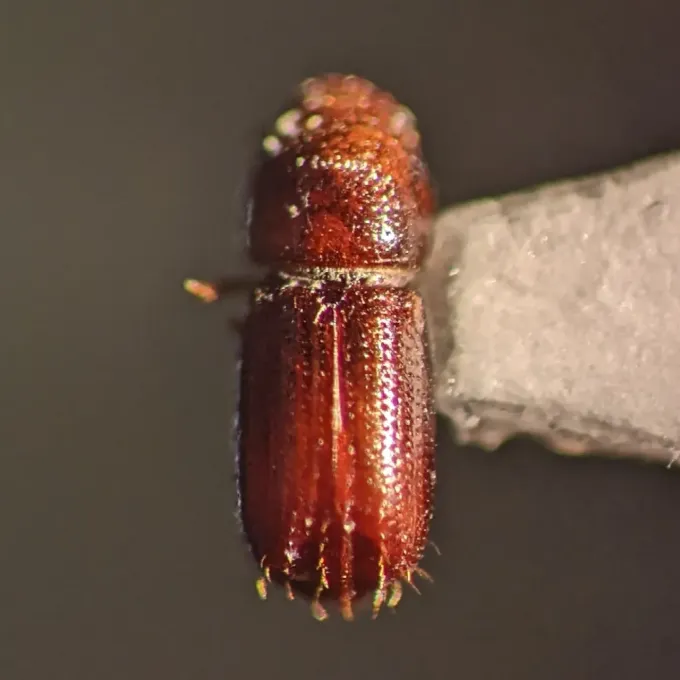
The spruce bark beetle (Pityophthorus consimilis) belongs to the family Curculionidae and the subfamily Scolytinae. These insects are small, typically measuring between 1.5 and 2.2 mm in length.
They possess a cylindrical body shape with a brownish coloration. The elytra are covered in fine grooves and short hairs, which is a diagnostic feature of the genus Pityophthorus.
The larvae are white, legless, and have a brown head capsule. They live exclusively beneath the bark, feeding on the inner tissues of the tree.
Adult beetles overwinter within the galleries they have constructed or in the forest litter, emerging in the spring to initiate the breeding cycle.
This species is well-adapted to exploiting stressed trees, making it a critical pest to monitor in both plantation and ornamental spruce settings.
What it damages
The primary host for this pest is the spruce tree (Picea). Infestations often target young trees or the branches and tops of weakened older specimens.
The beetles bore through the outer bark to reach the cambium layer. Their feeding galleries disrupt the flow of nutrients and water, eventually killing the affected tissue.
Severe infestations can lead to the rapid decline and death of the top section of the tree, creating conditions suitable for further colonization by secondary pests.
Additionally, these beetles act as vectors for fungal pathogens that cause vascular wilting and necrosis, further compromising the health of the host.
Without proper intervention, infestations can spread rapidly, causing significant aesthetic damage and loss of plant vigor in landscaping or forest stands.
When it appears
The flight activity of adult beetles begins in early spring, typically once temperatures remain consistently favorable, usually starting in April or May.
During the warmer months, mating occurs, and females lay eggs in maternal galleries. The development from egg to adult is rapid under optimal conditions.
Depending on the climatic zone and temperature, the beetle may complete one or even two generations per season.
Late summer marks the preparation for overwintering, as adult beetles move to lower trunk areas or debris to survive the cold months.
Monitoring for peak flight periods is essential for planning chemical interventions, as this is when the adult population is most vulnerable.
Signs of infestation
The most reliable indicator of an infestation is the presence of fine sawdust, often referred to as boring dust, collecting on the bark or at the base of the tree.
Small, perfectly round entry holes on the bark of branches or the main stem indicate where beetles have successfully penetrated the surface.
Discoloration of the needles, turning yellow and then brown, is a clear sign that the tree's circulation system is being compromised by the larvae's feeding.
- Pitch tubes or resin drops appearing at the entry holes.
- Needles falling off easily when the branch is shaken.
- Necrotic patches underneath the bark surface.
Removing a small section of bark will reveal the intricate patterns of maternal and larval galleries etched into the wood.
Control measures
The most effective management strategy is sanitation: identifying, removing, and destroying infested branches or entire trees before the next generation emerges.
Promoting overall tree vigor through proper irrigation and fertilization helps the tree naturally resist beetle attacks and heal from minor injuries.
Insecticide applications during the peak flight season can protect healthy trees from initial colonization by adult beetles.
Pheromone traps are valuable tools for detecting the presence of the beetle and determining the density of the population within a specific area.
Maintaining a clean environment by removing forest debris and fallen limbs significantly reduces available breeding sites for the spruce bark beetle.
Taxonomy
- Latin name
- Pityophthorus consimilis
- Order
- Coleoptera (beetles)
- Family
- Curculionidae
- EPPO code
- PITOCO
Discussion
No discussions yet — be the first.