
Spruce fringed bark beetle
Pityophthorus ciliatus
Description
How to identify
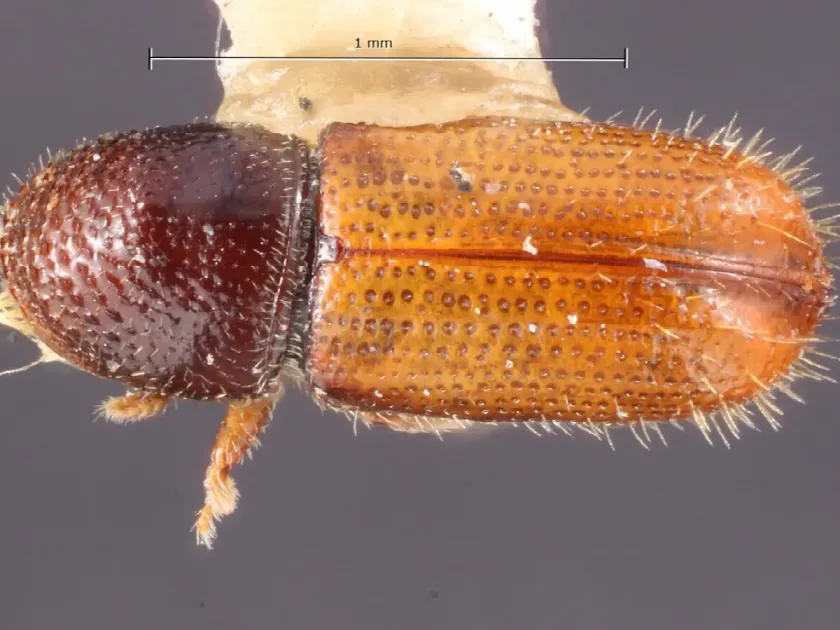
The spruce fringed bark beetle, known scientifically as Pityophthorus ciliatus, is a small member of the Scolytinae subfamily. Measuring about 1.5–2.0 mm, these beetles exhibit a cylindrical body shape typical of their group.
The species is distinguished by the presence of fine, prominent hairs—or fringes—along the pronotum and elytra. This morphological feature gives them a slightly fuzzy appearance when observed under magnification.
The larvae are legless, white, and possess a distinct brown head capsule. They spend their entire development phase beneath the bark, making them cryptic inhabitants of the host tree’s upper canopy.
Pupation occurs within small, oval-shaped chambers carved into the sapwood. After a short period, the pupae transform into teneral adults, which then emerge through exit holes in the bark.
While small in size, these beetles are capable flyers, which facilitates the colonization of healthy or drought-stressed trees throughout the growing season.
What it damages
Pityophthorus ciliatus primarily infests Norway spruce. They exhibit a strong preference for smaller, younger branches within the canopy, where the bark is thin and easier to penetrate.
The beetles construct galleries in the inner bark, which effectively girdle the branch. This disruption of the phloem prevents the movement of nutrients, leading to the rapid decline of the affected limb.
Heavily infested trees show signs of crown thinning and tip dieback. This damage is not only visually detrimental to the tree but also impacts the overall health of the specimen over time.
Furthermore, these beetles act as vectors for various pathogenic fungi. The introduction of these spores into the host tree often accelerates the death of branches and weakens the host's defenses.
In forest nurseries, high populations of this beetle can be devastating to seedlings, potentially causing widespread mortality if the infestation is not detected and addressed promptly.
When it appears
The adult beetles emerge from their wintering sites in early spring, usually as soon as temperatures exceed 15 degrees Celsius. This emergence is synchronized with the beginning of the tree's growing season.
The reproductive phase is concentrated in late spring and early summer, typically peaking in May and June. During this time, mating and gallery construction take place under the bark of branches.
The life cycle from egg to mature adult is completed in approximately 40 to 60 days. In regions with long, warm summers, this allows for rapid population growth within a single season.
As autumn approaches, the new generation of adults seeks shelter for overwintering. They often remain within the larval host branch or migrate to the tree base to hibernate in the leaf litter.
Periods of extreme heat and prolonged drought act as catalysts, stressing the host trees and making them significantly more susceptible to successful beetle colonization.
Signs of infestation
The most reliable sign of an infestation is the presence of minute entry holes on the bark of twigs and branches. Often, a tiny pile of reddish-brown frass is visible near the opening.
The crown of the tree will show yellowing and browning needles. This discoloration usually starts at the tips of the branches and progresses inward as the branch dies.
Upon removing the bark, one can observe a star-shaped or branched gallery system. These galleries are characteristic of the species and provide clear evidence of the beetle's activity.
Increased resin production on the bark surface is a sign that the tree is attempting to repel the intruders. However, if the beetle pressure is high, this defense is usually overcome.
Affected branches are often brittle and break off easily during wind events, which can be an overlooked sign of previous infestation and systemic tree decline.
Control measures
Sanitation is the cornerstone of control. Pruning and removing infested branches from the crown is essential to reduce the local beetle population before they emerge to infest new targets.
Pheromone traps are highly effective for monitoring the density of the beetle population. They provide data that helps in timing supplemental control measures throughout the growing season.
Maintaining tree vigor through proper irrigation and balanced fertilization significantly increases the host's natural resistance to secondary pests like the fringed bark beetle.
Systemic insecticides may be used in high-value ornamental plantings or nurseries to protect trees. Proper application timing, synchronized with beetle flight, is crucial for success.
Professional forest pathology monitoring is vital for early detection. Identifying small outbreaks early allows for local containment, preventing the escalation of the infestation to larger areas.
Taxonomy
- Latin name
- Pityophthorus ciliatus
- Order
- Coleoptera (beetles)
- Family
- Curculionidae
- EPPO code
- PITOCI
Discussion
No discussions yet — be the first.