
Fir bark beetle (Vorontsov's fir beetle)
Pityokteines vorontzowi
Description
How to identify
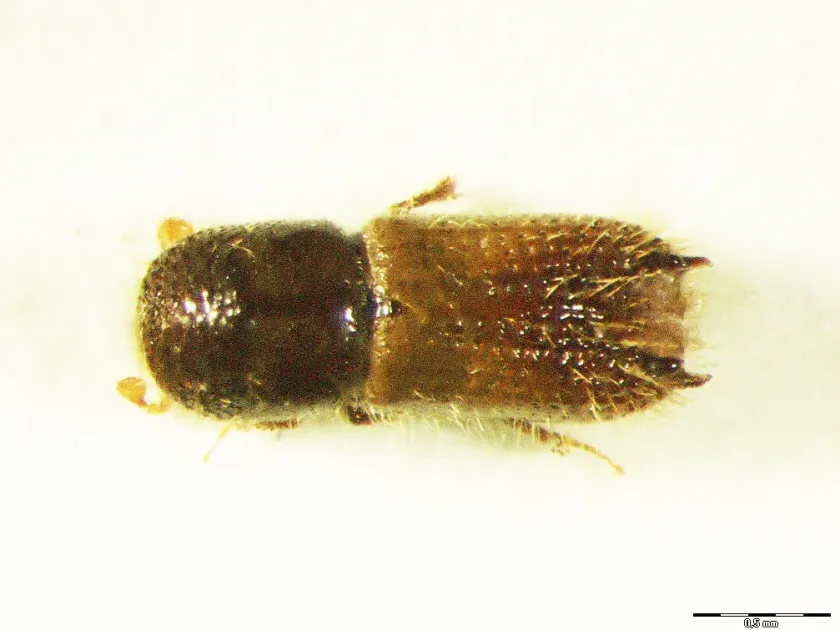
The fir bark beetle Pityokteines vorontzowi is a small coleopteran insect belonging to the Curculionidae family, subfamily Scolytinae, known for infesting fir species.
Adult beetles typically measure between 2.2 and 2.8 mm in length, possessing a cylindrical, dark-brown or black body that is characteristic of this genus.
The larvae are legless, white, and possess a distinct dark head capsule, spending their entire developmental period under the bark of host trees.
Identification is mainly based on the unique patterns of maternal galleries constructed in the phloem and cambium layer, often forming specific star-like or linear arrangements.
It is often confused with related species, but host specificity and the exact morphology of the gallery network are primary indicators for entomologists.
What it damages
This pest specifically targets fir trees (Abies spp.), primarily attacking mature and weakened trees in forest stands and nurseries.
By boring into the inner bark, the beetle destroys the tree's vascular system, preventing the transport of nutrients and water throughout the trunk.
Large-scale infestations often result in the total death of the host tree, as the beetles create a network of tunnels that effectively girdle the stem.
The damage is most severe in the upper crown and mid-stem sections where the bark is thinner and more conducive to colonization by the beetles.
Beyond individual tree mortality, the beetle promotes forest decline, significantly reducing timber value and increasing the risk of secondary infections by fungi.
When it appears
The activity of Pityokteines vorontzowi is highly dependent on ambient temperatures, usually initiating in late spring when thresholds exceed 12-15°C.
The primary swarming and colonization period occurs during May and June, when adult beetles emerge to locate new host trees to establish maternal galleries.
Depending on the climatic zone, the beetle may complete one or two generations per year, with larval feeding occurring throughout the warm summer months.
Winter survival is typically achieved in the adult stage, with the beetles remaining in the bark galleries or seeking shelter in the forest floor litter.
Drought stress during the growing season significantly increases the susceptibility of fir stands, leading to rapid population explosions of the beetle.
Signs of infestation
The presence of fine wood dust, commonly known as frass, at the base of the tree or within bark crevices is a primary indicator of recent beetle activity.
Yellowing or reddening of the foliage in the upper crown often indicates that the tree's vascular transport has been severely compromised by larval galleries.
Resin exudation, known as "pitch tubes," can sometimes be found at entry holes, although this response is often weak in already moribund or severely weakened trees.
Loosening or shedding of bark plates, revealing intricate galleries underneath, is a clear diagnostic sign that the tree is heavily infested.
Trees that exhibit premature needle drop and a thinning canopy are clear candidates for closer inspection to confirm the presence of this bark beetle.
Control measures
Sanitation felling is the most critical control measure, involving the rapid removal and disposal of infested trees before the next generation of beetles emerges.
Maintaining forest hygiene, such as removing fresh logging residues and fallen timber, prevents the creation of breeding sites for the population.
Pheromone traps are used to monitor beetle flight activity and can be employed to mass-trap adults in specifically high-risk areas.
Promoting forest resilience through appropriate stand density and species diversity helps trees resist colonization by these secondary pests.
- Immediate removal of infested timber (sanitary logging).
- Use of pheromone-based monitoring and attractant traps.
- Debarking of infested logs to kill larvae and pupae.
- Chemical treatment of high-value trees in ornamental or park settings.
Taxonomy
- Latin name
- Pityokteines vorontzowi
- Order
- Coleoptera (beetles)
- Family
- Curculionidae
- EPPO code
- PITKVO
Discussion
No discussions yet — be the first.