
Fir engraver beetle
Pityokteines spinidens
Description
How to identify
The fir engraver beetle (Pityokteines spinidens) is a member of the Curculionidae family and the Scolytinae subfamily. It is a small insect, typically measuring between 2 to 2.5 mm in length.
Adult beetles have a cylindrical body with a deep brown to black coloration. They are distinguished by the specific arrangement of spines on the declivity of their elytra, which serves as a key diagnostic feature.
The larvae are legless, white, and possess a distinct brown head capsule. They develop within the inner bark, specifically feeding on the phloem and cambium layers of the host tree.
As a specialist pest, this beetle is ecologically linked primarily to the genus Abies (firs). Its development depends on the tree's health status and climatic conditions within the forest.
Identifying the beetle in the field usually requires examining the subcortical environment, as the adults spend most of their lives hidden beneath the tree bark.
What it damages
The primary damage occurs when beetles and larvae tunnel through the tree's conductive tissue. This feeding behavior disrupts the flow of water and nutrients, leading to rapid decline.
Fir engraver beetles are considered primary pests in some instances, capable of attacking and killing healthy trees when their population densities reach outbreak levels.
Affected trees often show signs of rapid chlorosis (yellowing) and subsequent death of the crown. The loss of foliage reduces the tree's capacity for photosynthesis.
Mass infestations can lead to extensive patches of dead fir trees, causing significant economic losses and altering the structure of the local coniferous forest.
In addition to direct damage, the beetle often vectors pathogenic fungi, which further weaken the host tree and accelerate the mortality process.
When it appears
The beetle's life cycle is temperature-dependent. Adults emerge in spring when temperatures become favorable, typically starting in late April or May.
After mating, females construct egg galleries in the phloem. Depending on the geographical region and climate, the species can complete one or two generations per year.
The development from egg to adult takes approximately 40 to 60 days. The second generation, if conditions allow, emerges later in the summer to find new hosts.
Wintering occurs primarily in the adult stage. The beetles hibernate under the bark of standing trees or fallen woody debris to survive the cold months.
During dry summers, the beetles become more aggressive as trees are weakened by water stress, which reduces their ability to produce defensive resin.
Signs of infestation
The most noticeable sign of an infestation is the accumulation of reddish-brown boring dust (frass) at the base of the trunk or caught in bark crevices.
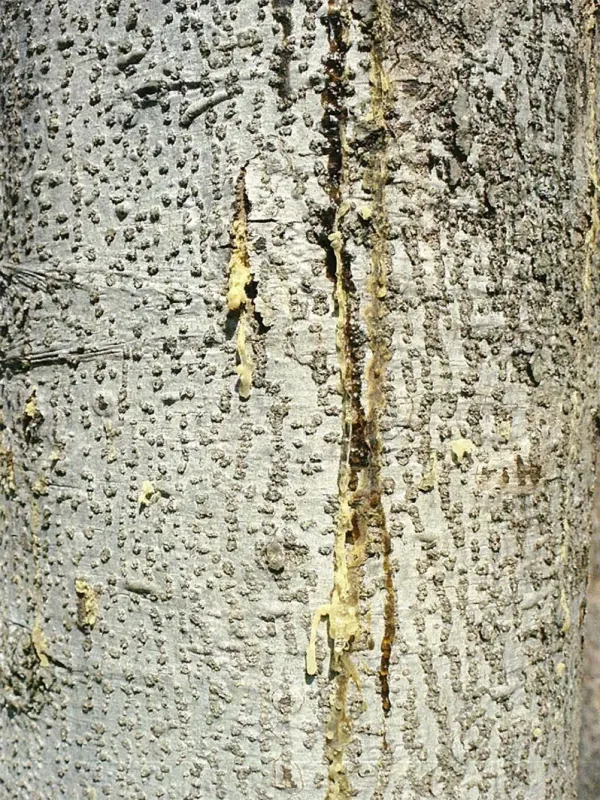
Entry holes are visible on the bark surface, usually accompanied by small droplets of resin if the tree still has enough vigor to attempt a defense response.
Crown symptoms are progressive, starting with the fading of needles, which turn from green to yellowish-green and finally reddish-brown before falling off.
- Visible bark-peeling reveals complex galleries carved into the wood surface.
- Top-down dieback of the tree crown.
- Increased woodpecker activity on affected trees searching for larvae.
Consistent monitoring for these visual cues is essential, as once the crown turns red, the damage to the conductive tissue is usually irreversible.
Control measures
Sanitation is the most effective control method. Removing and destroying infested trees before the next generation of beetles emerges prevents the spread of the population.
Pheromone-baited traps can be deployed for monitoring purposes and to reduce adult beetle density within specific forest management areas.
For high-value ornamental or park trees, preventive applications of contact or systemic insecticides to the bark can protect against colonization.
Biological control, including the preservation of natural predators and parasitoids, plays a significant role in keeping beetle populations at manageable levels.
Maintaining forest health by preventing water stress and ensuring proper spacing between trees helps improve natural resistance to bark beetle attacks.
Taxonomy
- Latin name
- Pityokteines spinidens
- Order
- Coleoptera (beetles)
- Family
- Curculionidae
- EPPO code
- PITKSI
Discussion
No discussions yet — be the first.