
Pityokteines
Pityokteines
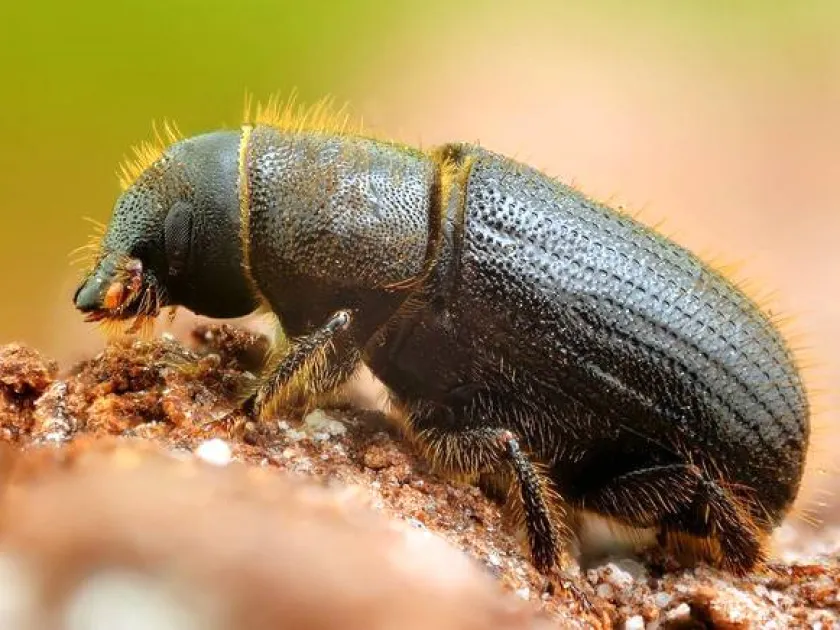
Description
How to identify
Pityokteines is a genus of bark beetles within the family Curculionidae and the subfamily Scolytinae. These insects are significant pests of coniferous trees, particularly specializing in fir species (Abies).
Adult beetles are very small, measuring between 1.5 and 3 millimeters in length. Their bodies are cylindrical and dark brown to black, a shape perfectly adapted for boring into wood and navigating narrow galleries under the bark.
The larvae are legless, white, and fleshy with a dark head. They live exclusively under the bark, feeding on the phloem and cambium layer, which is the nutrient-conducting tissue of the tree.
Distinguishing species within the genus relies heavily on the morphology of the elytral declivity, specifically the arrangement of the teeth on the rear of the beetle's wings, which is unique for different species.
Due to their secretive lifestyle, Pityokteines beetles are rarely seen unless a bark section is removed or specialized trapping methods are used during their flight period.
What it damages
Pityokteines mainly infests fir trees, though they can occasionally attack other conifers if the host tree is weakened by drought, disease, or mechanical damage.
The damage is caused by both adults and larvae. Adults tunnel into the bark to create mating galleries, while larvae bore radiating mines that cut through the tree's nutrient supply lines.
This disruption of water and nutrient transport causes the tree to slowly wither. Once the cambium is sufficiently damaged, the tree loses its ability to circulate sap and dies shortly after.
In outbreaks, Pityokteines acts as an aggressive pest, causing "group mortality" where multiple trees in a stand die rapidly as the beetle population spreads to neighboring healthy trees.
Because they target the cambium, even a relatively low population can be fatal to young or stressed trees, making early detection vital for forest management.
When it appears
Adult beetle flight typically begins in late spring, depending on temperatures. Warm spells in May or June act as the primary trigger for the initial spring infestation.
The male initiates the attack by boring into the tree and constructing a nuptial chamber. Once mating occurs, the female excavates a gallery where she deposits eggs.
The life cycle duration is highly temperature-dependent. In cooler climates, there is usually one generation per year, but in warmer regions, the beetle can produce two generations per season.
Larval development happens during the height of the summer, as they feed and grow beneath the bark, creating intricate feeding tunnels that expand in size as they mature.
The insects overwinter primarily as adults, often remaining within the bark of their host tree or moving to the leaf litter to survive the winter months until the next season begins.
Signs of infestation
The most reliable sign of a Pityokteines infestation is the presence of "frass"—a mixture of bark and wood dust—accumulated in bark crevices or at the base of the tree trunk.
Another visible indicator is the change in foliage color. As the tree’s circulatory system is compromised, the needles transition from healthy green to a dull yellow and eventually reddish-brown.
Small, circular entry holes are visible on the trunk. In healthy trees, the beetle attack may trigger a resin response, causing sap to flow and harden over the entry point.
When the bark is carefully peeled away, the classic pattern of the mating chamber with radiating larval galleries becomes visible, confirming the presence of these beetles.
- Fine wood dust (frass) on the bark.
- Gradual yellowing or reddening of the needles.
- Small, uniform entry holes in the trunk.
- Characteristic star-shaped gallery patterns under the bark.
- Dead tree clusters in a forest stand.
Control measures
Sanitation logging is the primary method of control. Removing infested trees before the next generation of beetles emerges is crucial to stopping the spread of the infestation.
Pheromone traps are extensively used for monitoring beetle flight activity and can be used to mass-trap adults to reduce the overall population pressure in a specific area.
Silvicultural practices that maintain tree vigor, such as thinning stands to reduce competition for water and nutrients, make trees less susceptible to successful beetle colonization.
In specific cases, such as ornamental trees in parks or landscapes, systemic insecticides can be applied to trunks to provide a barrier against colonization during the flight season.
Encouraging natural predators, such as woodpeckers and various parasitic wasps, can help keep Pityokteines populations at low, manageable levels within forested ecosystems.
Taxonomy
- Latin name
- Pityokteines
- Order
- Coleoptera (beetles)
- Family
- Curculionidae
- EPPO code
- PITKSP
Discussion
No discussions yet — be the first.