
Four-toothed bark beetle
Pityogenes quadridens
Description
How to identify
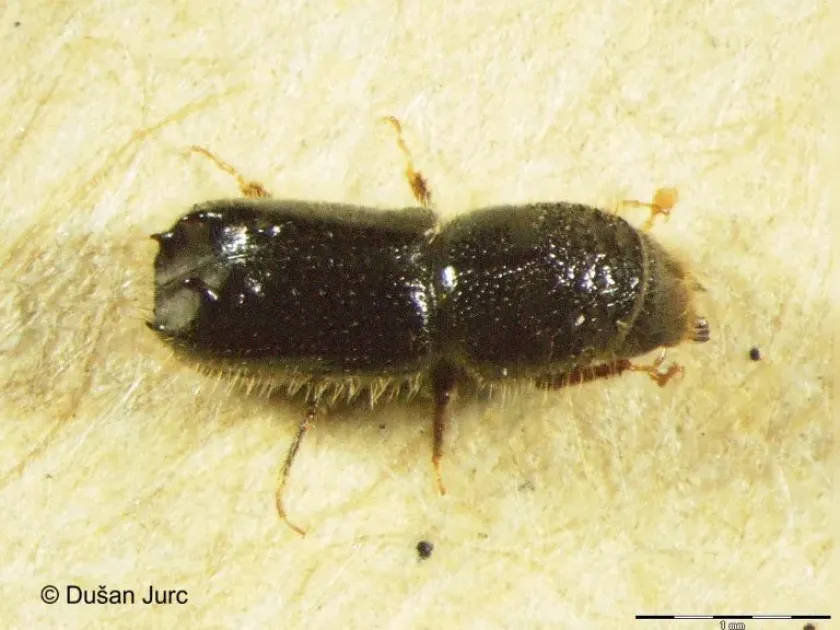
The four-toothed bark beetle, known scientifically as Pityogenes quadridens, is a small insect ranging from 2.2 to 3.2 mm in length. Its body is cylindrical and shiny, varying in color from dark brown to black.
The name of the species refers to the specific structure of the male beetle's elytra, which features four distinct teeth on each side of the posterior slope. Females lack these prominent teeth, having only small tubercles instead.
Larvae are typical for the subfamily: they are legless, white, C-shaped, and possess a small yellowish head capsule. They spend their entire developmental period beneath the bark.
Pupation occurs within the larval tunnels under the bark. The pupae are initially white and gradually darken as the mature adult beetle forms inside the protective gallery.
Its morphology is unique within the genus, making it distinguishable through the specific arrangement of the elytral teeth, which is a key diagnostic feature for forest entomologists.
What it damages
The primary host for this pest is the Scots pine (Pinus sylvestris). However, it may occasionally attack other coniferous trees, such as spruce or larch, when populations are high.
These beetles prefer thin-barked sections of the tree, specifically targeting the upper crown, thin branches, and young trees. They rarely attack the thick base of mature trunks.
The damage is caused by the adults and larvae feeding on the phloem and cambium layers. This feeding activity disrupts the transport of nutrients and water, eventually killing the affected parts.
Severe infestations often result in the rapid yellowing and death of the crown. In young forest stands, an outbreak can cause widespread tree mortality within a single season.
The beetle acts as a primary pest on weakened trees, but in high numbers, it is capable of successfully attacking healthy trees, making it a significant threat to timber resources.
When it appears
Adult beetles typically emerge in spring, usually in April or May, once temperatures are high enough to support flight activity and colonization of new hosts.
The colonization begins when males bore into the bark to construct nuptial chambers. They are followed by females, which initiate the mating and egg-laying process in radiating maternal galleries.
Development from egg to adult is relatively fast, typically taking about 6 to 8 weeks depending on the temperature, humidity, and sun exposure of the host trees.
In warmer climates, the beetle can complete two generations in a single year, significantly increasing the potential for population growth and rapid forest damage.
Wintering occurs primarily in the adult stage, with the beetles hibernating either within the bark of the infested tree or in the forest litter near the base of the trunk.
Signs of infestation
One of the earliest signs of an infestation is the presence of fine, reddish-brown boring dust (frass) visible around entrance holes on the bark surface.
Visible yellowing of the needles, particularly in the top part of the pine crown, is a clear indicator that the tree's vascular system has been compromised by beetle activity.
Removal of a section of bark reveals intricate, star-shaped gallery patterns. These consist of a central nuptial chamber surrounded by several maternal galleries.
Tree resin flow is a common reaction to beetle attacks. While resin can sometimes push out invading beetles, excessive resin streaks are often a symptom of a heavy infestation.
Top dieback, where the upper part of the tree turns brown while the lower trunk remains green, is the most characteristic visual symptom of a four-toothed bark beetle attack.
Control measures
The most effective management strategy is the timely removal and disposal of infested trees, known as sanitary logging, before the new generation of adults emerges.
Trap trees, which are freshly cut pines, can be used to attract beetles. Once the traps are infested, they must be debarked or destroyed to eliminate the beetles inside.
Proper forest hygiene is essential; all logging debris, slash, and small diameter wood should be removed from the site to prevent it from becoming a breeding ground.
Pheromone traps are used in high-value areas, such as parks and recreational forests, to monitor population levels and reduce the local beetle density during spring.
Maintaining high forest health through proper silvicultural practices is the best long-term strategy for preventing bark beetle outbreaks and minimizing potential damage.
Taxonomy
- Latin name
- Pityogenes quadridens
- Order
- Coleoptera (beetles)
- Family
- Curculionidae
- EPPO code
- PITYQU
Discussion
No discussions yet — be the first.