
Southern engraver beetle
Pityogenes meridianus
Description
How to identify
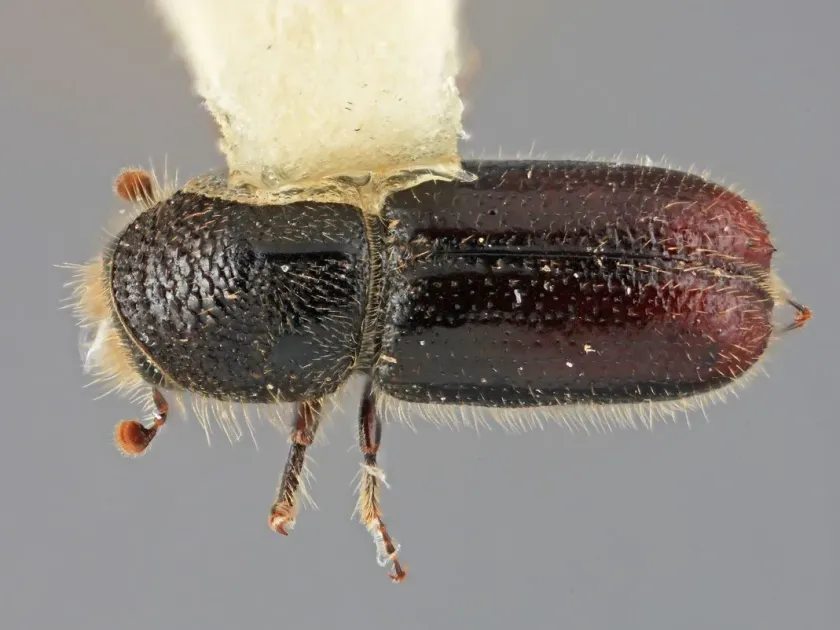
The southern engraver beetle (Pityogenes meridianus) belongs to the Curculionidae family and the Scolytinae subfamily. These are small beetles ranging from 2.0 to 2.8 mm in length.
The insect has a cylindrical body shape, typically colored deep brown to black. The surface is shiny and features fine rows of punctures, typical for bark beetles.
Males can be identified by the specific shape of the elytral declivity, which bears distinct teeth, serving as a key diagnostic feature for this species.
Larvae are white, legless, curved, and possess a distinct brown head. They develop within the cambium layer, creating tunnels that eventually girdle the host tree.
This species is highly adapted to coniferous ecosystems, often attacking pine trees. It is categorized as a secondary pest that becomes primary under favorable environmental conditions.
What it damages
The southern engraver beetle primarily infests coniferous trees, with a strong preference for Pinus sylvestris and other pine species in temperate regions.
It attacks branches and the trunks of younger trees, focusing on areas where the bark is thin enough for easy penetration by the adults.
Damage occurs when beetles and their larvae feed on the inner bark and cambium, effectively severing the tree's phloem and stopping the translocation of nutrients.
The beetle acts as a vector for various wood-staining fungi, which further weaken the tree's immune system and accelerate the death of the host plant.
Significant infestations lead to the rapid yellowing of the crown and eventual mortality, posing a serious threat to juvenile forest stands and plantations.
When it appears
The flight period typically begins in the spring, once temperatures rise above 15°C, usually coinciding with the onset of the active growing season.
Depending on regional climates, the southern engraver beetle can complete one or two generations per year, with activity peaking during the warm summer months.
Adults emerge from their pupal chambers after a period of maturation feeding, ready to colonize new, weakened, or freshly downed host material.
The developmental cycle from egg to adult is relatively fast, often taking less than two months, allowing populations to explode in stressed tree stands.
Adults overwinter beneath the bark of infested trees or within the leaf litter at the base of the trunk, emerging again when the weather conditions improve.
Signs of infestation
The most visible sign of infestation is the presence of fine, reddish-brown frass accumulating in bark crevices or at the tree's base, resembling sawdust.
Crown symptoms include chlorosis, followed by a transition from green to yellow and finally brown as the tree loses its ability to transport water.
- Entrance holes on the bark surface.
- Small resin droplets ("pitch tubes") where the beetle attempted entry.
- Characteristic star-shaped maternal gallery patterns found under the bark.
- Bark shedding or loosening in the infested sections.
- Top dieback in smaller trees.
Removing a patch of bark often reveals a complex network of feeding galleries, which is the most reliable way to confirm the presence of this specific engraver species.
Control measures
Sanitation felling is the most effective management strategy; it involves removing and destroying infested trees before the new generation of beetles can emerge.
Maintaining forest hygiene by removing slash and recently wind-thrown timber is crucial to prevent the build-up of beetle populations in the area.
Pheromone traps are extensively used for monitoring population density and timing intervention measures effectively during the peak flight season.
In ornamental or high-value urban plantings, systemic insecticides applied as trunk sprays or soil drenches can protect valuable conifers from attack.
Long-term management emphasizes tree vigor; healthy trees are significantly more resistant to beetle colonization, making silvicultural management the best defense.
Taxonomy
- Latin name
- Pityogenes meridianus
- Order
- Coleoptera (beetles)
- Family
- Curculionidae
- EPPO code
- PITYME
Discussion
No discussions yet — be the first.