
Lippert's bark beetle
Pityogenes lipperti
Description
How to identify
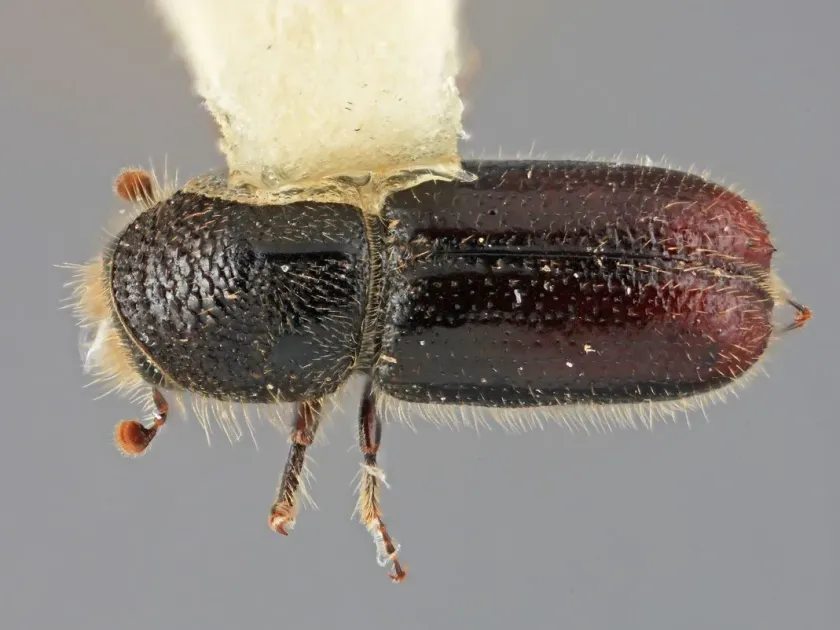
Lippert's bark beetle (scientific name Pityogenes lipperti) is a small wood-boring insect belonging to the Curculionidae family and the Scolytinae subfamily.
These beetles are characterized by their cylindrical bodies and dark brown to black coloration, typically reaching lengths between 2 and 3 millimeters.
The taxonomic identification of this species primarily relies on the specific morphology of the elytral declivity, particularly the arrangement of teeth in males.
The larval stage consists of small, legless white grubs with distinct brown head capsules, which spend their life feeding under the bark of host trees.
Adult beetles are often cryptic and remain hidden under the bark for most of their lifecycle, making them difficult to spot during routine inspections.
What it damages
The primary host species for Pityogenes lipperti are coniferous trees, with a strong preference for members of the Abies (fir) genus.
The insect typically attacks trees that are already suffering from environmental stress, such as drought, root damage, or mechanical wounds to the stem.
The damage is caused by the construction of complex maternal and larval tunnels beneath the bark, which severely disrupt the tree's vascular system.
By girdling the tree through internal tunneling, the beetles effectively block the translocation of nutrients and water between the roots and the canopy.
Heavy infestations can lead to rapid crown dieback and tree mortality within a single growing season if the population density is sufficiently high.
When it appears
The activity period for Lippert's bark beetle typically commences in early spring as soon as ambient temperatures promote beetle emergence and movement.
These insects rely on specific biological temperature thresholds to initiate their reproductive cycle, which usually happens when the bark begins to warm up.
Depending on the climatic conditions of the region, the species may complete several generations within a single long growing season.
Overwintering usually takes place in the adult stage, with the beetles finding refuge in leaf litter or beneath the thick bark of the tree base.
Fluctuations in the spring weather patterns can significantly impact the timing of the initial flight and subsequent establishment of the beetle population.
Signs of infestation
One of the first signs of an infestation is the presence of frass (boring dust) appearing near the entry holes on the bark surface or accumulating at the base.
Small circular exit and entry holes are characteristic evidence of the beetles' activity as they transition between the external environment and the subcortical space.
As the vascular system of the host tree is damaged, the needles begin to fade in color, transitioning from a healthy green to yellow and eventually reddish-brown.
Peeling back a piece of loose bark often reveals a network of galleries that exhibit the species-specific patterns characteristic of Pityogenes beetles.
Trees may also display localized resinosis as a defensive mechanism to repel the beetles' initial attempt to penetrate the outer layer of the bark.
Control measures
Management of Lippert's bark beetle primarily focuses on silvicultural practices, such as the prompt removal of infested, dying, or windthrown trees.
Sanitation cuttings play a vital role in reducing the overall pest pressure by eliminating breeding sites before the next generation of beetles can emerge.
The use of pheromone-based traps is a standard tool for monitoring population trends and identifying the timing of peak flight activity in the forest.
- Promoting forest health through selective thinning to increase tree vigor.
- Encouraging natural predator populations that feed on bark beetle larvae.
- Maintaining strict forest hygiene by promptly clearing and disposing of logging slash.
Chemical control is rarely utilized in large-scale forest settings due to environmental regulations and the inherent difficulty of targeting subcortical insects.
Taxonomy
- Latin name
- Pityogenes lipperti
- Order
- Coleoptera (beetles)
- Family
- Curculionidae
- EPPO code
- PITYLI
Discussion
No discussions yet — be the first.