
Knechtel pine bark beetle
Pityogenes knechteli
Description
How to identify
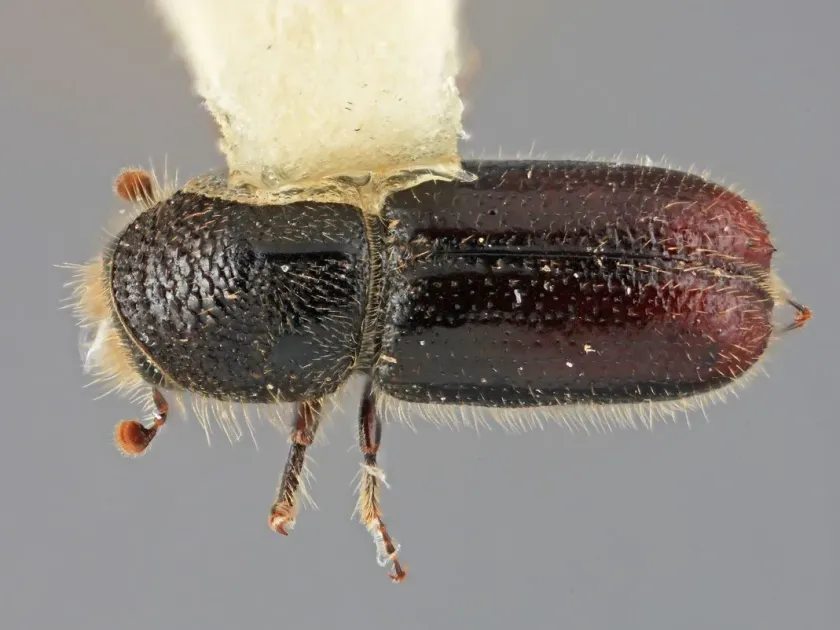
The Knechtel pine bark beetle (Pityogenes knechteli) belongs to the order Coleoptera and the family Curculionidae (subfamily Scolytinae). It is a small insect, typically measuring 2.5 to 3.5 mm in length.
Adult beetles have a cylindrical, dark brown to black body. They are easily identified by the unique structure of the elytra in males, which feature specific teeth used for removing frass from the galleries.
The beetle completes its entire life cycle under the bark of coniferous trees, where larvae develop by consuming the nutrient-rich phloem and cambium layers.
This species is highly adapted to life in a subcortical environment, often targeting stressed or weakened trees that are unable to produce enough resin to expel the invaders.
Its biology is closely synchronized with the phenology of pine trees, making it a critical pest to monitor in both managed forests and natural woodland areas.
What it damages
The primary hosts of this beetle are various species of pine (Pinus). It frequently attacks young plantations and stressed adult trees, causing significant ecological and economic impact.
Damage occurs when larvae and adults girdle the tree by creating a complex network of tunnels beneath the bark, which effectively shuts down the transport of nutrients.
Once infested, a tree often loses its vigor rapidly. If the population of beetles is high, they can cause the mortality of otherwise healthy-looking trees during severe heatwaves.
The economic impact involves the loss of timber value and the need for costly sanitation logging operations to prevent the spread of the beetle to healthy parts of the forest.
Often, the presence of these beetles facilitates the introduction of blue-stain fungi and other pathogens that further accelerate the decline and death of the host tree.
Signs of infestation
The most reliable early sign of infestation is the appearance of boring dust, known as frass, which collects in bark crevices or at the base of the trunk.
Needle discolouration is a secondary symptom; as the conductive tissues are destroyed, the foliage turns from vibrant green to light green, yellow, and finally brown.
Entry holes are visible on the bark surface, appearing as small, circular openings where the adult beetles initially penetrated the protective layer of the tree.
Upon removing the bark, you can observe a central nuptial chamber with distinct maternal tunnels radiating outward, providing clear evidence of an active colonization event.
Increased woodpecker activity on specific trees often serves as a late-stage indicator that a large population of larvae is present underneath the bark.
Control measures
Effective management focuses on sanitation and preventive silvicultural practices. Removing infested trees before the next generation of beetles emerges is the most successful strategy.
Pheromone traps are widely used in forest health management programs to track beetle population dynamics and to catch adult beetles during the flight period.
Maintaining high forest hygiene, such as the rapid removal of logging debris and storm-damaged timber, eliminates the breeding material necessary for population outbreaks.
Chemical control, while possible, is generally restricted to high-value trees or nursery stocks, as it is difficult to achieve adequate coverage beneath the bark.
- Sanitation logging of infested and dead trees.
- Monitoring populations using specialized pheromone lures.
- Promoting forest biodiversity to support natural predators like parasitic wasps.
- Avoiding long-term storage of cut logs near healthy pine stands.
Taxonomy
- Latin name
- Pityogenes knechteli
- Order
- Coleoptera (beetles)
- Family
- Curculionidae
- EPPO code
- PITYKN
Discussion
No discussions yet — be the first.