
Six-toothed spruce bark beetle
Pityogenes chalcographus
Description
How to identify
The six-toothed spruce bark beetle Pityogenes chalcographus is a small insect belonging to the order Coleoptera and the family Curculionidae. Adult beetles typically measure between 1.6 and 2.9 mm in length.
The beetle has a cylindrical, dark brown or black body with a glossy appearance. A key diagnostic feature for males is the presence of a distinct declivity on the elytra, adorned with three pairs of sharp teeth.
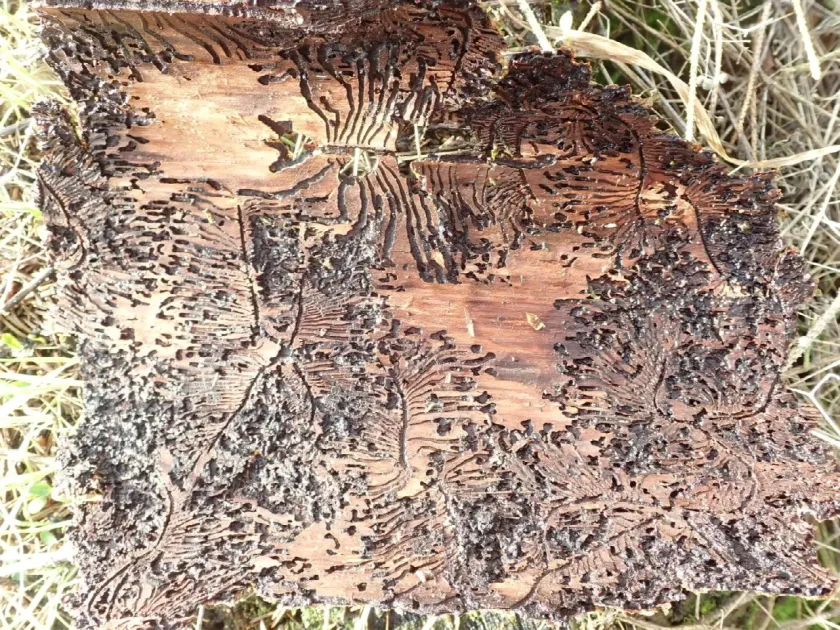
The larvae are white, legless, and possess a well-developed head capsule. They develop exclusively beneath the bark of host trees, feeding on the cambium layer and creating intricate galleries that disrupt nutrient transport.
Pupation occurs within small chambers carved into the sapwood or inner bark. Once the beetle matures, it exits through small, perfectly circular holes on the bark surface, signaling a completed cycle.
When investigating the bark, experts look for the star-shaped gallery pattern, which is characteristic of this species. This unique layout helps in distinguishing it from other bark beetle species that occupy the same host.
What it damages
The primary host for this beetle is the Norway spruce. While it typically attacks weakened or fallen trees, it can aggressively colonize healthy trees during periods of high population density, commonly known as outbreaks.
The beetle prefers younger trees and those with thin bark. This makes saplings and pole-sized stands particularly vulnerable to significant infestation, often leading to widespread mortality in affected areas.
Infestation severely damages the phloem and cambium. As the beetle population grows, the cumulative effect of their gallery construction cuts off the tree's supply of nutrients, leading to rapid yellowing and death.
Economically, the beetle is a major threat to forestry, as it can ruin entire sections of spruce plantations. It often attacks stands weakened by drought, windstorms, or other ecological stressors.
Beyond commercial losses, the beetle disrupts forest succession. The loss of young spruce stands changes the local microclimate and biodiversity, requiring long-term reforestation efforts to restore the ecosystem.
When it appears
The spring swarming phase begins when temperatures rise above 15-18 degrees Celsius. Males are the first to emerge, seeking suitable host trees to initiate the construction of the nuptial chamber.
The lifecycle duration is highly dependent on climate. In warmer regions or during hot, dry summers, the beetle can complete one to two full generations per year, rapidly escalating the threat to forests.
Peak flight activity typically occurs during late spring, specifically in May and June. During this time, the beetles are most mobile and focus on locating weakened trees to establish new breeding galleries.
New generations of beetles emerge towards the end of summer to engage in maturation feeding. This process usually involves boring into the bark of twigs or stems before the beetles eventually seek overwintering sites.
Wintering occurs primarily in the adult stage under the bark of infested trees or within the forest floor litter. Mild winters often lead to higher survival rates and more severe outbreaks in the following year.
Signs of infestation
The most reliable early sign of infestation is the appearance of fine reddish-brown boring dust, or frass. This material accumulates in bark crevices or at the base of the tree as the beetles tunnel inside.
Changes in needle color are a visual indicator of advanced infestation. Needles transition from a healthy green to a dull yellowish-brown, and eventually, the tree experiences heavy needle drop.
If small, circular holes are visible on the outer bark, the beetles have likely completed their cycle and emerged. This often indicates that the tree is already severely compromised or dead.
Woodpeckers are frequent visitors to infested stands. Intense chipping of the bark by these birds is a strong indicator that a significant population of larvae or beetles is present within the tree trunk.
- Accumulation of fine reddish boring dust.
- Discoloration and yellowing of the spruce needles.
- Small, circular exit holes on the bark.
- Evidence of woodpecker activity on the stems.
Control measures
Sanitation felling is the most effective management tool. Removing and debarking infested trees before the new generation of beetles emerges is crucial to containing the spread of the population.
Pheromone traps are extensively used to monitor population dynamics and lure beetles away from healthy stands. This method is effective for detecting early outbreaks and reducing the number of breeding adults.
Maintaining healthy forest hygiene is essential. Prompt removal of wind-thrown trees and logging debris prevents the beetle from finding suitable breeding material, thus inhibiting population booms.
Promoting mixed-species forest stands increases overall resilience against this pest. Diverse ecosystems are less prone to the rapid, widespread devastation typically seen in spruce monocultures.
In high-value areas, targeted application of biological agents may be considered. However, the success of such measures relies on strict timing and monitoring to ensure the impact on non-target species is minimized.
Taxonomy
- Latin name
- Pityogenes chalcographus
- Order
- Coleoptera (beetles)
- Family
- Curculionidae
- EPPO code
- PITYCH
Discussion
No discussions yet — be the first.