
Pine bark beetle
Pityogenes carinulatus
Description
How to identify
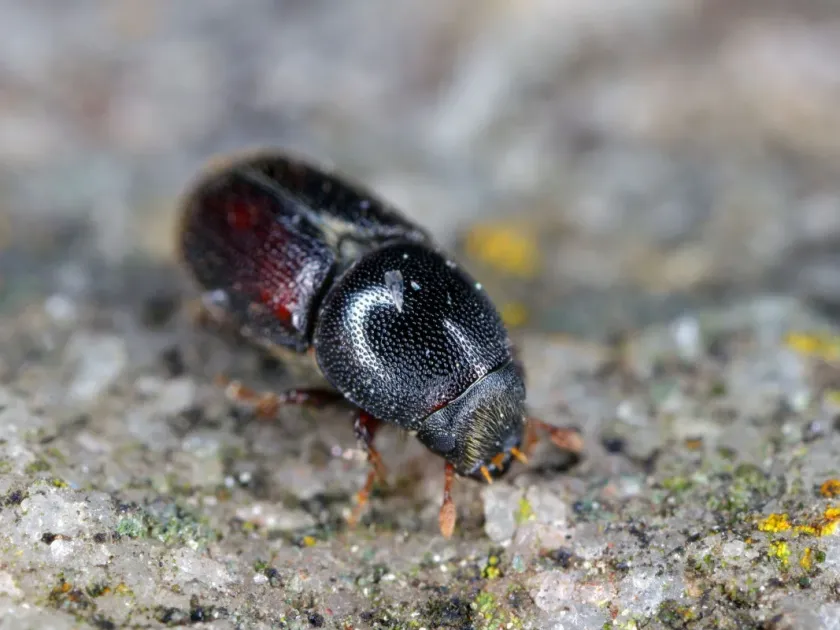
The pine bark beetle (Pityogenes carinulatus) is a small wood-boring insect belonging to the Curculionidae family, specifically the Scolytinae subfamily.
Adult beetles are relatively small, typically ranging from 2.5 to 3.5 mm in length, and possess a robust, cylindrical body that is dark brown or blackish in color.
The males exhibit a unique diagnostic feature consisting of six distinct tooth-like projections on the posterior declivity of their elytra, which serves as a primary method for species identification.
Larvae are legless, ivory-white in color, and have a small, yellowish-brown head capsule; they are typically found developing within the inner bark of host trees.
The species is highly mobile, with adults capable of flying over long distances to locate suitable host material, particularly trees that are already physiologically stressed.
What it damages
These beetles primarily attack species of the genus Pinus, with the Scots pine being a frequent target within their range of distribution.
The beetles target the phloem tissue, where they construct elaborate gallery systems that effectively girdle the tree and interrupt the transport of nutrients and water.
While often categorized as secondary pests, under high population densities, they can successfully attack and kill otherwise healthy, vigorous trees.
The galleries created by the larvae and adults often serve as entry points for blue-stain fungi and other pathogens that further degrade the tree's health.
Extensive damage results in the rapid death of the tree, which can lead to significant economic losses in commercial forests and ecological disruption in protected areas.
When it appears
Adult emergence typically begins in the spring as temperatures rise, usually peaking during late April or May depending on the local geographical latitude.
The species is known for its ability to produce multiple generations in a single year, provided that weather conditions remain favorable throughout the summer months.
Flight activity is continuous during the warmer part of the season, with peak infestation periods occurring during the hottest summer months.
As fall approaches, the beetles prepare for the winter months by seeking shelter under the thick bark of host trees or within the forest litter.
Environmental variables, particularly temperature and humidity, play a critical role in the rate of larval development and the number of generations produced annually.
Signs of infestation
The most reliable sign of an active infestation is the presence of fine, reddish-brown boring dust that accumulates in bark crevices or at the tree base.
Small, circular entrance holes in the bark are visible once the adult beetles successfully colonize and penetrate the tree's outer layer.
Changes in needle coloration, moving from green to yellow and eventually red-brown, indicate that the tree's vascular system has been severely compromised.
Pitch tubes or sap flow may be seen on the outer bark surface as the tree attempts to push out the attacking beetles using resin defense mechanisms.
- reddish-brown sawdust (frass);
- small circular entry holes;
- discoloration of the tree crown;
- characteristic star-shaped gallery patterns under the bark.
Control measures
Integrated pest management, specifically the prompt removal of infested trees (sanitary logging), remains the most effective control strategy.
Effective forest hygiene, including the removal of logging debris and slash, prevents the buildup of beetle populations in the forest environment.
Pheromone-baited traps are widely used to monitor the density of local populations and to divert beetles away from susceptible high-value forest stands.
Maintaining high forest vigor through proper silvicultural practices reduces the susceptibility of stands to successful colonization by bark beetles.
In cases of significant outbreaks, regional authorities may coordinate broad-scale monitoring to prioritize treatment areas and prevent further spread.
Taxonomy
- Latin name
- Pityogenes carinulatus
- Order
- Coleoptera (beetles)
- Family
- Curculionidae
- EPPO code
- PITYCA
Discussion
No discussions yet — be the first.