
Six-toothed bark beetle
Pityogenes bistridentatus
Description
How to identify
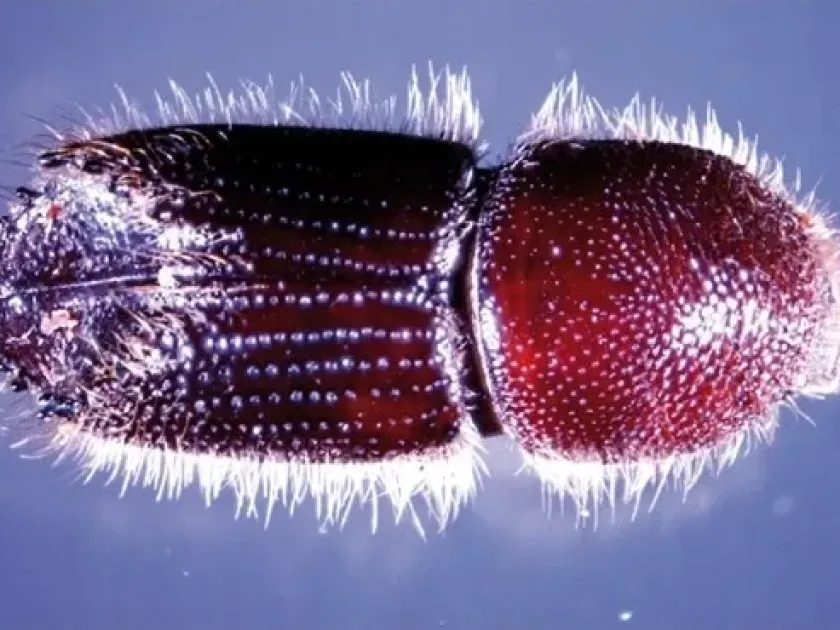
The six-toothed bark beetle (Pityogenes bistridentatus) is a small coleopteran insect belonging to the Curculionidae family. Adult beetles typically measure between 2 and 3 millimeters in length and possess a dark brown, cylindrical body.
The name comes from the characteristic morphology of the males, which have three pairs of teeth on the posterior slope of the elytra. The last pair of teeth is the most prominent and is curved upwards, serving as a key diagnostic feature for identification.
Females lack these distinct teeth and have a smoother elytral declivity. The body is covered with fine, sparse hairs and maintains a shiny appearance, which is typical for many species within this subfamily of bark beetles.
Larvae are legless, white-colored grubs with a yellowish-brown head, exhibiting the typical C-shaped posture. Development occurs entirely within the host tree, beneath the bark, feeding on the nutrient-rich phloem and cambium layers.
Pupation takes place in small chambers within the inner bark or the outer sapwood. This hidden lifestyle makes early detection of an infestation challenging, often leading to significant damage before the presence of the beetle is confirmed.
What it damages
The primary host for the six-toothed bark beetle is the Scots pine (Pinus sylvestris). However, it can also infest other coniferous species such as spruce or larch if they are growing in close proximity to heavily infested stands.
These beetles often prefer younger trees or thin-barked branches of mature trees. While they primarily attack weakened or stressed trees, massive outbreaks allow them to colonize healthier individuals, rapidly depleting their resources.
Feeding activities destroy the tree's vascular system, disrupting the flow of water and nutrients. This interference leads to rapid needle discoloration, wilting, and eventually the death of the affected tree or branch.
The beetle acts as a secondary pest, thriving in forests affected by drought, storm damage, or defoliation. In such cases, the six-toothed bark beetle significantly accelerates the mortality rate of the weakened tree stands.
Additionally, they often carry fungal spores that cause blue stain in the wood, further degrading the quality of the timber and causing severe economic losses in forestry operations and lumber production.
When it appears
Adult beetles emerge in early spring, typically when air temperatures consistently rise above 12–15 degrees Celsius. This synchronization allows them to locate and colonize suitable host trees as the growing season begins.
Following mating, the male constructs a nuptial chamber, from which the females create egg galleries. Depending on the local climate, the beetle can complete one or two generations within a single calendar year.
The entire developmental process, from egg to adult, usually lasts between 4 and 8 weeks. Younger generations of beetles often emerge during the summer months, continuing the cycle of tree colonization.
Winter is spent in the adult stage (imago). The beetles seek refuge in the leaf litter, under the thick bark of the tree base, or within the old galleries of the wood they occupied, remaining in a state of diapause.
Activity diminishes as autumn temperatures drop. Monitoring these seasonal transitions is critical for timing control measures and predicting potential outbreaks for the following spring season.
Signs of infestation
The most visible sign of an infestation is the presence of boring dust, which appears as fine, brown sawdust trapped in bark crevices or accumulated at the base of the tree. This is a byproduct of the beetles excavating their entry holes.
A change in the crown color is a major indicator. The needles will initially lose their luster, then yellow and eventually turn reddish-brown, often starting from the top of the tree or from specific branches.
Removing the bark reveals a characteristic network of galleries. The central mating chamber branches out into several larval galleries, which widen as the larvae grow and consume more of the cambium layer.
Peeling bark is a late-stage symptom, often indicating that the tree has already lost much of its vitality. At this stage, various life stages of the beetle, including larvae and new adults, may be found underneath.
Examining the bark surface for small, circular entry holes is a standard procedure for foresters to identify recently attacked trees that may still harbor active populations of the beetle.
Control measures
Sanitation felling is the most effective management strategy. Infested trees must be removed and destroyed—either by burning or mechanical processing—before the next generation of beetles emerges and spreads to nearby trees.
Proper forest hygiene is essential. Promptly removing logging residues and fresh timber from the forest prevents the creation of breeding sites, which are often used by the beetles to build up their populations.
Pheromone traps are highly effective for both monitoring beetle density and performing mass trapping. These devices use synthetic attractants to lure beetles away from healthy trees and into containment traps.
For high-value ornamental trees in gardens or parks, targeted insecticide applications to the tree trunks during peak flight periods can prevent the beetles from successfully penetrating the bark.
- Regular forest health surveys.
- Sanitary logging of infested trees.
- Implementation of pheromone-based trapping programs.
- Enhancing overall forest resilience to environmental stressors.
Taxonomy
- Latin name
- Pityogenes bistridentatus
- Order
- Coleoptera (beetles)
- Family
- Curculionidae
- EPPO code
- PITYBS
Discussion
No discussions yet — be the first.