
Two-toothed bark beetle
Pityogenes bidentatus
Description
How to identify
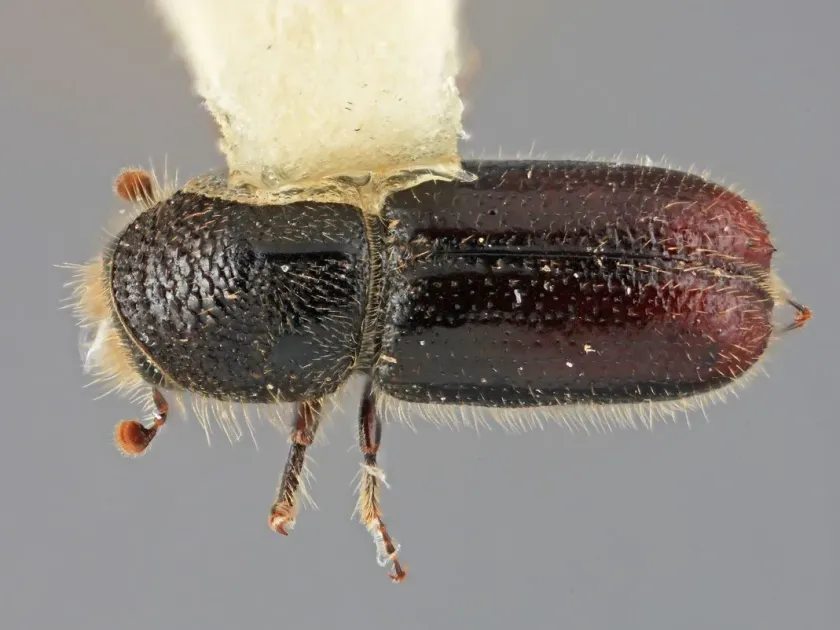
The two-toothed bark beetle (Pityogenes bidentatus) belongs to the Curculionidae family, specifically the Scolytinae subfamily. It is a tiny insect, typically measuring between 1.8 and 2.6 mm in length.
The adult beetle has a cylindrical, brown body covered with sparse, light-colored hairs. A distinct characteristic of the males is the presence of two prominent teeth on each side of the elytral declivity.
Larvae are white, legless, and have a yellow head. They develop beneath the bark, feeding on the inner tissues and creating a network of galleries that eventually girdles the host tree.
Pupae also appear white and are found within the maternal galleries, completing their transformation into adults before boring out of the bark.
The species is widely distributed across Europe and parts of Asia, where it predominantly occupies coniferous forest environments, focusing on young or stressed pine stands.
What it damages
The primary host of the two-toothed bark beetle is the pine tree, though it can also infest spruce or larch if they are in close proximity to a heavily infested stand.
The beetle typically attacks weakened or suppressed trees, focusing on the upper crown or areas with thin bark, making it a serious threat to pine saplings.
Infestations often follow environmental stressors such as prolonged droughts, forest fires, or wind damage, which compromise the tree's natural defense mechanism.
By creating feeding galleries, the beetles destroy the cambium layer, effectively disrupting the nutrient and water flow, which leads to rapid desiccation of the tree.
Severe infestations can lead to the mortality of entire stands of young trees, resulting in significant ecological and economic losses within forestry sectors.
When it appears
The flight period of the adult beetles usually commences in early spring, typically around April or May, when temperatures rise sufficiently to trigger activity.
Depending on the climatic zone and temperature conditions, the beetle can complete one or two generations within a single vegetative season.
Peak activity for colonization usually occurs during the summer months when new adults emerge from their birth galleries to seek new host trees.
As autumn approaches, the beetles prepare for overwintering, seeking shelter within bark crevices, leaf litter, or deep inside the tunnels of their host trees.
Climatic factors such as humidity and mild winter temperatures play a crucial role in the survival rate of the population and the timing of spring emergence.
Signs of infestation
The first sign of an active infestation is the appearance of small, round entry holes on the bark, accompanied by fine reddish-brown sawdust known as frass.
The tree may show symptoms of chlorosis, where the needles begin to fade from green to yellow, and eventually to a dull reddish-brown color as the tree dies.
Under the bark, one can observe the characteristic gallery pattern: a central maternal tunnel with numerous branching larval galleries radiating outward.
Bark shedding or localized peeling is another indicator, often revealing the extensive tunneling work performed by the larvae during the growth cycle.
In many cases, the presence of the beetle is confirmed by the smell of resin and the secondary appearance of fungi that exploit the weakened state of the wood.
Control measures
The most effective strategy involves prompt sanitary logging, which includes the removal of infested trees before the new generation of beetles emerges.
Proper forest hygiene, such as the removal of logging debris and wind-fallen timber, is essential to eliminate breeding sites that sustain population growth.
Pheromone traps are widely used to monitor population levels and help manage the timing of interventions, reducing the risk of wide-scale outbreaks.
Biological control, including the protection of woodpeckers and other insectivorous bird species, helps manage beetle populations naturally in forest ecosystems.
- Regular monitoring of tree health and density.
- Strict adherence to silvicultural practices to maintain stand vigor.
- Controlled disposal of harvested wood to prevent beetle spread.
Taxonomy
- Latin name
- Pityogenes bidentatus
- Order
- Coleoptera (beetles)
- Family
- Curculionidae
- EPPO code
- PITYBD
Discussion
No discussions yet — be the first.