
Pine cone weevil
Pissodes validirostris
Description
How to identify
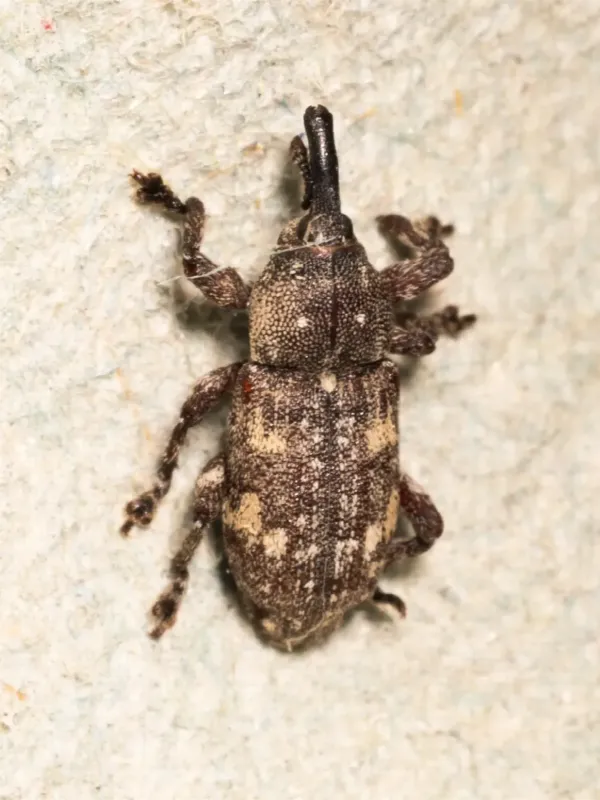
The pine cone weevil (Pissodes validirostris) is a member of the Curculionidae family, commonly known as snout beetles. These insects are significant pests in conifer seed orchards, with adults measuring between 5 and 7 mm in length.
The body is elongated, with a distinct long rostrum. The color ranges from reddish-brown to dark brown, often featuring a pattern of light-colored scales on the elytra that provides effective camouflage against pine bark.
Larvae are legless, white to creamy-yellow, and have a prominent brown head capsule. They spend their entire developmental period hidden inside the pine cones, making them difficult to detect during early infestation stages.
The species is highly specialized, having evolved to thrive specifically on the reproductive organs of pine trees. Its physiological development is tightly synchronized with the flowering and seed maturation process of the host.
This beetle is widespread across European and Asian pine forests, representing a major challenge for professional forest seed production and nursery management.
What it damages
The primary host for the pine cone weevil is the Scots pine (Pinus sylvestris). However, it also attacks other pine species, including the mountain pine and the Austrian pine, depending on geographical availability.
Damage is caused by larvae consuming the seeds and the internal scales of the cones. This results in direct loss of reproductive potential, often ruining the entire yield of affected seed crops.
Infested cones typically show signs of stunted growth, premature yellowing, or browning. They may fail to open properly and often fall off the tree before the normal seed dispersal period.
The tunneling activity of larvae creates paths for moisture, which facilitates secondary fungal infections. This combination of insect feeding and fungal decay leads to total destruction of the cone tissues.
In high-density populations, this weevil can destroy the vast majority of a year's seed crop, causing significant economic losses for commercial forest nursery operations.
When it appears
Adult weevils emerge from hibernation in the litter or tree bark during early spring, coinciding with the flowering phase of pine trees. This is when the females begin seeking out young cones for oviposition.
Females use their rostrum to drill holes into the scales of developing cones and lay their eggs inside. A single female can infest numerous cones, ensuring the widespread distribution of the next generation.
Larval development occurs throughout the summer months. During this time, they tunnel through the central axis and the scales of the cone, significantly damaging the developing seeds.
Pupation takes place within the cone itself, typically in late summer or early autumn. Newly emerged adults may remain inside the cone or exit to seek hibernation sites for the winter.
The lifecycle is generally univoltine, meaning one generation per year, which dictates the timing for effective monitoring and intervention strategies.
Signs of infestation
The presence of resin droplets or hardened resin on the surface of young cones is the primary indicator of an ongoing infestation, as females leave these marks after laying eggs.
- Premature yellowing or browning of cone scales during the growing season.
- Noticeable physical deformation or asymmetric development of the cones.
- Small, clean-cut emergence holes on the surface of matured, dried-out cones.
- The presence of boring dust (frass) visible near the entry or exit points of the larvae.
- Early abscission (dropping) of cones before they reach maturity.
Control measures
Sanitation is the most effective management tool; collecting and destroying infested cones before the new generation of adults emerges can drastically reduce local populations.
Chemical control using systemic insecticides can be applied during the adult feeding phase, but this requires precise timing and adherence to strict environmental safety regulations.
Biological control, utilizing parasitic wasps (hymenopteran parasitoids) that target the larvae inside the cones, offers a sustainable alternative to chemical interventions.
Promoting diverse forest stands and maintaining vigorous, healthy trees helps to lower the risk of severe infestations by reducing the overall attractiveness of the site to the beetles.
Regular monitoring using pheromone or trap logs allows managers to accurately predict the start of the weevil activity, ensuring timely and effective application of protective measures.
Taxonomy
- Latin name
- Pissodes validirostris
- Order
- Coleoptera (beetles)
- Family
- Curculionidae
- EPPO code
- PISOVA
Discussion
No discussions yet — be the first.