
Terminal weevil
Pissodes terminalis
Description
How to identify
The terminal weevil (Pissodes terminalis) is a member of the Curculionidae family, specifically recognized for its impact on young coniferous trees. This beetle is characterized by its elongated snout, which is a hallmark of the weevil group.
Adult beetles typically measure 5–7 mm in length. They are reddish-brown in color, often adorned with distinctive patches of light-colored scales on their elytra, providing excellent camouflage against pine bark.
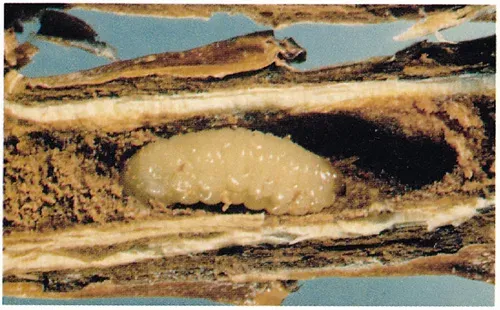
The larvae are legless, white to cream-colored, with a dark, hardened head capsule. They are exclusively internal feeders, spending their developmental stages within the plant tissue of pine shoots.
These insects are highly mobile during the adult stage, capable of flying between host trees to find suitable sites for oviposition, especially in young stands where shoots are tender.
They overwinter as adults, finding shelter in the forest floor litter or under thick bark flakes at the base of the host tree, which ensures their survival throughout harsh winter months.
What it damages
The primary hosts of the terminal weevil are various species of pine. The pest specifically targets the terminal leader (the top shoot), which is crucial for the tree's vertical growth and structural development.
Larval feeding creates tunnels within the vascular tissue of the leader shoot. This disruption stops water and nutrient flow, causing the tip to wilt, yellow, and eventually die.
Once the central leader is killed, the tree loses its apical dominance. Lateral branches begin to grow aggressively to replace the terminal, often resulting in a crooked trunk or "forked" top, which ruins the tree's timber value.
In young plantations, recurrent infestations can significantly reduce annual height growth. Stunted growth makes young trees less competitive in the forest canopy and susceptible to other environmental stressors.
Although rarely killing the entire tree, the cumulative damage over several years can render a stand commercially useless, requiring expensive corrective pruning or replanting efforts.
When it appears
Adult weevils emerge from their overwintering sites in the spring when temperatures consistently reach 10–12 degrees Celsius. This emergence coincides with the flush of new spring growth in pine trees.
Females lay eggs in small punctures made in the bark of the current year's terminal shoots. This egg-laying period is the most active phase for adult dispersal and colonization of new hosts.
Larval development takes place throughout the summer. The larvae continue to mine the shoot tissue, protected from most environmental threats and predators until they complete their pupal stage.
New adults emerge from the shoots in late summer or early autumn. They undergo a period of maturation feeding before eventually migrating downward to overwintering sites near the base of the tree.
After finding suitable overwintering cover, the beetles enter a state of dormancy until the following spring, completing their annual cycle and preparing for the next generation.
Signs of infestation
The most noticeable sign of infestation is the drooping and wilting of the current year’s terminal shoot during the summer, often referred to as "shepherd’s crook" deformation.
Sticky resin droplets appearing on the surface of the terminal shoot indicate the spots where the female weevil has punctured the bark to deposit her eggs.
Inside the wilted shoot, one can find complex, winding larval tunnels filled with frass. These tunnels are a definitive indicator of Pissodes terminalis activity.
Trees that have been infested in previous years often show a characteristic crooked stem or multiple competing tops, which are long-term structural scars of past weevil attacks.
The presence of adult beetles crawling on the lower trunk during the spring is a key indicator for forest managers to initiate monitoring protocols and control measures.
Control measures
Sanitation cutting is the primary control method. This involves removing and burning infested terminal shoots before the new generation of adult beetles emerges to prevent spread.
Pheromone-baited traps are effectively used for population monitoring. They help foresters detect the presence of the weevil early and determine the intensity of the infestation in a given area.
Insecticide applications are sometimes used in high-value plantations, targeting the adult weevils during the spring emergence phase to protect the emerging shoots.
Silvicultural practices, such as maintaining dense stands, can help encourage fast vertical growth, allowing trees to reach a size where terminal weevil impact is minimized.
- Regular monitoring of young pine plantations during the spring.
- Prompt removal and destruction of infested terminal leaders.
- Encouraging natural biological controls, such as parasitoid wasps that attack weevil larvae.
Taxonomy
- Latin name
- Pissodes terminalis
- Order
- Coleoptera (beetles)
- Family
- Curculionidae
- EPPO code
- PISOTE
Discussion
No discussions yet — be the first.