
White pine weevil
Pissodes strobi
Description
How to identify
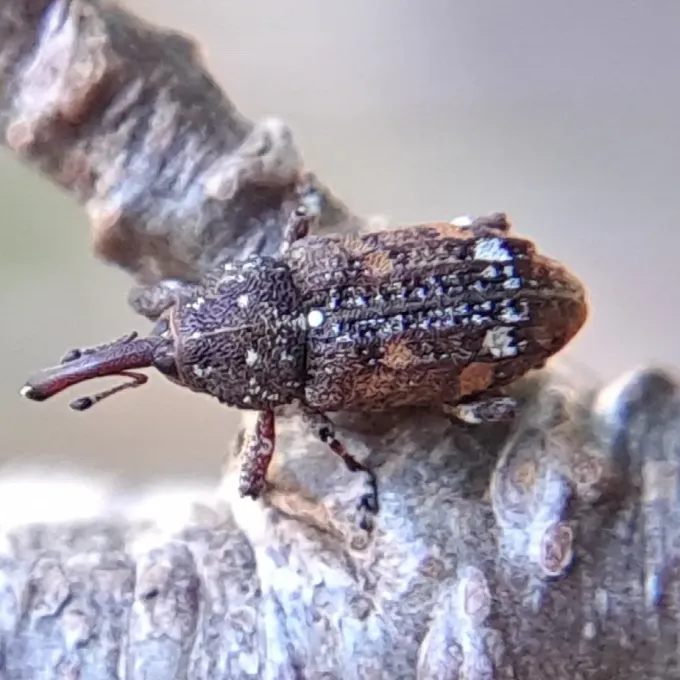
The white pine weevil is a small beetle, typically measuring between 4 and 7 millimeters in length. Its body color ranges from reddish-brown to dark brown, often featuring distinctive white or yellowish patches on the elytra that form faint, irregular transverse bands.
A key morphological characteristic of this species is its elongated snout (rostrum), which is typical for the Curculionidae family. The larvae are legless, cream-colored, and possess a well-defined, dark head capsule, designed for boring through the cambium layers of tree shoots.
Systematically, this beetle belongs to the order Coleoptera and the family Curculionidae. It is a highly specialized pest that targets the apical shoots of young conifer trees, significantly impacting their growth and development.
Adult beetles are most recognizable during their spring flight period, when they move into the canopy to feed and mate. Although they can be difficult to spot, their feeding activities leave behind clear, observable signs on the bark.
Identifying the pest early in its life cycle is crucial for nursery managers and foresters. Understanding their morphology helps in monitoring programs to prevent significant damage in young pine and spruce plantations.
What it damages
The white pine weevil primarily attacks various conifer species, with a strong preference for members of the Pinus and Picea genera. Young trees aged between 5 and 20 years are particularly susceptible to infestation by this insect.
While adult feeding can cause minor damage, the most severe economic losses are caused by larvae. They bore extensive galleries under the bark of the terminal leader shoot, effectively disrupting the nutrient transport system of the young tree.
The inevitable result of this damage is the death of the apical leader, which leads to a loss of apical dominance. Consequently, the tree often develops multiple competing branches, leading to crooks, forks, and permanent stem deformation that degrades wood quality.
Infested trees experience a significant decrease in growth rates and become highly vulnerable to secondary pests and various fungal pathogens. In dense stands, the loss of the leader significantly impacts the overall productivity and health of the plantation.
In cases of severe infestation, entire plantations can lose their commercial viability. The repeated destruction of leaders over several years can leave trees stunted, deformed, and structurally weakened, making them susceptible to environmental stress.
When it appears
The overwintering phase takes place in the forest litter or near the base of host trees. As spring arrives and temperatures rise, adult weevils emerge from their winter dormancy to begin their cycle of feeding and reproduction.
During the spring, the weevils move to the terminal shoots to mate and lay eggs. Females chew small niches into the bark of last year's terminal growth, depositing eggs that will soon hatch into larvae, which immediately begin feeding on the cambium.
The larval stage lasts throughout the summer, as they continue to mine the terminal shoot. By late summer or early autumn, the larvae prepare pupal cells made of wood chips, where they transform into the adult stage.
New adults emerge towards the end of the summer and undergo a period of feeding before moving to protected overwintering sites. This annual cycle ensures that the species remains highly adapted to the seasonal rhythms of coniferous forests.
Monitoring during the early spring and late autumn is critical. Understanding the timing of these life stages allows for the precise application of management interventions to minimize population buildup before the next reproductive cycle.
Signs of infestation
The first external sign of an infestation is the presence of small resin droplets on the bark of the terminal leader, caused by adult feeding. This is the tree's natural response to the damage, attempting to plug the feeding punctures.
A tell-tale symptom of larval development is the wilting and eventual browning of the needles on the terminal shoot. As the larvae consume the tissues under the bark, the leader loses its supply of water and nutrients, causing it to die back.
Careful inspection of the infested leader will reveal winding galleries etched into the wood, often packed with fibrous frass. Removing the bark allows for a clear view of the larvae or their pupal chambers, confirming the presence of the pest.
The "shepherd’s crook" deformation is the most common permanent sign of past infestations. Once the terminal leader dies, lateral branches may take over, causing the stem to grow in a crooked, stunted, or forked manner.
- Resin droplets on terminal shoots
- Wilting and browning of the leader needles
- Visible larval galleries under the bark
- "Shepherd’s crook" stem deformation
- Death of the terminal leader shoot
Control measures
The most effective cultural management strategy involves pruning and destroying infested leaders before the new generation of adults emerges. This simple yet vital action helps to significantly reduce the local population of the weevil.
Biological control methods focus on maintaining a healthy population of natural enemies, including predatory insects, birds, and parasitoid wasps. Enhancing forest biodiversity creates a natural buffer that can suppress weevil outbreaks.
Chemical control is generally reserved for nurseries or high-value landscapes where the impact of the weevil is unacceptable. Insecticides should be applied during the early spring flight period to prevent adult feeding and oviposition.
Silvicultural techniques, such as proper spacing and selecting more resistant species, are fundamental in preventing outbreaks. Maintaining vigorous, fast-growing trees helps them potentially outgrow the window of high susceptibility to the weevil.
Implementing a regular monitoring program using visual inspections or pheromone-based traps is essential. Early detection allows for immediate management, preventing the weevil from spreading and causing widespread damage across the entire plantation.
Taxonomy
- Latin name
- Pissodes strobi
- Order
- Coleoptera (beetles)
- Family
- Curculionidae
- EPPO code
- PISOST
Discussion
No discussions yet — be the first.