
Rough weevil
Pissodes scabricollis
Description
How to identify
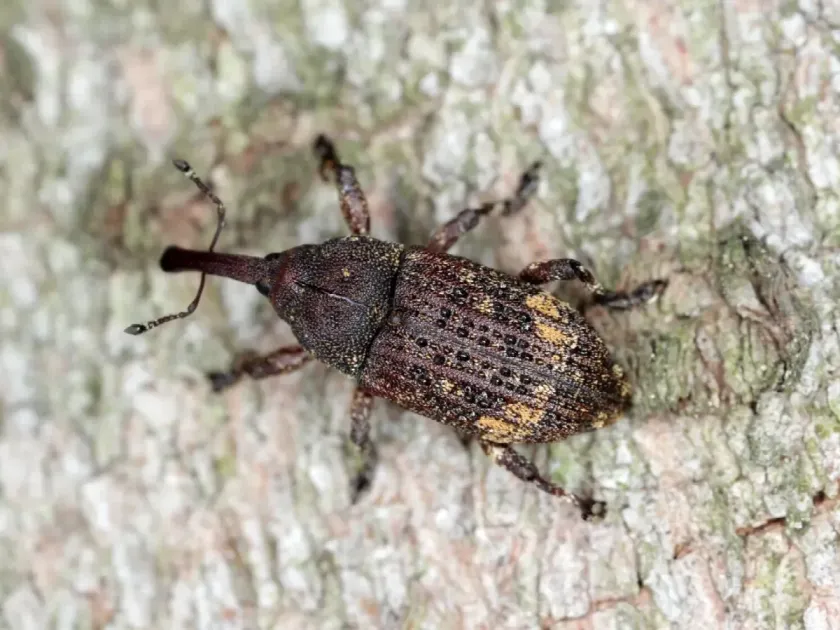
The rough weevil, known scientifically as Pissodes scabricollis, belongs to the order Coleoptera and the family Curculionidae. These beetles are typically 5–8 mm long and possess a dark brown body.
The species is distinguished by its rough, tuberculate pronotum, which gives it a textured appearance. This feature is a key identifier for specialists working in forest pathology.
Like other Pissodes species, it has a curved, prominent rostrum used for boring into the bark and cambium of coniferous host trees for both feeding and oviposition.
The larvae are legless, white, and possess a well-defined, darkened head capsule. They are exclusively wood-boring, living beneath the bark of the host tree throughout their development.
The adults are capable flyers, facilitating their spread across managed forests and natural stands, where they seek out hosts that are already under physiological stress.
What it damages
This weevil primarily targets various species of pine, although it can also impact other conifers in its native range. It is particularly drawn to young, stressed, or recently felled trees.
The main damage is caused by the larvae, which construct galleries in the phloem and cambium layers. This feeding activity disrupts the tree's vascular system, hindering the transport of water and nutrients.
If larval density is high, they can perform girdling, which effectively cuts off the tree's circulation, leading to severe vigor loss or death of the affected specimen.
Adults also contribute to damage through maturation feeding on the tender bark of young shoots, causing localized mechanical injury and potentially opening entry points for pathogens.
- Widespread damage to young pine stands.
- Disruption of the tree's phloem and cambium.
- Increased vulnerability to secondary pests and fungi.
- Potential for total tree mortality in extreme cases.
When it appears
Adult weevils typically emerge in the spring once the ambient temperature consistently exceeds the threshold for activity, often correlating with early growth stages of conifers.
After a period of maturation feeding, the females locate suitable host trees to deposit eggs in the bark crevices of the lower stem and root collar area.
The larval stage occupies the majority of the summer, with the insects continuously expanding their galleries beneath the bark as they grow and develop.
Pupation usually occurs in late summer within specialized chambers, often reinforced with frass, created just beneath the bark surface or within the outer wood.
By autumn, the new generation of adults typically emerges, spending the colder months overwintering in the forest floor litter or protected crevices before the next cycle begins.
Signs of infestation
The presence of small, circular exit holes on the bark of the lower stem is a primary visual indicator that the tree has been successfully colonized by the weevil.
Resin flow, which hardens into distinct droplets or streaks on the trunk, is a common reaction of the tree to the feeding and egg-laying activities of the adults.
Fading, yellowing, or browning foliage is a clear symptom of a compromised vascular system caused by the larval galleries beneath the bark at the base of the tree.
Bark discoloration or localized swelling can sometimes indicate areas where larvae have been particularly active, disrupting the normal growth of the tree's outer tissues.
Peeling away a section of dead or dying bark often reveals the characteristic galleries filled with frass and wood shavings, which is the definitive sign of an infestation.
Control measures
The primary control strategy involves the early identification and removal of infested trees during sanitation thinning to prevent the buildup of the local beetle population.
Maintaining high forest health through proper silvicultural practices, such as density management and ensuring tree vigor, serves as a preventative barrier against attacks.
The use of trap trees, which are intentionally felled to attract weevils before they disperse, is an effective technique to aggregate and then remove the pests.
In high-value areas such as forest nurseries, targeted applications of insecticides may be used if the threat level justifies the intervention according to local guidelines.
Encouraging the presence of natural predators and parasitoids within the ecosystem helps to keep the population of the rough weevil in check through natural mortality.
Taxonomy
- Latin name
- Pissodes scabricollis
- Order
- Coleoptera (beetles)
- Family
- Curculionidae
- EPPO code
- PISOSC
Discussion
No discussions yet — be the first.