
Pissodes punctatus
Pissodes punctatus
Description
How to identify
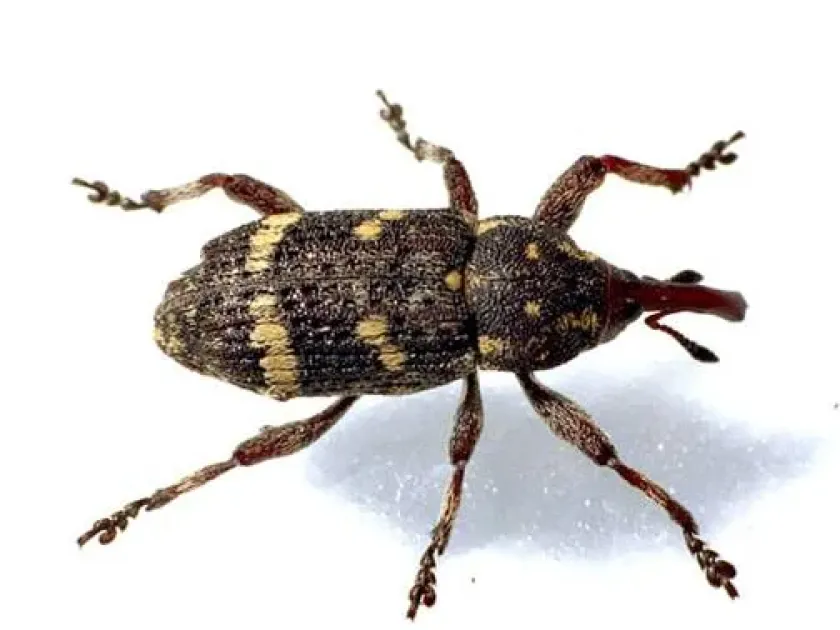
Pissodes punctatus is a species of weevil belonging to the family Curculionidae. These beetles are characterized by their elongated snouts and a distinctive mottled appearance on their elytra, created by scales.
Adult insects typically measure between 6 and 9 millimeters in length. Their bodies are dark brown or black, often blending seamlessly with the rough, flaky bark of their host coniferous trees.
The larvae are legless, white grubs with a well-developed, brownish head capsule. They are specialized to tunnel through the subcortical layers, feeding on the cambium and phloem of the tree.
As with all members of the genus Pissodes, this species undergoes a complete life cycle, consisting of egg, larval, pupal, and adult stages. Each stage is adapted to the specific environment under the bark.
The species is primarily found in spruce and fir forests, preferring older, well-established stands where moisture levels remain consistent throughout the growing season.
What it damages
The primary damage is caused by the larvae, which create extensive galleries in the cambial layer. This tunneling activity effectively disrupts the flow of water and nutrients, causing the tree to weaken progressively.
Adults contribute to the damage by feeding on the buds and young shoots. While this rarely kills a mature tree, it can significantly deform young growth and inhibit the development of saplings.
Severe infestations often lead to the girdling of the main trunk, which is fatal for the tree. Once a tree is weakened by Pissodes punctatus, it becomes highly susceptible to secondary attacks by bark beetles.
In forest plantations, the presence of these weevils can lead to significant economic losses due to tree mortality and reduced timber quality in harvested lumber.
Damage is cumulative; a healthy tree may withstand low numbers of the insect, but environmental stress can quickly shift the balance in favor of the pest population.
When it appears
The life cycle of Pissodes punctatus is generally univoltine, taking one year to complete. In colder climates, development may be delayed, extending the life cycle to two years.
Adults typically emerge in late spring when temperatures are conducive to flight and mating. This period is critical for monitoring as adults migrate to new host trees.
Following mating, females oviposit under the bark of host trees. Eggs hatch shortly after, and the larvae begin their development, which spans most of the summer season.
Pupation occurs in small chambers gnawed by the larvae within the bark or sapwood. The transformation into adults takes place toward the end of summer or early autumn.
Young adults may remain in the pupal chambers for a period of time before emerging to feed and locate suitable overwintering sites in the soil or bark crevices.
Signs of infestation
The most visible indicator of an infestation is the presence of small, round emergence holes on the bark of the trunk, left behind by adults after they complete their development.
Accumulations of frass, or "boring dust," near the base of the tree or caught in bark fissures indicate active larval feeding galleries just beneath the surface.
Crown symptoms include a gradual thinning of the needles, followed by yellowing and eventual browning. This occurs as the tree's vascular system fails due to larval tunneling.
Resin flow, or "bleeding," on the trunk surface at the points where adults have fed or females have laid eggs serves as a diagnostic sign for early detection.
Peeling back a piece of bark in affected areas will reveal the characteristic, winding galleries, often packed with fibrous frass, confirming the presence of the larvae.
Control measures
Sanitary logging, which involves the timely removal and disposal of infested trees, remains the most effective method for controlling the spread of this pest in forest stands.
Pheromone traps are essential for monitoring population levels and timing control efforts effectively. They help foresters identify the peak emergence period of the adults.
In nursery settings, contact insecticides may be applied to protect young seedlings during the peak flight season of the adult beetles, ensuring minimal damage to new growth.
Encouraging natural biological controls, such as parasitic wasps and predatory birds, can assist in keeping the weevil population below the economic threshold in managed forests.
- Implementation of systematic forest sanitation.
- Prompt removal of slash and logging debris.
- Use of trap trees to concentrate populations for removal.
- Regular inspection of high-risk tree stands.
Taxonomy
- Latin name
- Pissodes punctatus
- Order
- Coleoptera (beetles)
- Family
- Curculionidae
- EPPO code
- PISOPU
Discussion
No discussions yet — be the first.