
Pine bark beetle
Pissodes piniphilus
Description
How to identify
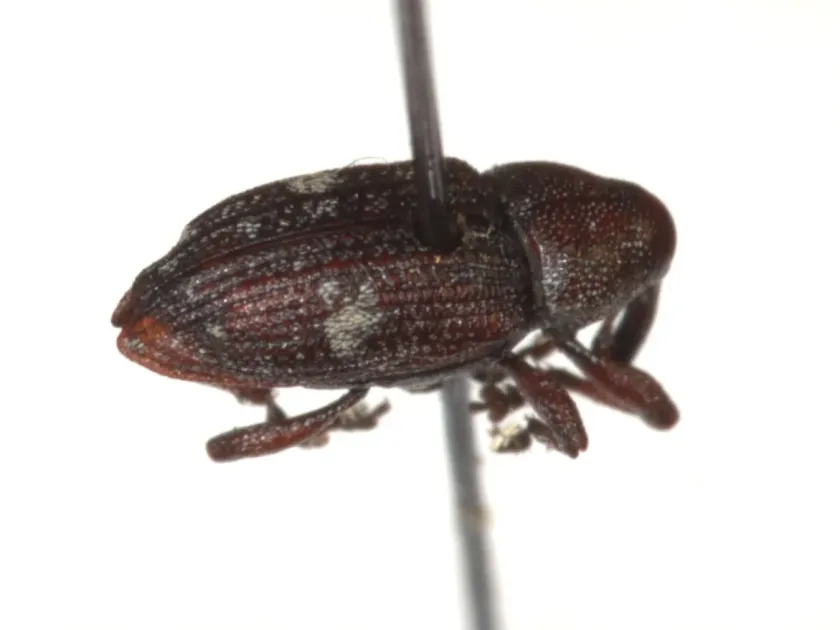
The pine bark beetle, scientifically known as Pissodes piniphilus, belongs to the Curculionidae family. These insects are characterized by their elongated snout and are typically 4–6 mm in length.
Their bodies are covered in scales that provide camouflage on pine bark. The larvae are legless, white grubs with distinct brown head capsules, which is a key morphological feature for identification.
These weevils prefer pine trees, especially those showing signs of physiological stress. They are highly specialized in their habitat selection, often choosing the upper parts of the tree or thin-barked branches.
Adults exhibit a behavior called tonic immobility, where they drop to the ground when threatened. This makes them difficult to spot during visual inspections in forest stands.
The distribution of this species is closely tied to the host tree's health. They thrive in managed forests where trees are densely packed or neglected, creating ideal breeding conditions.
What it damages
Both adults and larvae cause damage to the host tree. Adults feed on the phloem of young shoots, causing localized injury that disrupts the tree's nutrient transport system.
The larvae are the most destructive phase. They bore galleries under the bark, which can girdle the tree or branch, preventing sap flow and leading to death of the affected area.
High levels of infestation often result in the top of the tree dying back. This condition is frequently referred to as "top-kill," which significantly reduces the aesthetic and commercial value of the timber.
Stressed trees provide an entry point for secondary infections, such as fungal pathogens. Once weakened, trees may succumb to a variety of other forest pests, leading to stand degradation.
In young plantations, the beetle can cause significant growth stunting. If left unmanaged, the damage can spread rapidly throughout the stand, creating localized dieback patches.
When it appears
Adult activity begins in late spring, following the rise in temperatures. This is the period when mating occurs and females begin selecting suitable bark surfaces for oviposition.
Larval development occurs primarily during the summer months. As they feed under the bark, they construct complex tunnel systems, preparing for pupation in late summer or autumn.
The insects usually overwinter as larvae or adults beneath the bark. They remain in their protective galleries until spring, when the cycle of emergence begins anew.
Weather patterns, particularly thermal accumulation, dictate the timing of their emergence. In warmer climates, the lifecycle can be faster, sometimes resulting in multiple generations.
Monitoring programs often use pheromone-baited traps to track flight periods. This helps foresters determine the best window for intervention strategies.
Signs of infestation
One of the first signs of infestation is the yellowing and wilting of needles on the top of the tree. This is an indicator that the vascular system at the apex has been severely compromised.
Exit holes, which appear as small, round perforations on the bark, are a classic sign of adult beetle emergence. Resin flow, or "pitching," often occurs at the site of feeding or egg-laying.
Peeling back the bark in infested areas reveals the signature larval galleries etched into the wood. The presence of frass, or wood dust, at the base of the tree is another strong indicator.
Trees may also appear generally stunted or have thin foliage compared to healthy neighbors. Early identification is crucial to preventing a larger outbreak in the forest.
- Yellowing of terminal shoots;
- Resin bleeding on the bark surface;
- Presence of circular exit holes;
- Larval galleries visible under the bark;
- Wood dust (frass) near the tree base.
Control measures
The primary control measure is sanitation. Removing infested trees before the beetles emerge is essential to breaking the lifecycle and protecting the surrounding forest stand.
Silvicultural management plays a key role. Maintaining optimal tree spacing and ensuring trees are healthy minimizes the vulnerability of the stand to beetle attacks.
Insecticides may be used in nursery settings or high-value forest stands to protect young trees. Timing the application to coincide with adult flight is critical for maximum efficacy.
Encouraging natural predators, such as woodpeckers and parasitic wasps, can provide a level of biological control. Maintaining a healthy ecosystem is vital for long-term forest resilience.
Frequent forest health surveys allow for the early detection of localized outbreaks. Quick action is the best defense against Pissodes piniphilus, preventing costly large-scale management efforts.
Taxonomy
- Latin name
- Pissodes piniphilus
- Order
- Coleoptera (beetles)
- Family
- Curculionidae
- EPPO code
- PISOPP
Discussion
No discussions yet — be the first.