
Pine weevil
Pissodes pini
Description
How to identify
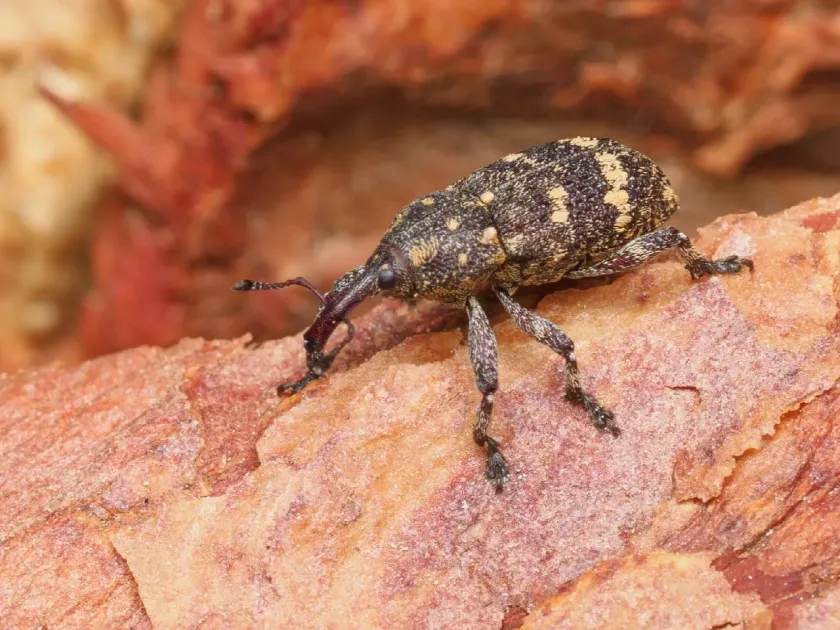
The pine weevil (Pissodes pini) is a beetle belonging to the Curculionidae family within the Coleoptera order. Adult beetles typically measure between 6 and 9 mm in length.
The body is elongated and ranges in color from dark brown to reddish-brown, characterized by two pairs of distinct light-colored spots on the elytra.
The snout, or rostrum, is moderately curved, which is a hallmark feature of the genus Pissodes. Larvae are white, legless grubs with a well-developed yellowish head.
The life cycle involves overwintering as both adults in the forest litter and larvae within the bark of host trees, ensuring population survival across varying seasons.
These insects are highly adaptable, capable of completing their life cycle within one or two years depending on temperature conditions and host tree health.
What it damages
The primary host for this pest is the Scots pine (Pinus sylvestris), although it is known to attack other coniferous species when primary hosts are unavailable or weakened.
Young forest plantations established on recent clear-felled areas are at the highest risk, as fresh stumps and logging debris provide optimal breeding grounds.
Adult beetles cause damage by feeding on the bark of young shoots and stems, which disrupts the tree's vascular system and reduces its overall vigor.
Larval feeding beneath the bark in the cambium layer effectively girdles the tree, preventing the transport of nutrients and often leading to the death of the host.
Infestations often result in significant economic losses due to stunted growth, stem deformations, and widespread mortality in young coniferous stands.
When it appears
The emergence of overwintering adults typically occurs in early spring, once temperatures rise above 10-12 degrees Celsius, coinciding with the onset of sap flow.
Peak activity for mating and feeding occurs throughout April and May, as adults actively colonize young trees and oviposit in the bark.
The summer generation continues development, with larvae boring through the inner bark to create feeding galleries, eventually pupating in specialized chambers.
By autumn, the new generation of adults emerges to feed on bark before seeking overwintering sites in the soil or protected crevices of the forest floor.
Foresters utilize this seasonal knowledge to schedule regular monitoring and implement control measures before the population density reaches economic thresholds.
Signs of infestation
The presence of pine weevils is indicated by small, crater-like feeding punctures on the bark of stems and young shoots, often accompanied by resin droplets.
Yellowing and subsequent wilting of the needles, particularly on the leading shoots, are classic symptoms of larval-induced damage beneath the bark.
Inspection of the inner bark of dying or dead trees reveals characteristic winding galleries filled with frass, confirming an active infestation.
Physical presence of the adult beetles during nighttime inspections or on the bark surface during warm spring days is a definitive sign of an established population.
- Resin bleeding on stems.
- Wilting of top growth.
- Larval galleries in the cambium.
- Adult beetles on host trees.
Control measures
Sanitation felling and the prompt removal of logging debris and fresh stumps are the most critical cultural practices to minimize breeding habitats.
The use of trap logs, placed strategically in infested areas, helps to attract and concentrate adult weevils, allowing for their subsequent destruction.
In nursery environments or high-value plantations, insecticide applications targeting the stem surfaces can protect young trees during the peak adult migration period.
Promoting biodiversity by creating mixed-species stands can reduce the susceptibility of forest plantations to mass outbreaks of specific coniferous pests.
Ongoing monitoring and the use of pheromone-based detection tools enable forestry managers to make evidence-based decisions regarding pest control operations.
Taxonomy
- Latin name
- Pissodes pini
- Order
- Coleoptera (beetles)
- Family
- Curculionidae
- EPPO code
- PISOPN
Discussion
No discussions yet — be the first.