
Fir weevil
Pissodes piceae
Description
How to identify
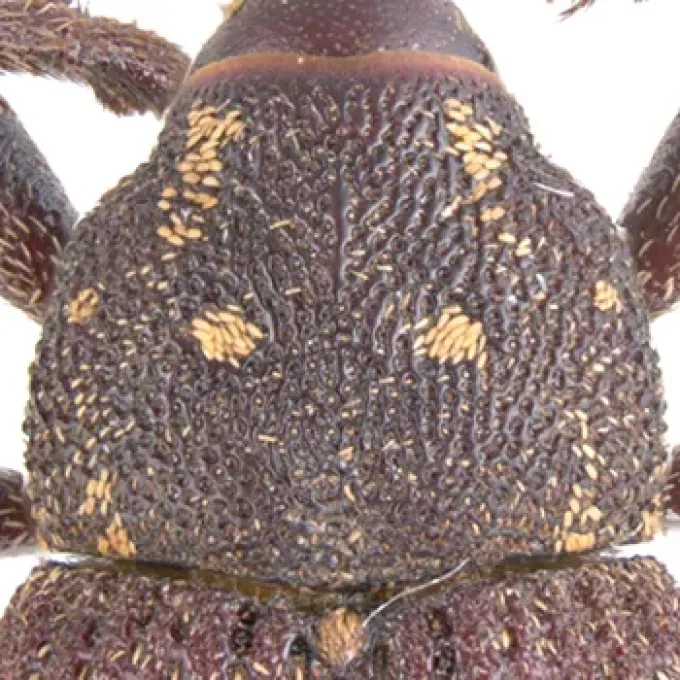
The fir weevil (Pissodes piceae) belongs to the Curculionidae family and is a significant pest of coniferous trees. Adults are small, typically measuring between 5 to 8 millimeters, and possess the distinctive snout characteristic of the weevil family.
The insect's body is generally brown, often featuring pale spots or markings on the elytra (wing covers) created by small scales. The larvae are cream-colored, legless grubs with a brown, hardened head capsule.
The life cycle involves complete metamorphosis, including egg, larva, pupa, and adult stages. Depending on environmental conditions, the development from egg to adult may take one or two years.
They are primarily associated with the genus Abies (fir), though they can opportunistically infest other conifers. They favor trees that are already stressed by environmental factors or pathogens.
Understanding their morphology and taxonomic position is crucial for foresters to differentiate them from other bark-boring insects, which is necessary for choosing the correct management strategy.
What it damages
Fir weevils primarily damage the cambium and phloem of trees. The larvae tunnel beneath the bark, disrupting the flow of nutrients and water from the roots to the crown.
Extensive tunneling can girdle a tree, leading to the rapid decline and death of branches or the entire individual. This makes them a major concern in both managed forests and decorative plantations.
In young trees, even moderate infestation can cause permanent deformation or stunted growth, reducing the tree's market value and structural integrity.
Adult feeding on the tender bark of young twigs can provide entry points for secondary pathogens, such as fungi and bacteria, which further degrade the health of the host.
Mass infestations often occur in areas with many weakened or fallen trees, creating a reservoir for the pest that threatens nearby healthy stands if not managed properly.
When it appears
The adult flight and mating period typically begins in the spring, usually from April to May, when temperatures become consistently warm. During this time, they migrate to find suitable host trees.
Oviposition (egg-laying) occurs over an extended period. As a result, larvae of various developmental stages are often found simultaneously under the bark during the summer months.
Winter survival occurs at different stages, including larvae, pupae, and young adults. They typically overwinter under the bark or in the duff layer at the base of the tree.
The speed of development is highly dependent on ambient temperatures. Warm spring and summer conditions significantly accelerate the life cycle, leading to potential population explosions.
Monitoring the emergence of adults is the most critical aspect of seasonal management, as this is when they are most susceptible to chemical control or trapping methods.
Signs of infestation
The presence of Pissodes piceae is often indicated by tiny exit holes in the bark, each about 2-3 mm in diameter. Frass (boring dust) can often be seen accumulating in bark fissures.
When the bark is carefully removed, the galleries created by the larvae are clearly visible, often packed with fibrous frass. Pupa chambers, shallowly pressed into the sapwood, are diagnostic.
Crown symptoms include yellowing or browning of needles, premature needle drop, and a general thinning of the canopy as the tree fails to maintain its foliage.
Resin flow (bleeding) on the trunk surface is a common reaction of the tree to larval boring, although it is rarely successful in stopping a heavy infestation.
Increased woodpecker activity on the stems is a strong indicator of an active infestation, as these birds hunt for the larvae developing beneath the bark.
Control measures
The most effective management approach is sanitation, which involves the prompt removal and destruction of infested trees to prevent the emergence and spread of the next generation.
Trap trees can be used to attract adult weevils during their flight period. Once colonized, these trees are removed and debarked to destroy the developing larvae.
In nurseries, systemic or contact insecticides may be applied during the spring flight period to prevent adult feeding and oviposition on vulnerable saplings.
Encouraging natural enemies, such as parasitic wasps and predatory beetles, is a sustainable long-term strategy for keeping weevil populations below the economic threshold.
- Regular monitoring of tree health to detect early infestations.
- Removal of dead or heavily stressed trees from the stand.
- Use of pheromone traps for population density monitoring.
- Maintenance of tree vigor through proper silvicultural practices.
Taxonomy
- Latin name
- Pissodes piceae
- Order
- Coleoptera (beetles)
- Family
- Curculionidae
- EPPO code
- PISOPC
Discussion
No discussions yet — be the first.