
Dark weevil
Pissodes obscurus
Description
How to identify
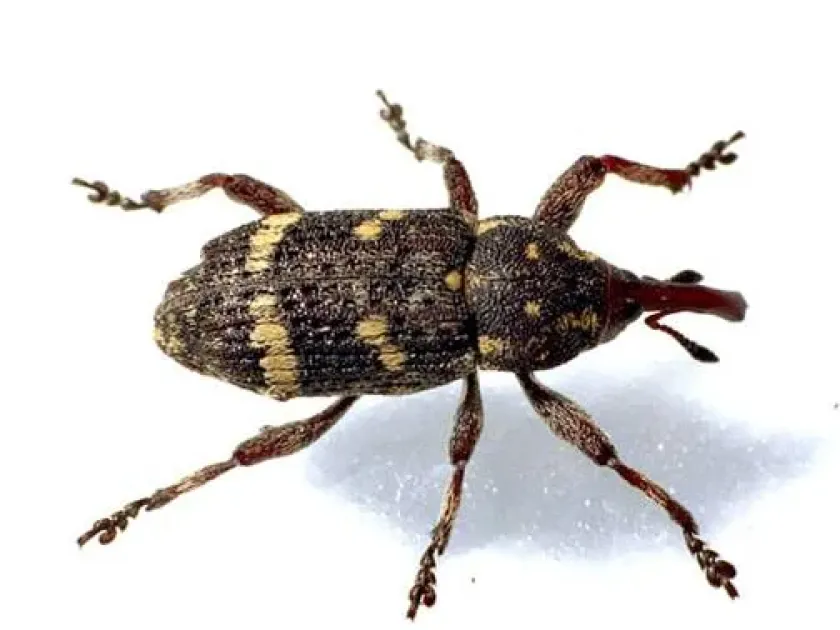
The dark weevil (Pissodes obscurus) belongs to the Curculionidae family of beetles, known for their elongated snouts and significant impact on forest health.
Adult beetles are relatively small, typically measuring between 6 to 8 mm in length, with a dark brown or blackish coloration that blends with tree bark.
The larvae are legless, white, and possess a distinct brown head capsule, specialized for boring into the cambium layer of coniferous hosts.
Pupation occurs within a specially constructed chamber in the wood, often covered by a protective cap of fibrous shavings and wood dust.
The morphological characteristics of the species allow for efficient movement under the bark, where they complete most of their developmental stages.
What it damages
This pest primarily infests coniferous species, with a particular affinity for pines (Pinus) and spruces (Picea) that are already under physiological stress.
The larvae feed on the inner bark and cambium, creating galleries that disrupt the flow of nutrients and water within the tree trunk.
As the larval galleries expand, they girdle the stem, which can lead to the rapid decline or death of the infested tree.
In addition to direct damage, the weevil creates entry points for various pathogenic fungi, which exacerbate the overall degradation of the tree.
Repeated infestation in forest stands can lead to localized dieback, significantly impacting timber quality and overall forest productivity.
When it appears
The emergence of adult weevils typically occurs in the spring when temperatures consistently favor insect flight and host-seeking behavior.
During the late spring and summer months, females deposit eggs into small punctures made in the bark of susceptible or weakened trees.
Larval development proceeds through the summer, with the duration of the cycle heavily influenced by local temperature and bark moisture levels.
By early autumn, the larvae reach maturity and construct their pupal cells, where they remain until the next developmental stage or winter season.
Overwintering usually occurs in the adult stage, with beetles finding shelter in leaf litter or protected crevices on the bark of host trees.
Signs of infestation
Detection is largely based on visual inspection of the bark, where small, circular emergence holes indicate that adults have recently vacated the tree.
The presence of fine wood dust, known as frass, on the bark surface or at the base of the trunk is a hallmark of active larval boring.
Resin flow or "pitching" on the trunk is often observed as the tree attempts to defend itself against the boring activity of the larvae.
A change in foliage color, typically yellowing or browning, indicates that the tree's transport system is being compromised by larval feeding.
- Circular emergence holes in the bark.
- Accumulation of frass beneath infested trees.
- Wilting of terminal shoots or branches.
Control measures
Management of the dark weevil relies heavily on preventive silvicultural practices, primarily the prompt removal of infested or weakened trees.
Sanitation cuttings should be conducted before the emergence of the new generation of beetles to minimize the spread within the forest.
Maintaining high stand vigor through thinning and proper tree spacing reduces the likelihood of successful weevil colonization.
Where high-value trees are at risk, systemic insecticides can be applied as a preventive measure against adult feeding and egg-laying.
Monitoring using pheromone-based traps is recommended in high-risk areas to detect population spikes and allow for timely intervention.
Taxonomy
- Latin name
- Pissodes obscurus
- Order
- Coleoptera (beetles)
- Family
- Curculionidae
- EPPO code
- PISOOB
Discussion
No discussions yet — be the first.