
Deodar weevil
Pissodes nemorensis
Description
How to identify
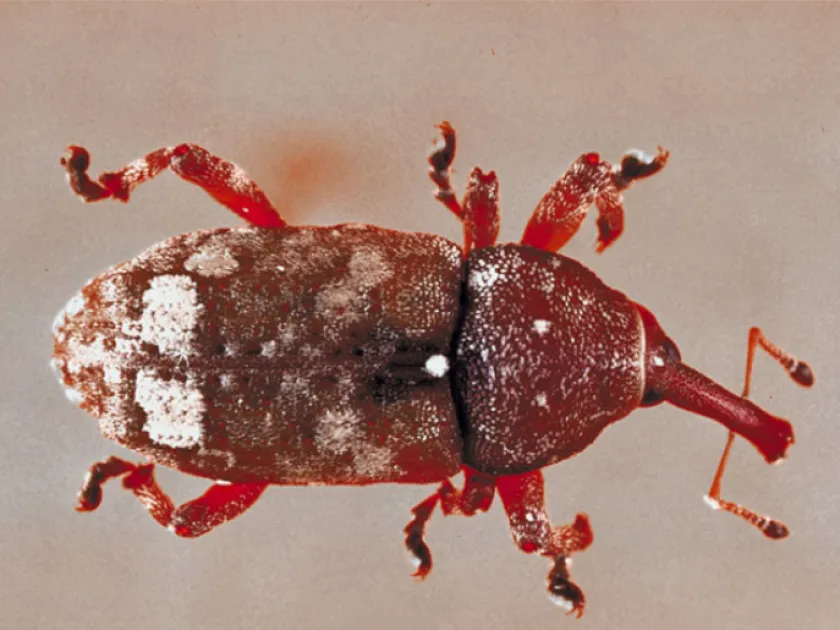
The Deodar weevil (Pissodes nemorensis) is a species of snout beetle in the Curculionidae family, order Coleoptera. Adult weevils are typically characterized by an elongated rostrum and a body length ranging from 6 to 9 millimeters.
Their coloration is generally reddish-brown to dark brown, often accompanied by lighter scales on the elytra that form vague patterns. This appearance provides excellent camouflage against the bark of host conifer trees.
The larvae are white to yellowish, legless grubs with a heavily sclerotized, dark-colored head capsule. They spend their entire developmental period in the subcortical layers of the tree, feeding on the inner bark.
Pupation occurs in specialized chambers created by the larvae beneath the bark, often filled with coarse wood shavings. These so-called "chip cocoons" are a distinct physical characteristic of their lifecycle.
Taxonomically, they are identified by their specific morphological traits and their preference for specific host species compared to other members of the Pissodes genus commonly found in similar ecological niches.
What it damages
The primary host trees for Pissodes nemorensis are various pine species, including the Scots pine and yellow pine. Under conditions of high population density, they may also attack spruce and other coniferous species.
The weevil shows a strong preference for physiologically stressed trees, such as those suffering from drought, soil compaction, or recent fire damage. Healthy stands are generally less attractive but can be compromised if the beetle population is high.
Larval feeding causes the most severe damage by constructing galleries in the phloem and cambium layers. This disruption of the vascular system prevents nutrient transport, eventually causing branch dieback or total tree mortality.
Adult weevils feed on the bark and foliage, leading to mechanical damage and resin flow. This resinosis serves as a stress point, often inviting secondary infestations by wood-boring insects and pathogenic fungi.
The economic impact involves significant loss of wood quality and growth reduction, often necessitating preemptive sanitation logging to prevent further spread of the pest across large forest areas.
When it appears
The lifecycle of the Deodar weevil is highly dependent on temperature, with activity typically commencing in early spring. Adults emerge from overwintering sites in the soil or bark crevices as soon as temperatures rise.
Mating occurs shortly after emergence, followed by oviposition. Females use their snouts to drill small holes in the bark of suitable host trees, where they deposit their eggs in small groups.
Larval development proceeds through the spring and summer months. The duration of this stage is determined by ambient heat and the nutritional quality of the host tree, with faster development occurring in warmer climates.
Pupation usually peaks in late summer or early autumn. Emerging adults may undergo a period of supplemental feeding before entering winter diapause to survive the colder months in protected environments.
In regions with mild winters, the species may complete more than one generation per year, significantly increasing the potential for rapid population buildup and severe damage to local coniferous stands.
Signs of infestation
Visible resin flow on the trunk is the most common early sign of infestation. These hardened sap deposits appear as amber-colored droplets, indicating successful entry or feeding by the weevil.
Needle yellowing or browning, particularly on the lower portions of the crown, indicates a disruption in the vascular system. As the infestation progresses, needles may drop prematurely, leading to crown thinning.
Small exit holes on the bark surface signify the emergence of the new generation of adults. While often discrete, multiple holes on a single section of the trunk are a strong indicator of successful colonization.
Under the bark, galleries filled with wood-boring dust (frass) provide clear evidence of larval presence. Removal of a bark sample will reveal these winding paths or the aforementioned chip cocoons.
Increased presence of wood-pecking birds, such as woodpeckers, on pine trunks can also act as an indirect sign of an active infestation, as they feed on the larvae located beneath the bark.
Control measures
Good silvicultural practices are the cornerstone of Deodar weevil management. Ensuring tree vigor through proper spacing and moisture management makes stands less susceptible to attack.
Sanitation logging is essential; removing and destroying infested trees before the adult beetles emerge is the most effective way to keep local population levels in check.
- Deployment of pheromone-based traps to monitor populations.
- Removal of harvesting residues to eliminate potential breeding sites.
- Application of systemic insecticides in nursery settings for high-value seedlings.
- Conservation of natural predators, including parasitic wasps and predatory beetles.
Chemical control can be implemented by spraying the trunks of at-risk trees during the peak flight period. This creates a protective barrier that prevents females from depositing eggs in the bark.
Biological control through the introduction of entomopathogenic fungi is a promising, eco-friendly approach. These pathogens can specifically target larval populations, reducing their numbers without causing damage to the wider environment.
Taxonomy
- Latin name
- Pissodes nemorensis
- Order
- Coleoptera (beetles)
- Family
- Curculionidae
- EPPO code
- PISONE
Discussion
No discussions yet — be the first.