
Banded pine weevil
Pissodes fasciatus
Description
How to identify
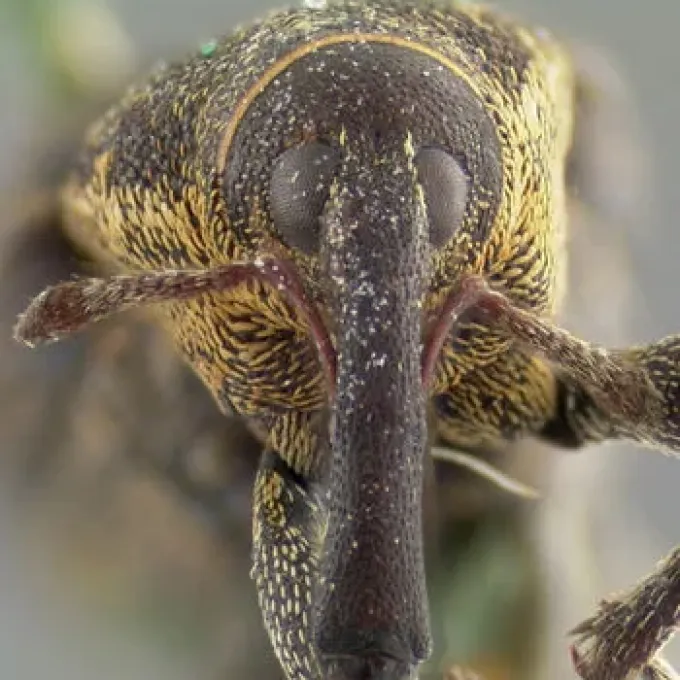
The banded pine weevil, scientifically known as Pissodes fasciatus, belongs to the Curculionidae family. These beetles are relatively small, typically measuring 6–8 mm in length, and are easily recognized by their elongated body and characteristic light-colored transverse bands across their elytra.
Like other weevils, they possess a distinct, downward-curving rostrum (snout). This specialized structure is essential for their feeding habits and for boring small holes into the bark of host trees to deposit their eggs securely.
The larval stage consists of legless, creamy-white grubs with dark head capsules. Because they develop entirely beneath the bark of host trees, they remain hidden from view, which is a major challenge for early detection in forestry management.
During the pupal stage, the insects create oval-shaped chambers known as pupal cells within the sapwood or just under the bark. These cells are often densely packed with wood shavings, creating a unique signature for this species.
These insects are primarily associated with stressed or weakened conifer trees. Their presence often serves as a biological indicator of poor stand health or adverse environmental conditions within a forest ecosystem.
What it damages
The primary hosts of the banded pine weevil include various species of pine, spruce, and fir. While they often target stressed or recently fallen trees, they can become a primary threat if environmental stress weakens a healthy stand.
Adult beetles feed on the inner bark and twigs of host trees, creating numerous small feeding punctures. These punctures disrupt the tree's health and can serve as entry points for secondary fungal infections.
The most significant damage is caused by the larvae, which construct extensive, winding galleries underneath the bark. This activity effectively girdles the tree, cutting off nutrient transport and eventually leading to the death of the infested section or the entire tree.
Infestation negatively affects the quality of the timber, making it unsuitable for commercial use. The wood galleries and associated discoloration significantly decrease the economic value of the forest resources.
High infestation rates can lead to widespread tree mortality within a stand, requiring intensive forest management intervention and salvage operations to prevent the spread to healthy neighboring trees.
When it appears
Adult emergence typically occurs in early spring as temperatures rise, signaling the start of the mating and dispersal season. During this time, they actively search for suitable host material for colonization.
The peak period for egg-laying is generally during late spring and early summer. Females are highly selective, choosing trees that show signs of stress, such as those damaged by storms or drought.
Larval development proceeds throughout the summer months. The duration of this stage is highly dependent on ambient temperature and the moisture levels within the bark, which regulate the insect's metabolism.
As autumn approaches, activity levels decline as the insects prepare for hibernation. Adults often move to the lower trunk or the leaf litter at the base of the tree to survive the winter temperatures.
Depending on the geographic region and climate, the banded pine weevil may have one or two generations per year. Monitoring these phenological stages is critical for the success of any pest control program.
Signs of infestation
The initial signs of an infestation include small, needle-like punctures on the bark surface. In many cases, these punctures are accompanied by minor resin flow as the tree attempts to defend itself against the invaders.
Crown symptoms, such as the yellowing or browning of needles, are clear indicators that the vascular system is being compromised by larval galleries underneath the bark, which restrict water and nutrient uptake.
Peeling back the bark reveals intricate galleries filled with coarse boring dust. This pattern of tunnels is a definitive diagnostic feature used by foresters to confirm the presence of this specific weevil.
The presence of pupal chambers in the wood, often surrounded by a mix of wood shavings and debris, confirms that the insect has completed its developmental cycle at that specific location.
A noticeable increase in the number of adult beetles or their remains in the forest floor near the base of the trees often indicates a growing population and an ongoing infestation cycle.
Control measures
Sanitary logging remains the most effective control method. Removing and disposing of infested trees before the next generation of adults emerges is crucial for limiting the spread of the population.
Implementing proper forest hygiene is essential, which includes the rapid processing or removal of logging slash and debris to prevent them from becoming breeding grounds for the weevil.
Pheromone traps are a valuable tool for monitoring beetle activity and suppressing adult populations. By placing these traps strategically, managers can effectively track population surges and time interventions.
In high-value areas like tree nurseries or ornamental gardens, systemic insecticides may be used as a preventative measure. However, their use in commercial forests is often limited due to environmental considerations and the hidden nature of the larvae.
Promoting a healthy and diverse forest ecosystem is the long-term solution. Maintaining adequate tree vigor through proper silvicultural practices minimizes the risk of successful colonization by the banded pine weevil.
Taxonomy
- Latin name
- Pissodes fasciatus
- Order
- Coleoptera (beetles)
- Family
- Curculionidae
- EPPO code
- PISOFA
Discussion
No discussions yet — be the first.