
Larch weevil
Pissodes cembrae
Description
How to identify
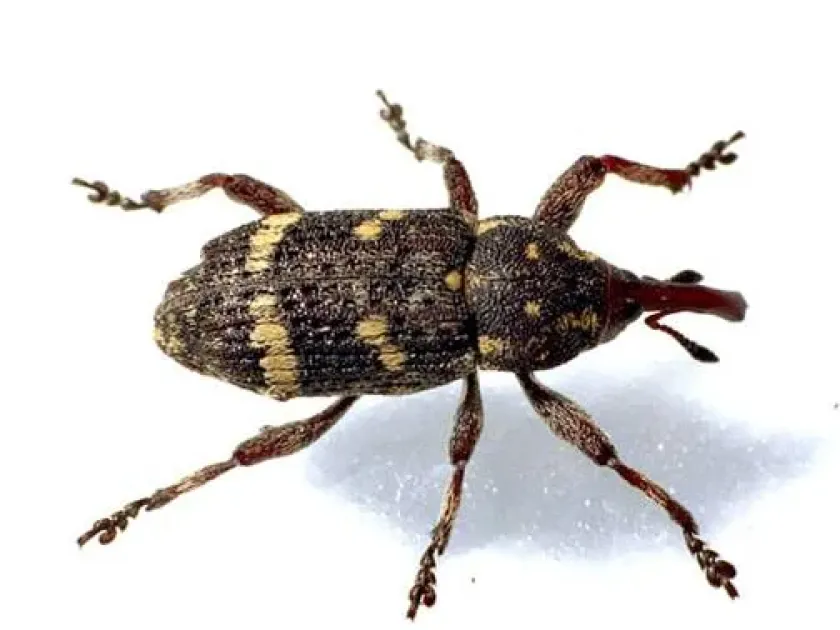
The larch weevil (Pissodes cembrae) is a member of the Curculionidae family, commonly known as a snout beetle. Adult beetles have an elongated body, typically measuring between 6 and 8 mm, with a reddish-brown coloration and light-colored spots on the elytra.
The characteristic rostrum (snout) is well-developed, allowing the beetle to bore into the bark of coniferous trees to feed and deposit eggs. The antennae are elbowed and club-like, which is typical for the Pissodes genus.
Larvae are legless, cream-colored, and slightly curved with a darker head capsule. They develop beneath the bark, where they feed on the cambium and phloem layers of the tree.
This species is specifically associated with the Larix genus, although it may occasionally infest other conifers such as Pinus or Cedrus in shared stands.
The life cycle is generally completed in one year, but environmental conditions can lead to variations in the duration of development stages.
What it damages
The primary hosts for Pissodes cembrae are larch species, particularly European and Siberian larch, which suffer most from larval feeding activity.
Weakened trees, those suffering from drought, mechanical damage, or previous infestations, are the most frequent targets for the weevil's colonization.
At high population densities, the larvae can girdle the trunk by consuming the cambium layer, which disrupts nutrient flow and leads to the eventual death of the tree.
In forest nurseries, the presence of the larch weevil is particularly devastating, as it can cause significant loss of young seedlings and stunted growth in saplings.
Damage to the bark also exposes the tree to secondary infections by pathogens and other wood-boring insects, further accelerating the tree's decline.
When it appears
Adult weevils emerge from their overwintering sites in the soil or under the bark during early spring, once temperatures become consistently warm.
They engage in supplemental feeding on fresh young shoots, causing small, distinct bite marks on the bark, which is the first phase of their spring activity.
Egg-laying typically takes place in early summer, with females selecting suitable areas on the trunk or branches to insert their eggs.
Larvae actively feed throughout the summer months, creating complex galleries under the bark as they grow and mature towards the pupal stage.
Pupation occurs in late summer or autumn within specialized chambers under the bark, where the emerging adults remain until the following spring.
Signs of infestation
The most visible sign of infestation is resin flow, appearing as sticky droplets or patches on the trunk where the weevils have pierced the bark for feeding.
A high density of resin spots often indicates a high population of weevils, signalling a serious risk to the health of the individual tree or stand.
Needle yellowing and branch dieback in certain areas of the crown suggest that the vascular system is being compromised by larval activity underneath.
Removing a section of the bark reveals distinct, winding larval galleries filled with frass, which confirm the presence of Pissodes cembrae.
Small, perfectly circular exit holes on the bark surface are clear evidence that a new generation of beetles has completed its development and emerged.
Control measures
Sanitary logging, which involves removing infested trees before the new generation of adults emerges, is the most effective way to control population levels.
The use of pheromone-baited traps is a valuable tool for monitoring population density and reducing the number of breeding adults in the forest.
Insecticidal sprays applied to the trunks during the spring emergence period can help protect valuable ornamental trees or forest nursery stock.
- Prompt removal of infested timber
- Destruction of harvesting residues
- Monitoring with pheromone traps
- Promotion of natural predators
- Maintenance of tree vigor through silviculture
Integrated management is essential, focusing on keeping trees healthy and resilient to reduce the attractiveness of the stand to potential weevil colonization.
Taxonomy
- Latin name
- Pissodes cembrae
- Order
- Coleoptera (beetles)
- Family
- Curculionidae
- EPPO code
- PISOCE
Discussion
No discussions yet — be the first.