
Pissodes castaneus
Pissodes castaneus
Description
How to identify
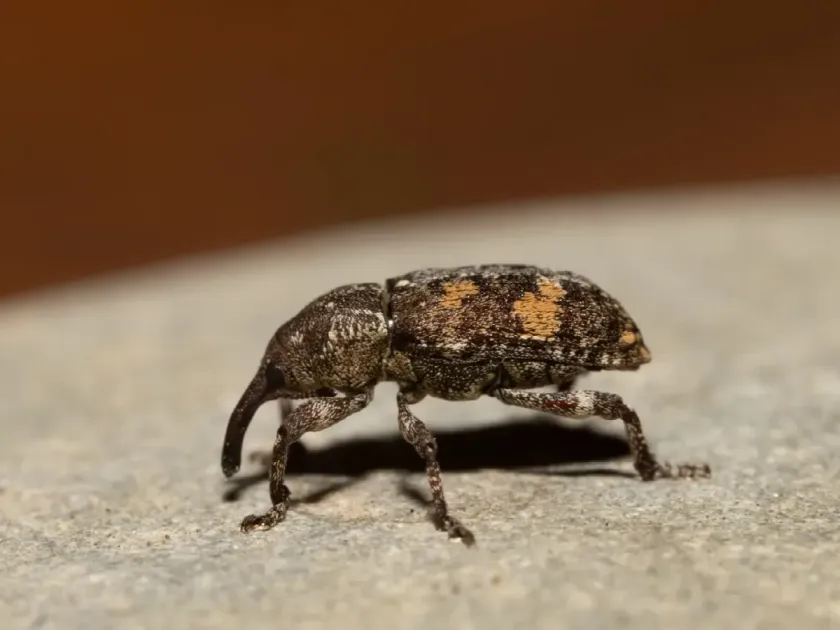
Pissodes castaneus, commonly known as the brown-headed pine weevil, belongs to the Curculionidae family within the order Coleoptera. Adult beetles typically measure between 5 to 8 millimeters in length.
The body is characterized by a reddish-brown to almost black coloration. A distinct feature of this species is the presence of two transverse yellowish or whitish bands on the elytra, formed by dense scales.
The larvae are legless, white to yellowish in color, with a prominent dark brown head capsule. Their bodies are typically C-shaped, which is a common characteristic of weevil larvae found inside wood.
Pupation occurs within a specially constructed chamber, known as a pupal cell, which the larva excavates beneath the bark of the host tree before transitioning into the adult stage.
This species is highly adapted to locating stressed or young conifer trees, where the bark is thin enough for the female to oviposit and for the larvae to easily access the nutrient-rich cambium layer.
What it damages
The primary hosts for Pissodes castaneus include various pine species (Pinus), with a strong preference for Pinus sylvestris. Additionally, spruces, firs, and larches can be affected.
Young trees, particularly those in the 2 to 15-year age range, are the most susceptible. The pests concentrate their damage on the root collar and the lower sections of the stem.
Adult weevils damage the bark of young shoots through feeding, creating small depressions. This feeding behavior weakens the trees and creates entry points for fungal pathogens and other opportunistic insects.
The larvae are responsible for the most severe damage by tunneling under the bark and consuming the cambium. These galleries effectively girdle the tree, disrupting the transport of water and nutrients.
Widespread infestations often lead to the rapid decline and death of large portions of young forest stands, resulting in significant ecological and economic losses.
When it appears
Adult weevils generally emerge from their overwintering sites in early spring, typically around April or May, when temperatures become suitable for their metabolic activity.
A period of maturation feeding occurs throughout the spring and early summer, during which the beetles actively move between trees to find suitable hosts for mating and oviposition.
Egg-laying activities continue throughout the summer months. Depending on the local climate and temperature gradients, the insect may produce one or more generations per year.
Larval development takes place throughout the summer and into the autumn. They continuously expand their galleries while feeding on the cambium layer before preparing for pupation.
Overwintering can occur in multiple life stages. Both adult beetles and larvae or pupae may successfully survive the winter months hidden under the bark or in the forest litter.
Signs of infestation
The earliest signs of infestation are small, circular puncture holes on the bark of shoots and stems, which indicate where the adult weevils have been feeding.
The presence of fine wood dust, often called frass, at the base of the tree or on the bark surface is a strong indicator that larvae are actively boring beneath the bark.
Needle yellowing and progressive browning are common external symptoms of a heavily infested tree, as the damaged vascular system fails to supply the necessary nutrients to the crown.
When peeling back the bark, one can observe complex, winding galleries carved into the wood and the cambium, which are typically packed with fecal matter and wood debris.
Advanced infestation signs include the death of the terminal leader, total cessation of growth, and eventually, the structural collapse or snapping of the tree at the point of heaviest infestation.
Control measures
Sanitary management, including the immediate removal and destruction of infested trees, is the most effective approach to reduce the beetle population in forest stands.
The use of trap trees, which are felled and left in the area during the flight season to attract beetles, is an effective way to concentrate and subsequently eliminate the pest.
In nurseries and young plantations, insecticidal applications targeting the stem are recommended during the period of adult emergence to prevent mass egg-laying.
Improving the overall vigor of the plantation through proper silvicultural practices reduces the vulnerability of the trees to colonization by weevils.
- Deployment of pheromone-based monitoring traps to track population density and flight patterns.
- Encouraging the presence of natural predators, such as woodpeckers and parasitic wasps that prey on larvae.
- Maintaining proper spacing in plantations to minimize competition and environmental stress on young conifers.
Taxonomy
- Latin name
- Pissodes castaneus
- Order
- Coleoptera (beetles)
- Family
- Curculionidae
- EPPO code
- PISONO
Discussion
No discussions yet — be the first.